Theosophical Movement
|
The movement sought for spiritualism, a blend of Indian and western ideas for the reformation of society.
|
|
|
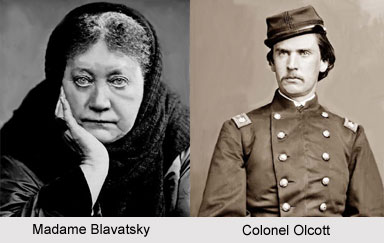 The Theosophical Movement was a reformist movement, organised by the Westerners, influenced by Indian ideals and values. Madame Blavatsky, a Russo-German, had established the Theosophical society. Later Colonel Olcott of the U.S Army joined her. They together laid the foundation of the Movement in U.S in 1875. In 1882, the headquarters of Theosophical society was shifted to India in Adyar, an outskirt in Madras. Since these westerners were imbued with Indian thought and culture, they decided to shift the headquarters to India, so they could carry out their functions effectively. Theosophical society was developed on this basic principle that a special relationship could be established between a person's soul and god through contemplation, prayers, revelation etc. The Society accepted Hindu religious beliefs like reincarnation, karma etc. and drew inspiration from the philosophy of Sankhya, Upanishads, Yoga and Vedanta school of thought. The motto of Theosophical Society was universal Brotherhood of Humanity, irrespective of race, religion, caste, creed etc. The society sought to investigate the unexplained laws of nature and powers latent in human being. Theosophical movement, with the passage of time came to be allied with Hindu Renaissance. The Theosophical Movement was a reformist movement, organised by the Westerners, influenced by Indian ideals and values. Madame Blavatsky, a Russo-German, had established the Theosophical society. Later Colonel Olcott of the U.S Army joined her. They together laid the foundation of the Movement in U.S in 1875. In 1882, the headquarters of Theosophical society was shifted to India in Adyar, an outskirt in Madras. Since these westerners were imbued with Indian thought and culture, they decided to shift the headquarters to India, so they could carry out their functions effectively. Theosophical society was developed on this basic principle that a special relationship could be established between a person's soul and god through contemplation, prayers, revelation etc. The Society accepted Hindu religious beliefs like reincarnation, karma etc. and drew inspiration from the philosophy of Sankhya, Upanishads, Yoga and Vedanta school of thought. The motto of Theosophical Society was universal Brotherhood of Humanity, irrespective of race, religion, caste, creed etc. The society sought to investigate the unexplained laws of nature and powers latent in human being. Theosophical movement, with the passage of time came to be allied with Hindu Renaissance.
Theosophical Movement in India became more popular with the election of Annie Besant as the President after the death of Colonel Olcott. Mrs. Besant was well acquainted with Indian society and culture. Her inherent spiritualism led her to incline towards Vedanta philosophy. Later she translated Bhagavata Gita with the solemn aim to propagate the message of Bhagavata Gita. The main emphasis of Theosophical Movement was spiritualism, rather than the occult. Mrs. Besant had established a bridge between the matter and mind. In this way Mrs.Besant turned a Hindu, not only in her views, but also in her form. Gradually, Theosophy became a movement of Hindu Revival.
In her aim to reform the Indian society, Mrs. Besant believed that only a proper education could liberate the society from its evils. An amalgamation of western ideas with Indian spiritualism was the perfect way of instruction. She had laid the foundation of Central Hindu College in Beneras in 1898, where both Hindu religion and western scientific subjects were taught. This College came to be known as Beneras Hindu University in 1916. She had also formed the Homerule League on the pattern of Irish Homerule Movement.
However, Theosophical Society provided a common denominator for various sects and fulfilled the urge of educated Hindus. To the average Indian, the philosophy of Theosophical Movement seemed rather vague in reorganising the latent society. Although the impact of Theosophical movement was limited to a small segment of the society, yet it had initiated Hindu revival in the Indian society.
|
|
|
|





