Sugar Industry in India
|
Sugar Industry in India is a highly developing industry. In fact, India is the largest producer of sugarcane so the sugar industry is pretty booming in India.
|
|
|
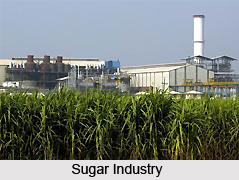 Sugar industry is one of the leading industries of India. This industry is entirely based on the availability of sugarcanes. That is why the sugar factories are situated only in the cane growing areas and almost within 25 kms distance from the sugarcane farms. However, proportion of area under sugar cane production is small relatively. As such, sugar factories are highly dispersed even in those areas that have an appreciable hectarage under cane. The raw ingredients are supplied to the sugar industries at the prices fixed by the Government of India. Sugar industry is one of the leading industries of India. This industry is entirely based on the availability of sugarcanes. That is why the sugar factories are situated only in the cane growing areas and almost within 25 kms distance from the sugarcane farms. However, proportion of area under sugar cane production is small relatively. As such, sugar factories are highly dispersed even in those areas that have an appreciable hectarage under cane. The raw ingredients are supplied to the sugar industries at the prices fixed by the Government of India.
India is the largest producer of sugarcane. Placing sugar khandsari and gur or jaggery together, India stands first in the world production. The number of sugar mills in the country increased slowly and gradually over the years. Since it deals with a consumable raw material, it is extensively scattered and is fundamentally a rural-based industry. The sugar industry still follows the dual-pricing system and compulsory levy to the public distribution sector. However, the line between the two sets of prices is now pretty low. The industry had commenced in the private sector and was mostly limited to Uttar Pradesh and Bihar. Now it is reasonably extensive. As many as 256 mills are within the cooperative sector. The pockets of sugar industry are well irrigated and have also become pockets of rural opulence to a certain degree. It is a seasonal industry and as such is befitted with the co-operative sector. The sugar content in cane is moderately higher in Maharashtra and other southern states. The industry therefore has been amplifying speedily in these parts. Plains of Uttar Pradesh and Bihar account for a huge portion of sugar of the total production of the country.
In the northern region of India, sugar factories are situated mainly in the northern part of the Ganga Plain, northern and eastern regions of Punjab as well as eastern parts of Haryana. In Bihar, they are basically concentrated in the north western districts specifically in Muzaffarpur, Darbhanga, Champaran, Patna, Saran and Gopalganj. In Uttar Pradesh, there are two areas of concentration of sugar industries and these are Meerut, Muzaffarnagar and Saharanpur districts and Bijnor, Basti, Faridabad, Gonda, Muradabad, Sitapur, Deoria and Gorakhpur districts. Moreover, the river valleys in the western part of the Maharashtra Plateau have a significant concentration of sugar mills. In Andhra Pradesh sugar factories are situated mainly in the coastal districts north of Krishna Delta and the districts of Nizamabad and Medak.
The sugar industries in Tamil Nadu are mainly situated in districts of Arcot, Coimbatore and Tiruchchirappalli. The number of sugar factories in operation and overall production of sugar of India have increased appreciably.
|
|
|
|





