


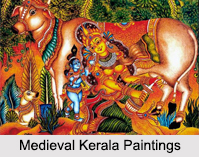
 Medieval Kerala Paintings portray myths and tradition, which were drawn on the walls of temples and churches in South India, primarily in Kerala. The medieval Kerala was divided into small political units. During that time the art and paintings also got affected by the political powers. The Madurai Nayakas, the former feudatories of the Vijayanagara Empire had domination at that time. Medieval Kerala Paintings portray myths and tradition, which were drawn on the walls of temples and churches in South India, primarily in Kerala. The medieval Kerala was divided into small political units. During that time the art and paintings also got affected by the political powers. The Madurai Nayakas, the former feudatories of the Vijayanagara Empire had domination at that time.
Apart from the Vijayanagar traditions, the local traditions supported strongly by the Chalukya-Hoysala traditions of earlier periods led to the development of a new regional style in decorative art and paintings. The religious fervour along with the Vaishnavism, which was predominant in the medieval Kerala, gave birth to amazing pictorial narrations. History of Medieval Kerala Paintings The ancestry of the present fresco tradition of Kerala could be traced as back as the 7th and 8th century AD. The early Kerala murals with its architecture came closely under the influence of Pallava art. The oldest murals in Kerala were discovered in the rock-cut cave temple of Thirunandikkara, which is currently in the Kanyakumari district of Tamil Nadu. The leaders of Kolikod, Kochi and Travancore were the leading figures in Medieval Kerala. The churches at Kottayam, Angamaly, Kanjoor, Cheppat, Ollur and many other places have paintings which are recognized for their wonderful execution and style. Features of Medieval Kerala Paintings The approach of the Medieval Kerala Paintings in the temple and palaces are much related to the woodcarvings and stucco figures. The themes for murals were received from spiritual texts. Palace and temple murals were settled with extremely stylized pictures of gods and goddesses of the Hinduism. Flora, fauna and other features of Nature were also pictured as backdrops in extremely stylized techniques. The typical 18th century paintings can be seen in the Padmanabhapuram Palace. All these are now well preserved and have a wealth of detail and iconographic interest. One of such paintings shows Durga on the cut head of a buffalo and Bhairava. The other themes such as Harihara, Ganesha are also executed with great skill. Existing Medieval Paintings of Kerala One of the temple of Kerala at Trichur has paintings of the same period depicts a theme with Rama seated in 'virasann' with the thumb and pointing finger of the right hand. It gives the impression that Rama is teaching the highest principle in philosophy to the assembled sages and his brothers while Hanuman reads the manuscripts. This can be found at Mattancheri also and is a favourite of the people of this region. The paintings depicting a battle of archers can also be seen in this temple. The earlier phase of the late 16-17th centuries is represented in the murals from the Triprayar temple, along with those from Tiruvanchikulam. All the paintings were drawn very minutely giving all details. The crown looks almost like a kalasa on the head with a full-blown lotus with its spread out petals occupying it almost entirely. The paintings in the temple at Ettumanur are considered to be the earliest after those at Tirnandikkarai and go back to the 16th century. Among these, there is a painting, which depicts the 'Nataraja' with 16 arms dancing on 'apasmara'. This painting of medieval Kerala represents a fusion of northern and southern traditions. The temple of Trichakapuram in Kerala contains paintings in the style that became more popular in the latter half of the 18th century. Another painting of the Krishnapuram Palace named 'Gajendra Moksham', shows Vishnu on Garuda coming to the rescue of the afflicted animal that cried for help. This painting is earlier by a few decades. The medieval paintings of Kerala had close association with woodcarving. The Portuguese built the Mattancheri palace in Kerala (Cochin) in 1557. The long room of this palace contains the Ramayana murals called the 'palliyarui' forms, which is a remarkable collection of typical paintings of this period. During the beginning of 18th century, the paintings of the staircase room and that of the coronation hall were implemented with the themes such as Mahalakshmi, Bhutamata, Kiratamurti, coronation of Rama, etc. The most interesting among these paintings of medieval Kerala is the one in which Shiva was caught in a compromising position with Mohini by Parvati. |
| |||



Medieval Kerala Paintings
| Medieval Kerala paintings depicted the political scenario and the religious matters mainly. |
| ||||||||||||||||||||||||||||

