


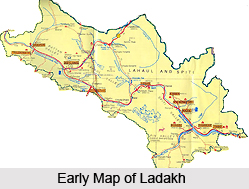
 History of Ladakh can be traced back a rather long way. The earliest inhabitants of Ladakh in the ancient times are believed to be a mix of nomadic herdsmen from the Tibetan plateau and a small group of early Buddhist refugees from northern India called the monks. In the 5th or 6th century, these groups were frequently accompanied by tribes of Indo-Aryan origin known as the Dards. They migrated Southeast alongside the Indus Valley, bringing with them the idea of irrigation and settled agriculture. With the passage of time, the Dards, Tibetans and other races too met and inter-mingled to ultimately form a new community with its own characteristics. History of Ladakh can be traced back a rather long way. The earliest inhabitants of Ladakh in the ancient times are believed to be a mix of nomadic herdsmen from the Tibetan plateau and a small group of early Buddhist refugees from northern India called the monks. In the 5th or 6th century, these groups were frequently accompanied by tribes of Indo-Aryan origin known as the Dards. They migrated Southeast alongside the Indus Valley, bringing with them the idea of irrigation and settled agriculture. With the passage of time, the Dards, Tibetans and other races too met and inter-mingled to ultimately form a new community with its own characteristics.
Earlier History of Ladakh According to historical evidence, in the 1st century, Ladakh was a part of the Kushana Empire. Later in the 8th century, Ladakh was involved in a clash between Tibetan expansion pressing from the East, and Chinese influence wielding from Central Asia through the passes. It remained the site for constant clashes between the Chinese and the Tibetans, and there was seen a time when Tibetan suzerainity was successfully established here. However, in course of time the Tibetans were unable to hold fort and their influence was completely wiped off. First West-Tibetan Dynasty in Ladakh Following the collapse of the Guge Empire of western Tibet, a nobleman named Nyima Gon took advantage of the situation and established the first independent kingdom in Ladakh in the 9th century. This was the period in which Ladakh underwent Tibetanization, eventually making Ladakh a country inhabited by a mixed population, the predominant racial strain of which was Tibetan. However, soon after the conquest, the dynasty, intent on establishing Buddhism, looked not to Tibet, but to north-west India, particularly Kashmir. This has been termed the Second Spreading of Buddhism in the region Namghyal Dynasty of Ladakh Continuous raids of plundering Muslim states from Central Asia made Ladakh region weak. It was then divided into two portions- Lower Ladakh ruled by King Takpabum from Basgo and Temisgam, and Upper Ladakh by King Takbumde from Leh and Shey. Later, Bhagan, a basgo king reunited Ladakh by overthrowing the king of Leh. He took the surname of Namghyal and founded the Namghyal Dynasty which still survives today. Ladakh in Modern Times During early 19th century, Mughal Empire had collapsed and Sikh Rule was established in Punjab and Kashmir. There were constant fights and wars and ultimately the Dogra General Zorawar Singh conquered it. After annexing the region, he presented it to the Maharaja of Kashmir in 1834. The Ladakhi royal family was banished to Stok Palace, where their descendants reside on this day. Ladakh became a part of independent India in the year 1948. Currently, around seventy percent of the state of Jammu & Kashmir is occupied by Ladakh. Finally, after years of agitation, the Ladakhis were successful in setting up the Autonomous Hill Development Council in September, 1995. |
| |||



Home > Travel > Indian Cities > Cities of India > Cities of Jammu and Kashmir > Ladakh > History of Ladakh
History of Ladakh
| History of Ladakh reveals a rather strong Tibetan influence in the region. Ladakh became a part of independent India in the year 1948. |
| ||||||||||||||||||||||||||||

