Growth of the Left Ideologies in India - Informative & researched article on Growth of the Left Ideologies in India
  Indianetzone: Largest Free Encyclopedia of India with thousand of articles History of India


in  
Art & Culture | Entertainment | Health | Reference | Sports | Society | Travel
Forum  | Free E-magazine
History of India : Sources of History of India l Ancient History of India l Medieval History of India l Modern History of India l Indian Historical Dynasties l Indian Battles l Sepoy Mutiny 1857 l Indian Rulers l History of India l Indian Freedom Struggle l Indian Governor- Generals l British Indian Acts l Post Independence India l Iron Age in India
Home > Reference > History of India > Modern History of India > Growth of the Left Ideologies in India
Growth of the Left Ideologies in India
Towards the end of the Ist World War, the prevailing socio-political & the economic condition.

The terms Left and Right, as a political term was first introduced in France during the French Revolution to distinguish the Pro Revolutionaries (the Left) from the anti revolutionaries (the Right). The terms acquired wider connotation after the industrial revolution and the rise of the Socialist and s the Communist thought.


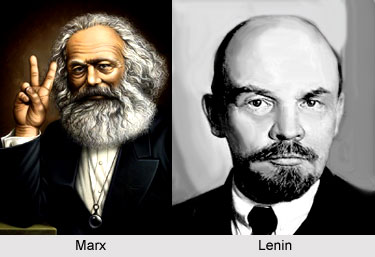
The first and the foremost evil effects of the first World war was the financial devastation. Financial burdens and the rising prices of the daily necessities led to famine. The imperialist-capitalist domination did not even adopt any steps to secure the common s mass. Hence the s politico-economic condition of the contemporary period led to the growths of the Leftist Movement. The revolutionary ideas of Marx and Lenin was extremely alluring and appealing to the Indian Intellectuals and the political leaders. The philosophy of Marx , Lenin imbued the Indian National leaders with a new ideology with socio-economic content. Gandhiji`s slogan for Swaraj and Swadeshi and his attempt to give it a national color gave a new orientation to the trend of the political movement. The Leftist tendency began to guide the national political movement. Even the peasants and the workers were drawn to the mainstream of national life. The new development provided favorable condition for the inauguration of the organized and ideologically inspired socialist movement. A section of educated middle class people who s became unemployed in the British dominance lost their faith in the liberal politics of the 19th century liberalism. Hence the emerging ideas of the new socialist ideologies guided by the Leftist philosophy influenced this group of educated middle class. Moreover the non-violent and weak policy of Gandhiji no longer appeal to the people. The radicals demanded for a formidable resistance against the British. Government. The radicals also emphasized the attainment of Swaraj.

Thus the above conditions were responsible for the growth of Leftist movements in India.

(Last Updated on : 31/01/2009)
  More Articles in Modern History of India
 
Advent of Europeans to India European colonies in India British Empire in India
Foundation of British Rule in India Birth of Indian National Congress Partition of Bengal 1905
Socio-Religious Reform Movements in India Indian Renaissance Maritime India
Famines in India Indo-Pak Wars Integration of Indian States
Cellular Jail Indian Revolutionaries Indian Nationalism
Indian Organisations during Freedom Struggle Revolutionary Terrorist Movement in India Indian Revolts
Rise of Extremism in India Growth of the Left Ideologies in India Peasant Movement and Uprisings in India
Interim Government Theosophical movement Aligarh Movement
Portuguese Rule in India Ilbert Bill Maharaja Ranjit Singh
Surat Split India and Second World War Ludhiana Resolution
Gurdwara Reform Movement    
Recently Updated Articles in History of India
  • Mughal Architecture
    Mughal architecture is a combination of Islamic, Persian, Turkish and Indian architecture. It is a style that was developed under the Mughal dynasty in the sixteenth and seventeenth centuries.
  •  
  • Mansabdari System in Mughal Dynasty
    Akbar introduced the Mansabdari System in the Mughal army which primarily meant the ranking of officers on decimal system.
  •  
     
  • Deccan Policy of Mughal Dynasty
    Deccan Policy of the Mughal dynasty was weak during the reign of Babur and Humayun but after the accession of Akbar on the throne, the political situation changed and the Deccan policy was a success.
  •  
  • Coins of Pandyas
    Coins of Pandyas bear the legend of different Pandya ruler in different times.
  •  
  • Art and Architecture of Mughal Empire
    Art and architecture of Mughal Art offers an aesthetic degree to all art lovers. The subtlety of the finesse and the dazzle of the aura create huge amount of interest among tourist.
  •  
    E-mail this Article | Post a Comment
    RSS Feeds
    Forum
    Forum on History of India

    Free E-magazine
    Subscribe to Free
    E-Magazine on Indian Crafts
     
     
    Growth of the Left Ideologies in India - Informative & researched article on Growth of the Left Ideologies in India
    Sitemap
    Contact Us   |   RSS Feeds
    Copyright © 2008 Jupiter Infomedia Pvt. Ltd. All rights reserved including the right to reproduce the contents in whole or in part in any form or medium without the express written permission of Jupiter Infomedia Pvt. Ltd.