Breathing Exercises
|
Breathing exercises comprise various kinds of breathing in and out, to facilitate pranayama, a tough workout.
|
|
|
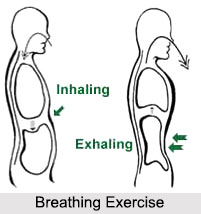 Breathing Exercises can bring the mind to a pleasant state by enhancing and regulating the life force in the system. Breathing is something one can control and regulate; it is a useful tool for achieving a relaxed and clear state of mind. Practicing regular, mindful breathing exercise can be calming and energizing and can even help with stress-related health problems ranging from panic attacks to digestive disorders. Breathing Exercises can bring the mind to a pleasant state by enhancing and regulating the life force in the system. Breathing is something one can control and regulate; it is a useful tool for achieving a relaxed and clear state of mind. Practicing regular, mindful breathing exercise can be calming and energizing and can even help with stress-related health problems ranging from panic attacks to digestive disorders.
The ancient Yogis developed a number of breathing techniques to optimize the benefits of Prana. In Yoga, Pranayama is used as a separate practice in itself to help clear and purify the body and mind. It is also used as a preparation for meditation. In asanas, the practice of postures, breathing exercises help optimize the benefits of the practice and mind focus.
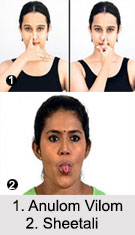 Types of Breathing Exercises Types of Breathing Exercises
Breathing Exercises comprise several of them in different kinds. A few basic breathing exercises illustrated below are the ones an individual can follow:
Deep Breathing: This is also known as Complete Breathing. One first needs to sit down in a relaxed position and watch the path of breath, making both inhalation and exhalation as fully as achievable. It is advised to breathe deep into the belly, then into the chest and eventually into the shoulders and throat. Later, one needs to exhale, inverting the order, and repeating it a number of times.
Breath of Fire: This is a speedy, diaphragmatic breathing using rapid, light breaths formed by snapping in the muscles of the abdomen in quick progression.
Alternate Nostril Breathing: This is an unhurried, systematic breath which works on the central nervous system and results in increased easiness and deeper sleep. One needs to close off the right nostril with the right hand and breathe deeply through the left nostril. When the breath is full, one should close off the left nostril and exhale through the right side. When the breath is empty again, one must inhale again through the right side, shifting when full and exhaling on the left. The outline is to inhale-switch-exhale which should be continued 20 times or more on each side.
Bandhas: "Bandha" means lock, and the bandhas of pranayama are processes of holding the breath and locking it into specific parts of the body. There are three fundamental bandhas - chin lock, abdominal lock and anal lock; that works on preservation of the breath in the three key areas of the body.
Thus, breathing exercises are extremely helpful in overcoming various kinds of breathing and health problems. It acts as a bridge into those functions of the body which are generally ignored by any conscious control.
|
|
|
|





