


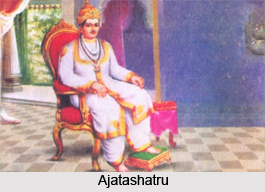
 Ajatashatru, son of Bimbisara, was a great warrior, who conquered 36 republican states surrounding his kingdom and firmly established the predominance of Magadha in Eastern India. Historical record says that he was impatient to rule the kingdom of Magadha and had murdered his father in 493 BC in order to become a king. Like his father, Ajatashatru also believed in the expansion of land with the help of military conquest. Rajagriha was the capital of Magadha and was naturally fortified by 5 hills which stood surrounding the city. But Ajatashatru in order to enhance the security of the town had built a fort at Pataligrama, on the bank of the River Ganges. As Bimbisara, father of Ajatashatru had conquered the eastern state of Anga so Ajatashatru had concentrated towards the north and the west. He had started his conquest from Kosala and continued till Kashi in the far west. Ajatashatru, son of Bimbisara, was a great warrior, who conquered 36 republican states surrounding his kingdom and firmly established the predominance of Magadha in Eastern India. Historical record says that he was impatient to rule the kingdom of Magadha and had murdered his father in 493 BC in order to become a king. Like his father, Ajatashatru also believed in the expansion of land with the help of military conquest. Rajagriha was the capital of Magadha and was naturally fortified by 5 hills which stood surrounding the city. But Ajatashatru in order to enhance the security of the town had built a fort at Pataligrama, on the bank of the River Ganges. As Bimbisara, father of Ajatashatru had conquered the eastern state of Anga so Ajatashatru had concentrated towards the north and the west. He had started his conquest from Kosala and continued till Kashi in the far west.
Wars Fought by Ajatashatru Ajatashatru was a great warrior and had conquered 36 republics in and around his kingdom and had established the supremacy of Magadha on whole of eastern India. Some of the famous wars that were fought by Ajatashatru were the battle with Licchavi Republic and the 16 year long war with the Vrijji confederacy. In fact this war stands as the best example of war between a clan and a kingdom. The scythed chariot was invented by Ajatashatru in 475 BC and was used by him to fight against the Licchavi Republic. The scythed chariot was essentially a war chariot which had a blade on both ends of the axle. Life of Ajatashatru Ajatashatru had led a life which was full of wars, restlessness and violence. Towards the later part of his life, his soul was filled with grief and repentance. In order to cleanse his heart from all sins, he surrendered himself at the feet of Lord Buddha, where he found peace and he was completely dedicated towards the Buddhist faith. His dedication was so complete that he was made the chief claimant of Buddha’s relics after the death of Buddha. Ajatashatru subsequently built stupas all over the capital and renovated 18 monasteries in memory of Buddha. He was the one who had established the first Buddhist General Council. He also suffered a fate similar to his father and was assassinated by his son Udaybhadra in 461 BC. Ajatashatru was succeeded by 5 kings who were not all worthy of kinghood and were like parasites. As a result the people of Magadha revolted and the Shishunaga dynasty came to power. |
| |||



Home > Reference > History of India > Ancient History of India > Rise of Magadha > Ajatashatru - Ruler of Magadha
Ajatashatru - Ruler of Magadha
| Ajatashatru was a prominent ruler of Magadha and had established the pre-dominance of Magadha in Eastern India. |
| ||||||||||||||||||||||||||||

