


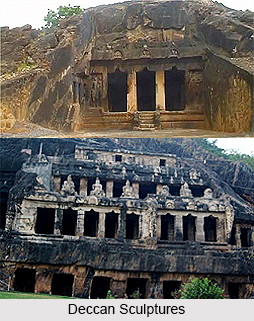
 Deccan Sculptures are known for their charming ornamental designs. They echo the true essence of Gupta art. The sculptures have been influenced by ruling dynasties like Cholas, Pallavas, Chalukyas, Hoysalas and Rashtrakutas mainly. These rulers produced an independent style of their own. Both Hindu and Muslim influence can be observed on Deccan Sculptures. Deccan Sculptures are known for their charming ornamental designs. They echo the true essence of Gupta art. The sculptures have been influenced by ruling dynasties like Cholas, Pallavas, Chalukyas, Hoysalas and Rashtrakutas mainly. These rulers produced an independent style of their own. Both Hindu and Muslim influence can be observed on Deccan Sculptures.
Hindu Influence on Deccan Sculptures The Hindu sculptures of the Deccan are tremendously inspired by the Hindu scriptures. This is particularly true of the beautiful sculptures in the caves at Mogulrajapuram and Undavalli. The carvings at the latter place feature a number of themes from Hindu mythology like Varaha, raising the earth, Trivikrama taking three paces, Vishnu rescuing Gajendra, Lord Krishna lifting Govardhana, etc., all of which show unmistakable Gupta inspiration. The sculpture of this period is rich in charming ornamental designs. On a doorjamb from Garhwa, the Kalpalata motif is treated in a very artistic style. The foliated scroll is a special trait of the Gupta art. Another example of the Gupta sculptures can be found- in the Dasavatara temple at Deogarh. It has an elegantly carved doorway on one side and three big panels placed outside the three walls. One of them depicts the penance of Nara and Narayana, the second Gajendramoksa and the third Vishnu reclining on Sesa. These constitute the high-water mark of Gupta sculpture. The flaming beauty of these sculptures is an abiding testimony to the deep religious devotion of the Bhagavata teachers and their followers who patronized such bobble art. Islamic Influence on Deccan Sculptures However, it would be wrong to bound Deccan sculptures and architectures to these ancient temples. According to historical data, the Deccan sculpture once again came to the forefront in the late 15th century. The Deccan sultanate came into being and this time the features of Deccan sculptures and architectures were inspired from the Islamic architecture. The Deccan sculpture was also known as the Indo-Islamic architecture. This time there were no shikharas or foliage sculptures. The predominant features were dome shaped monuments and the pillars were replaced by the minarets. The profusion of the sculptures was replaced by the arches and the turrets, cupolas and patterned tiles. Instead of the inscriptions, there are verses from Quran engraved on the walls of the mosques. However, Hindu motifs like lotus, pendant and others are also found on these monuments. |
| |||



Deccan Sculptures
| Deccan Sculptures are known for their charming ornamental designs. The Hindu sculptures of the Deccan are tremendously inspired by the Hindu scriptures. |
| ||||||||||||||||||||||||||||

