


 Several centuries after the death of Buddha the spirit of revolution, which characterized its early stages, began to be retarded as a result of its contact with current Hindu thought and practices. Mahayana Buddhism was followed by people of various tastes, temperaments and capacities. Tantrikism made its way into Buddhism. Tantrik Buddhism was due to the mixture of Mahayanist and aboriginal superstitions absorbed through the medium of Hindu deities. Buddhism did not have sufficient independence to keep its pantheon distinct. So Vairocana and Tara received most of the attributes Brahmanas had given to Siva and Kali. Several centuries after the death of Buddha the spirit of revolution, which characterized its early stages, began to be retarded as a result of its contact with current Hindu thought and practices. Mahayana Buddhism was followed by people of various tastes, temperaments and capacities. Tantrikism made its way into Buddhism. Tantrik Buddhism was due to the mixture of Mahayanist and aboriginal superstitions absorbed through the medium of Hindu deities. Buddhism did not have sufficient independence to keep its pantheon distinct. So Vairocana and Tara received most of the attributes Brahmanas had given to Siva and Kali.
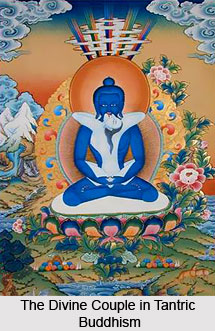
For the purpose of making Buddhism broad-based the Buddhist leaders allowed their followers to worship numerous gods and goddesses. Esoteric elements like mantra, mudra and mandala or mystic circles also found their entry into Buddhism. Buddhism had now to find a place even for the weird rites of abhichara, marana, mohana, stambhana, vidvesana, uchchatana and vasikarana. These were introduced for the realization of the ultimate truth. According to one tradition Asanga, the great exponent of the Yogachara school of Mahayana Buddhism introduced tantrikism into Buddhism. According to another tradition Nagarjuna the famous exponent of the Madhymika School was the real founder of tantrik Buddhism. The Mantrayana school of Mahayana seems to be the introductory stage of tantrik Buddhism from which all the other offshoots of Vajrayana Kalachakrayana and Sahajayana etc. arose in later times. In Mantrayana the ordinary followers were enjoined to commit to memory and regularly recite the mantra, with implicit faith and it was assured by Bodhisattvas that the recite the mantras was capable of producing infinite merit in the reciter and conferring immense benefit on him. It is said that in response to the muttering of bijamantras the ultimate voice or Sunyata will transform herself into the particular from the god or goddess. It will also confer infinite benefit on the reciter the mudras or postures contained the secrecy of touch as associated with the potency of the physiological system and mandamus or mystic circles were associated with certain rites for worshipping the deities. These elements of esoterism have by nature a propensity to generate beliefs in magic, sorcery, charms etc. Vajrayana and Sahajayana are the popular form of Tantrik Buddhism. The main Tantric practices in Buddhism can be summarized in the four purities like seeing one's body in the body of deity, seeing one's environment as the pure land or Mandala of the deity, perceiving one's enjoyments as the bliss of the deity and considering as free from any attachment and performing one's actions only for the benefits of the others. The Tantric Buddhism has three methods viz Guru yoga, deity yoga and death yoga. Guru Yoga: It is the tantric devotional process where the practitioner unites their mind stream with the mind stream of the guru. The process of Guru Yoga often involves the visualization of a refuge tree as an invocation of the lineage. Deity yoga: Deity yoga employs high-refined techniques of imagination and visualization in order to self identify with the divine form and sacred qualities of a particular deity as the union of skill and wisdom. The deity is represented as Murti, Tangka or Mandala. Visualization, invocation and evocation are important parts of Deity Yoga. Mandalas are sacred enclosures and uncontainable essence of a Yidam. Death Yoga: It is another important aspect of Tantra techniques. The death Yoga is practiced during the life. It is the meditative practice that helps to prepare the practitioner for what they need to do at the time of their death. At the time of death the mind is in a clear state that can achieve enlightenment, when used very skillfully. During the time of death, rebirth and in between state the mind is in a very subtle state and an advanced practitioner can use these natural states to make significant progress in the spiritual path. Love and Passion are important part of Tantric Buddhism. Buddhist iconographers use sexual polarity to symbolize the twin concepts of insight and compassion. All goddesses are the symbols of the insight and the gods represent the compassion. This union is represented visually by showing two deities in the sexual congress. In Sanskrit such images are called Yuganaddha (pair united). This sexual metaphor is also used to denote the highest stage of Yoga in which everything is free from polarity or any discrimination. The Buddhist couples of Tantric iconography celebrate the deep harmony of sexes, which ultimately devoted to the realization of the ultimate truth. |
| |||



Tantrik Buddhism
| The great exponent of the Yogachara school of Mahayana Buddhism introduced tantrikism into Buddhism. |
| ||||||||||||||||||||||||||||

