Indianetzone.com - Web Portal on Indian Culture & LifestyleArt & Culture  •  Health  •  Movies & Entertainment  •   Society  •  Reference  •   Sports  •  Travel  

  Home >> Art & Culture >> Indian Sculpture >> Sculpture in Orissa
Forum
Forum on Indian Sculpture
Discuss Now
Free E-magazine
Subscribe to Free E-Magazine on Indian Culture & Lifestyle.
Learn More
Interesting Readings
  - Medieval Indian Sculpture
  - Colonial Sculptures In India
  - Indian Contemporary Art
  - Indian Folk and Tribal Art
  - Indian Rock Cut Sculpture
  - Indian Fresco
  - Buddhist Temple Sculpture
  - Indian Stone Sculptures
  - Indian Marble Sculptures
  - Indian Sand Sculptures
  - Indian Bronze Sculptures
  - Indian Wooden Sculptures
  - Indian Art
  - Indian Sculpture
  - Indian Temple Sculptures
  - Ancient Indian Sculpture
Jimtrade.com : India Business to Business Directory
Business Directory of Indian Suppliers Manufacturers and Products from India.
India`s leading Yellow pages directory.
Sculpture in Orissa

Almost nothing is known about the history of Orissa, from the beginning of the present era, until the late 6th century. Roman coins have been discovered at Sisupalgarh, which appears to have remained in occupation until the 4th century, and some yaksa and naga statues, normally in a pretty dilapidated state of preservation, date from this era, when Orissa seems to have been beyond the restrictions of orthodox Hinduism. Its unusually displaced political history indicates that even during post-Gupta times it had remained rather backward. In 7th century, however, it became one of the most substantial centres of architecture and sculpture, and had remained so throughout the post-Gupta and later Hindu eras. Some of the earlier temples, seldom large, are among the most enthralling in India. The opulence of deeply cut relief sculpture rising from the stone and covering almost the whole fabric at first holds the mark of a solid tradition; the inventiveness of the sculptors outlives when a classier idiom takes over.

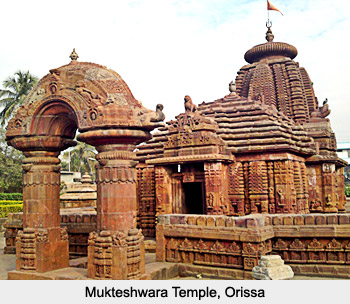
By far, the largest concentration of temples is at Bhubaneshwar, shoved by the modern town, constellated around the sacred lake Bindusatovar, and standing in the neighbouring fields. The oldest, of the late 6th or early 7th centuries, are possibly the three tiny parallel shrines of the shatrughaneshwar temple group, mere shells, much regenerated. They consist only of the shrine proper (Orissa- deul), although they surely once possessed front halls (Orissa- mukhaitilti or jagamohana). Two distinguishing facets can be realised- the eight, not nine, grahas (planets) in relief on the lintel of one of the sanctum doors, and the group of narrative or mythological scenes between the haifa, the wall area of the shrine and the shikhara. Similar groups appear in the same spot on some of the temples at Osian, a prominent instance of characteristics common to some of the most extensively separated post-Gupta temples.

Parasuramesvara temple The Parasuramesvara, fairly larger and in a secure state of fixing, is the best known of the earliest Orissa temples. Its extremely squat deul, crowded by a mammoth amalaka, and the walls of its mukhasala covered with sculpture in low relief lends it a faintly antiquated appeal. A central recess protrudes from the walls beneath the spire, flanked by two smaller one son either side, each with its own mouldings. Since they are all Shiva temples, the foremost recesses always house images of Parvati (absent here) and Karnikeya. . The shikhara is pancharatha, with a boldly protruding central aspect on either side, widest in the front, with one enormous chaitya window at the base underneath another, bearing a dancing Shiva. All these temples, with their `northern` shikharas, are classed in Orissa as rekha; the other kind, the khtikharti, has a rectangular inner sanctum coronated with a barrel-vaulted component (itilti).

The rectangular mukhsala of the Parasuramesvara, with its flat roof, raised clerestory, internal pillars, and jalas, brings to mind the first-phase early western ιlan, excluding that here it is the outside walls which are ornately chiselled, while the inside is nearly plain. The entryway on the side as well as at the end of the wall is, moreover, an inimitable facet, not to be repeated in later temples. Also characteristically early is the carving of reasonably huge images, straightaway on the walls, carrying over from one block of masonry to another- achievable only where the relief is comparatively shallow. A further sign of an untried stage is the defective masonry (rebuilding with the original blocks of masonry). Lack of proportion rather than lack of order, furthermore, appears to mark this affluent sculptural embellishment. The rows of figurines, and the pretty seldomly depicted Chandra, seated between preposterously short pilasters, are squeezed by the soaring architrave above, its outsize gavasakas and figures not a great deal humbler than those beneath. Such imbalance is often linked with folk art, and there is undeniably a strong folk element.

Svarnjalesvara temple Walls, entryways, recesses and windows are ornamented with gavasakas, pilasters with vase and foliation capitals (and bases), birds on the lower boundaries of eaves-mouldings, chequer designs, fan-palm bands, rosettes, indeed roughly the whole repertory of post-Gupta architectural ornamentation. The lintels, however, incline to carry narrative or mythological scenes as a substitute of beam-ends carved with lion masks, and the mouldings of the doorjambs are not carried across them. The local folk spirit is predominantly strong here, possibly most evidently in the over-overexploitation of dots (pearls) to delineate the elements. It is well, however, to remember Stella Kraamrishch`s words- `None of the sculptures is architectural in the accepted sense for none enhances by its effect the function of that part which is decorates (decoration as a mere embellishment exists only by contrast with and as a supplement to naturalistic art); none of the carvings moreover is merely decorative for each has its meaning at its proper place and is an image or symbol`.

Three of the earliest temples at Bhubaneshwar- the Parasuramesvara, the Svarnajalesvara, and the Gauri-Sailkara, have stylistic feature rather than the standard pot forms. There is textual proof for these `air lingas` as the topmost members of shikharas. Other early temples comprise the Mohini, the tiny Paschimesvara, and the Uttaresvara. The Mohini possesses its absolute complement of piiriva devatiis- accessory deities- in the main recesses of the deul. The Uttaresvara, nearly all its details plastered over in the course of reinstatement, stands in its own compound alongside the Bindusarowar, with tiny shrines and a small tank. The recess sculptures, tall trim figurines with remarkably small heads, are strikingly dissimilar from those of the other early temples, and one authority believes that they were initially established somewhere else.

Not all the early shrines are in Bhubaneshwar. The temple at Kualo, northwest of Cuttack, is also there. Some of the auxiliary shrines are convincingly well preserved. A tiny Durga temple on the Mahanadi, only 12ft. (approx. 4m.) in height, is khakhara. With their rectangular inner sanctums, these temples, in Orissa and elsewhere, are always consecrated to Devi in one manifestation or other.

Mukhalingam in Andhra The significant Madhukesvara temple at Mukhalingam in Andhra, the ancient Kalinganagara and capital of the eastern Gailgas, adopts the Orissan tradition, though with stark dissimilarities. It is bigger than any of the temples famous so far, with the typical deul and columned mukhasala, girded by a high-walled compound with supplementary shrines at the corners, barrel-roofed shrines at the mid-points, and two entrance gateways. Abnormally enough, while the smaller shrines pursue the customary Orissa model, the fundamental one has recess-less walls, a shikhara of entirely plain superimposed courses with niches between them, and a double amalaka. The immense grandeur of the Madhukesvara complex lies however in its abundant sculpture- excellent vegetative scrolls on entryways, and the murtis on the exterior walls of the front hall. Although a certain folk element prevails, Gupta reverberations are clearer than in the early Bhubaneshwar temples. The flamboyance and absolute extravagance of the carving, undoubtedly abetted by the soft khondalite of which the temple is erected, is of the very spirit of post-Gupta style. The most expected date is the second half of 8th century; two smaller but exquisite temples at the similar site are from a later period. To a more modern though still early stage, belong four fascinating temples, three of them in the same part of Bhubaneshwar.

Sisiresvara temple At Sisiresvara, like in Parasuramsvara, the openings have straight crossbars of the Gupta style, but richly carved and varied with kapotas. In their truthful attachment to the grille, along with its reverberations of the ancient vedika, these Orissa jalas are in discernible disparity to the more varied and twisting designs in contemporary style. Gone is the confusion of the exterior walls of the Parasuramesvara mukhasala, with its too short pilasters. The embellishment of the exterior of the Siilganatha hall is even more intricate, skillfully orchestrated, in much deeper relief. An exquisite carved band of scenes from the Ramayana runs along the base of the roof.

The Vaital deul, one of the most attractive of all Orissa temples, is in the same compound as the Sisiresvara, to which it is related in style. It is khakhara, with a rectangular sanctum. On the coronating sala is a row of three amalakas, each with a jar-shaped finial. For once the name of the temple (Vaital, having to do with vetalas, ghosts, demons, goblins, etc) straightaway corresponds to a khakhara type, named in one of the texts, which writes that Vaitala temples are for tantric (Kaula) worship of the Mothers, who undeniably occupy the sanctum. The remaining images- and the Vaital deul is unequalled in Orissa in having figurines carved on the inside walls of the garbhagriha- include some predominantly morbid illustrations of Bhairava, the dreadful form of Shiva, abounding in cut-off heads, cups for blood-drinking and corpses, all indicating towards human sacrifice.

On the other hand, on the back of the deul, outside the womanly element, is all seductiveness and bewitching. In five inches, not disrupting the base mouldings, on both sides of a Shiva Ardhanari stand the first of the full-size kanyiis, the beauteous feminine statuettes, looking in a mirror (darpanakanyii), tying on a scarf, putting on make-up, and so on, for which Orissan temples are legendary.

Saivism, which was to dominate Orissa until at least the 13th century, dictates the iconography of the early temples. As elsewhere during the early Gupta period, the Pasupata cult seems to have prospered, because images of Lakulisa thrived in all respects. Where he is seated (his normal posture) with his hands in the preaching mudra (dharmachakra) and a pair of deer on the podium, there is evident Buddhist influence. Galfesa and Kartikeya are compulsory deities in the primary recesses of the deuls, and the dancing Shiva is the nearly unavoidable choice on the front of the shikhara, but most of the post-Gupta images are recurrent, too. Ekapas, the one legged Saivite image, was abnormally popular in Orissa. In the earliest sculpture there is a substantial folk element- figurines are crouched, and when (as commonly) they are seated, the legs are principally inept. Later, as at Khiching, they become classier, incorporating much of the post-Gupta aesthetic, and haloes tend to vanish.

The three hills of Ratnagiri, Lalitagiri and Udayagiri (not the site of the early Jain caves near Bhubaneshwar), northeast of Cuttack, hold crucial Buddhist ruins. In Ratnagiri vigilant excavation by the Archaeological Survey has uncovered a large stupa and two viharas, of which the first- Monastery I, is the supreme in terms of carved stone adornment to have survived in India. Formerly at least two storeys in height, it is made of brick, with ample stone for entryways, pillars, and images. The carved stone base mouldings and niched statuettes of the primary entryway, in the contemporary Orissa fashion, together with the entrance to the main shrine at the back of the interior courtyard, comprises some of the most daintiest compositions in survival. Particularly gorgeous is the chromatic contrast between the blue-green chlorite and the local khondalite, a auriferous gneiss with plum coloured overtones. The original monastery is not documented, but the pattern of the architectural embellishment and many of the carvings leaves no doubt that it belongs to the similar time- approximately 8th century- as the Vaital deul and the two other temples in Bhubaneshwar mentioned with it. There is, in fact, some proof that the same sculptors were engaged at times, establishing a lack of sectarian specialization. In a refurbishment, maybe in the 11th and 12th centuries, accurate arches were constructed over the antechambers to some of the cells in the Vajrayana pantheon. In both chlorite and khondalite, and of generally high quality, almost certainly for iconographic grounds they often portray a stylistic resemblance to early Pala sculpture unknown elsewhere in Orissa.

khakhara Varahi shrine Khiching, now distant and hard to access, was evidently a northern centre of some grandness. A profusion of sculpture designates that there must have been many more than the three temples that remain, the greatest erroneously reconstructed at the beginning of the 20th century. The images are unusually huge and often of extraordinary beauty- tall and trim, with tender `archaic` smiles, radiating warm-heartedness and refinement. Especially good are a virtually freestanding Mahisasuramardini and a seated Shiva Parvati, almost 6 ft. (2m.) in height. The striking 9th century khakhara Varahi shrine in Chaurasi belongs in most regards to the concluding phase of the post-Gupta fashion in Orissa. It is pancharatha on each of its facades, and the tall columnar elements portray the similar inclination to fragmentation by lamination as some Karnataka temples of the era. Here, however, sculpture and ornament continue to flourish, giving a glistening opulence of texture, ornate in its sprightliness. The mukhasala, one of the last on a rectangular arrangement, has an intricately bejeweled roof, one of the friezes portraying an army on the march. The image in the sanctum is a flawlessly preserved Varahi, her outsized figure contrasting with her richly carved ringlets. She holds a fish in one hand.

The miniature scenes on the fabric of the temple generally portray acts of copulation. One series strongly follows a text dealing with erotic religious practices. If the tantric rituals connected with the Vaital deul seem to have been principally butcherly, those of the Chaurasi temple seemingly belonged to the erotic kind, linked with the Kaula Kalalika sect.

Recently updated articles in Indian Sculpture
Home | Sitemap | Contact Us