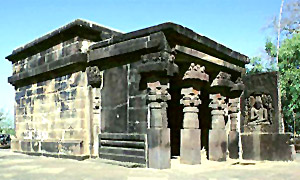
 Of the religious monuments of the Gupta period the foremost is the Gupta temple. No longer excavated from rock, it was an independent structure built of dressed stone blocks placed together, which afforded ample scope for the exercise of the architect`s genius. Another feature of the Gupta temple was related to its aesthetic character. It marks the begetting of a new sensibility, a change from the mere imitative to the infinitely creative, from the servile copying of meaningless forms expressive of undeveloped mind and unskilled forces to a reasoned application of the first principles of architectural compositions. These two features mark the emergence of the Hindu temple in a stone masonry.
The chief surviving temples of the Gupta age can be mentioned as follows
•Visnu Temple at Tigawa in Jubulpore district,
•Siva Temple at Bhumara in Nagod State,
•Parvati Temple at Nachna-Kuthara in Ajaigarh State,
•Buddhist shrines at Sanchi,
•Buddhist shrines at BodhGaya,
•The Dasavatara Temple at Deogarh,
•A temple in a ruined state but of great merit found at Dash-Parabatia on the banks of Brahmaputra in Darrong district of Assam,
•A temple of Siva at Khoh in Nagod State i.e. the beautiful Ekamukhi Linga and a mass of sculpture showing lively ganas from this temple are now deposited in Allahabad museum as well.
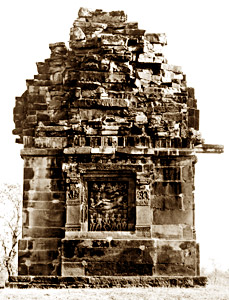 The earliest known Hindu temples in stone show the early phases and features of stone temple architecture. They were shrines for images and not places for congregations of the worshippers. The roof was usually flat and stone masonry was finely dressed and held together without any kind of mortar. Thus the early temples of the Gupta age present a marked contrast to the later temples with high sikharas or pinnacles and extensive mandapas or halls. A transition to the later style had however begun towards the end of the Gupta period in c. 500 A.D. and can be seen in the Dasavatara temple at Deogarh. This temple had originally a sikhara of about 40 feet. Its stones were secured together by dowels and its four porches afforded relatively more space for the worshippers to congregate. The sikhara in this temple is in three tiers rising on the top of square cella, and embellished with an elegantly carved doorway on one side and three big panels placed outside the three walls. The sanctum of this temple stood on a raised plinth occupying the central square of the open terrace. The doorway leading to the sanctum was the chief centre of the attraction, serving as an elegant outer frame to set off the image installed in the cella.
Besides the eight temples mentioned above there are some other temples that made entirely of brick, numerous examples of which have been found from Bhitar gaon in Kanpur distrit to Paharpuer in Bengal and Sirpur in Madhya Pradesh. Of these the temple at Bhitar-gaon, conceived from top to bottom in terms of terracotta and brick, is particularly worth mentioning. It is beautiful with several Courses of well-preserved friezes and moulded bricks with designs exceedingly varied and beautiful. The temple has a pyramidal roof and its walls were decorated on the outside with terracotta panels, depicting scenes from Hindu mythology. Architecturally, the temple is important as possessing the earliest true arch in India.