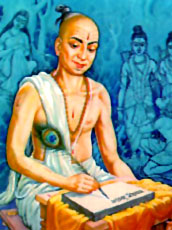
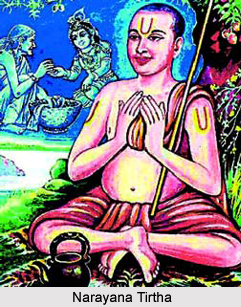
 Narayana Tirtha was a music scholar of 17th century Andhra. He is regarded as one of those who enriched the bhajana tradition of the Tanjavur territory. The magnificent Sri Krishna Lila Taranjjini was authored by him. In his earlier life, Narayana Tirtha was known as the Govinda Sastri.
Narayana Tirtha was born in a Tallavajjhala family, who were Telugu Brahmins. His father`s name was Nilakanta Sastri and Parvati Amma was his mother. The native village of him was at Kaza in Guntur district. He earned the knowledge of music, Sanskrit and the Sastras at a very young age. His marriage occurred at an early age as per the tradition of that period.
The transformation of Govinda Sastri to Narayana Tirtha in an ascetic order includes a very interesting story. The story goes like this; it said that once while he was going to his father in law`s place, he needed to cross the swollen Krishna River. And anecdotes have such that as he attempted so, Narayana Tirtha faced the threat of drowning. At that time, he did not get any other option to save himself and he took apatsanyasa i, e, asceticism in the face of danger. Then the flood stopped and he reached his wife`s place. He did not tell about it to his wife but she got the hint of his ascetic nature. Govinda could realise the divine intention behind this and then revealed what had happened. So, later he was initiated by one Sivarama Tirtha and he became a sanyasi. Thus, the birth of Narayana Tirtha took place from Govinda Sastri.
There is another interesting story related to his life. It is said that Narayana Tirtha suffered from an incurable stomach ache later in his life. During that time, Lord Venkatesvara emerged in his dream and asked him to go after the first object, which he saw the next morning. And in the next morning, he saw first a pig, which directed him to the village of Varahur, also known as Bhupatirajapuram. It is said that Narayana Tirtha was cured of all his ailments here. After this incident, Narayana Tirtha decided to stay at Varahur and completed his magnum opus, `Sri Krishna Lila Taranjjini` patronage
But the reason behind the relocation of Narayana Tirtha to Varahur is yet controversial. Some says that he shifted there because the Maratha rulers extended their voluntary help to him again few other says it is driven by fate. The `Sri Krishna Lila Taranjjini` of him is a rough translation of the abridged version of the Dasamaskanda (10th chapter) of the Srimad Bhagavatam. This composition starts with the birth of Krishna and ends with his marriage to Rukmini. The elements of prose, verse and drama, the three limbs of literary art were incorporated by Narayana Tirtha in his compositions. The frequent use of jatis or solkattus (dance syllables) in this compositions show that the author wished it to be a dance drama. It was written in the mould of Yakshagana. His used a variety of mudras to sign his work, prominent among them being, Vara Narayana Tirtha, Siva Narayana Tirtlia and Yati Narayana Tirtlia.
It is said that Narayana Tirtha himself presented it on the stage at Varahur before the temple of Lord Venkatesvara and later also at Melattur Bhagavata Mela tradition. Gita Govinda of Jayadeva inspired Narayana Tirtha and his music had a lot of influence in the subsequent composers, in particular over Tyagaraja. Tygaraja offered his gratitude to him for inspiring him to write his own two operas named the Prahlada Bhakti Vijayam and the Noivka Charitram.
It is said by the legends that Narayana Tirtha attained the `Jiva Samadhi` on the Sukla Ashtami day of the Masi month at Tirupoondiuruthi, which is about five kilometers from Tiruvaiyaru. Now, a mango tree stands on the spot of his Samadhi.