


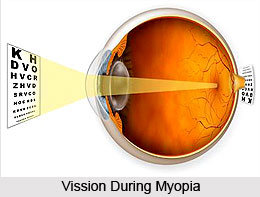
 Myopia is popularly known as near-sightedness or short-sightedness. This is a refractive defect of the eye in which collimated light produces image focus in front of the retina when accommodation is relaxed. The myopia affected people see nearby objects clearly but distant objects appear as blurred to them. With myopia, the eyeball is too long, or the cornea is too steep, so images are focused in the vitreous inside the eye rather than on the retina at the back of the eye. Myopia is popularly known as near-sightedness or short-sightedness. This is a refractive defect of the eye in which collimated light produces image focus in front of the retina when accommodation is relaxed. The myopia affected people see nearby objects clearly but distant objects appear as blurred to them. With myopia, the eyeball is too long, or the cornea is too steep, so images are focused in the vitreous inside the eye rather than on the retina at the back of the eye.
For proper eyesight, the cornea and the lens must properly focus or 'refract' light onto the retina i.e. at the back of the eye. If the length or shape of the eye is not ideal, the light may get focused too early or too late leaving a blurred image on the retina. Myopia, or near-sightedness, is the ability to clearly see objects up close but not those at a distance. Causes and Symptoms: Myopia generally occurs in the young; the patient experiences difficulty in seeing far-off objects. Spectacles with concave lenses of the required curvature may help in correcting the vision. But the defect continues to increase with age. The patient of this type of progressive myopia has to continue to change the lenses of his spectacles. It is an inherited condition usually detected in children between the ages of eight and twelve. Few factors outside of heredity affect this condition as well. Using dim light, reading too much or nutritional deficiencies do not seem to impact it one-way or the other. 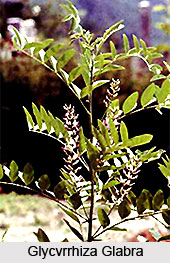
According to Ayurveda, nervous frailty and susceptibility to cold and constipation are the predisposing factors responsible for myopia. It begins with blurred vision, particularly with regard to objects at a distance and, later, leads to an inability to recognize persons unless they are standing next to the sufferer. The blackboard and the screen in a motion picture house may become blurred for the viewer. The eyes may water due to strain, and an itch and a sensation of heaviness and burning may be experienced in the eyes. An offshoot of the malady may be headaches or disturbance in sleep. Medicines & Prescriptions: The first requirement before any cure of myopia can be undertaken is to rid the patient of cold and constipation. Any tendency towards constipation is likely to interfere with the course of the treatment. Triphala should be administered to deal with these ailments. Triphala water should be drunk and also used for washing the eyes thoroughly. Four ounces of decoction of triphala should be taken to relieve the constipation and the dose may have to be regulated according to the severity of the constipation. Washing with triphala water and taking it internally may have to be continued for three to four months to deal with the condition. The other medicine of choice for myopia is Yashthi Madhu or Glycvrrhiza glabra. The powder of the root of the plant is given in a half teaspoonful dose, mixed with a quarter spoon of pure ghee and half teaspoon of honey. The dose is to be given twice daily on an empty stomach. If myopia is of nervous origin, namely, if it has been caused by nervous debility, Saptamrita Lauha is the obvious remedy. A teaspoonful of this medicine is given twice daily with milk. In case of constipation, the obvious remedy is Mahatriphala Ghrita. The dose of which may be increased to three teaspoonfuls twice daily with milk. Cold and nasal congestion may be dealt with by dropping five to six drops of Shadbindu Taila into each nostril. Treatment Myopia is best treated with eyeglasses and also contact lenses, which compensate for the elongated shape of the eye allowing the light to focus properly on the retina. As children grow through the teen years, the condition typically worsens and then levels off in adulthood. During this growing period, new eyeglasses may be needed as often as every six months to correct the problem. 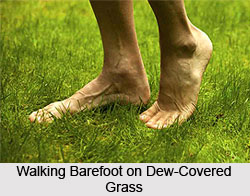 There is no scientific evidence that contact lenses or eye exercises stop the progression of myopia as such. Refractive surgery is available as a treatment for myopia but most ophthalmologists-medically trained eye doctors-feel that eyes with simple myopia would best be treated with glasses or contact lenses.
Diet and Other Regimen: Pungent and sour foods are to be avoided. Those foods can sometimes exacerbate costiveness. Fried things should be prohibited, though ghee made from cow's milk may be used in moderate quantities. The patient is advised to avoid eyestrain. Continuous reading is not helpful. After a few pages of reading, the patient should rest his eyes for some minutes. Work-demanding concentration of eyesight including the needlework and also reading and writing at night should not be permitted. Walking barefoot on dew-covered grass and long walks in the morning are helpful. One should not read while lying in bed. |
| |||



Myopia or Dristi Dosha
| Myopia or dristi dosha is popularly known as near-sightedness or shortsightedness. |
| ||||||||||||||||||||||||||||

