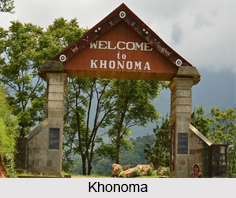
Khonoma, Village in Nagaland - Informative & researched article on Khonoma, Village in Nagaland
  Indianetzone: Largest Free Encyclopedia of India with thousand of articles Indian Villages


in  
Art & Culture | Entertainment | Health | Reference | Sports | Society | Travel
Forum  | Free E-magazine
Indian Villages : Indian Villages l Indian Village Art l Indian Village Life l Indian Village Festivals l Indian Village Transport l Indian Dalits l Indian Puranic Villages l Villages of Goa l Villages of Gujarat l Villages of Haryana l Villages of Jammu and Kashmir l Villages of Himachal Pradesh l Villages of Jharkhand l Villages of Karnataka l Villages of Meghalaya l Villages of Maharashtra l Villages of Nagaland l Villages of Mizoram l Villages of Tripura l Villages of Orissa l Villages of Sikkim l Villages of Punjab l Villages of Uttarakhand l Villages of West Bengal l Indian Village Society l Villages of Tamil Nadu l Villages of Madhya Pradesh l Villages of Rajasthan l Dowlaiswaram l Khonoma l Villages of Alappuzha l Villages of Bihar l Villages of Chhattisgarh l Rural Population in India
Home > Society > Indian Villages > Khonoma
Khonoma, Village in Nagaland
Khonoma village in Nagaland is one of the most beautiful villages in India located amidst several hills.

Khonoma is a small little village which showcases the delightful views of Nagaland`s natural beauty and ecological diversity. En route look out for the memorial stones erected to commemorate Feasts of Merit and the intricate system of bamboo pipes, which carry water for long distances. The unique variety of soil conditions and elevations of its fields have resulted in about 20 different types of rice bring grown here.

Khonoma Village, Nagaland Khonoma village is situated twenty kilometres to the west of Kohima. The village supports a predominantly agrarian population of about 3000 people. Extensive rice terraces have been carved out of the hill slopes surrounds the village. Over twenty varieties of paddy are grown at different elevations on these terraces. The forested slopes of the village, spreading over 152 square kilometres are relatively undisturbed, baring a few patches of jhum-cleared cultivations which is also known as shifting cultivation.

Situated in the Kohima district, the village Khonoma enjoys a sub-tropical climate with heavy rains from the month of May to August and little rainfall during September to October. The dry season is usually from the month of November till April. The environmental temperature in the village during the summer months goes up to a maximum of 31ºC and a minimum of 16ºC. In the winter season, the minimum temperature is 4ºC and the maximum temperature is 24ºC.

Etymologically speaking, the village of Khonoma derived its name from a plant called Goulthera fragrabtisima, better known as Khwuno, which is grown in the region. Sub tropical climate of Khonoma is favourable, thereby attracting tourists from far off places. During the summer season temperature varies between 16 C to 31 C. Winters are chilly when temperature drops down to as low as 4 C. In Khonoma average rainfall has shown a counting of 2000mm to 2500mm. Heavy rainfall occur during the months of May and April.

The village is also known as Khwunoria by the residents and is estimated to be about four hundred years old. The village is surrounded by hills which are over 9000 feet. It runs along a ridge, which is characteristic of Angami villages, and its domain extends from the terraced rice fields in the valley immediately beneath the ridge to deep into the uplands of the Barail Range of hills, all the way southwards till the border with the Senapati district of Manipur. This domain is estimated at covering a spread of around one twenty three square kilometers.

Khonoma is famous for its past heritage of fighting and warfare. It is the place where the brave Naga soldiers made an attempt to resist the British rulers in the year 1879. One can also find a simple white tower. It was constructed in the memory of martyrs like G.H. Damant, Maj. C.R. Cock, Lt. H.H. Forbes and Sub. Maj. Nurbir Sai. The Khonoma Nature Conservation and Tragopan Sanctuary (KNCTS) established in the year 1998 by the people of village Khonoma with ecological consciousness. Its aim is to protect the Blyth`s Tragopan, a rare pheasant of Nagaland. Apart from it, a multitude of wild creatures are preserved in their peaceful haven. This sanctuary is privately possessed and handled by the Village Community of Khonoma. The sanctuary is also an ideal abode of many other endangered and rare species of animals and plants. If any one wants to sample adventure and like to behold the bewitching beauty of nature, a visit to Khonoma would be ideal.

(Last Updated on : 17/11/2009)
Recently Updated Articles in Indian Villages
  • Occupation in Indian Villages
    Occupation in Indian villages varies greatly from Agriculture to fishing, weaving, cottage industry, handicrafts, cottage industry, pottery, carpentry, leather work and others
  •  
  • Indian Village Life
    Indian Village Life reflects the simple way of living. The simplicity and unity of the innocent villagers, their superstitions, beliefs, cultures, serenity make their life complete.
  •  
     
  • Villages of Punjab
    Villages of Punjab hold key to the state’s economical, industrial and agricultural strength. A major part of the state population stays in villages.
  •  
  • Village Life in South India
    Village life in South India is highly dependent on agriculture and fishing. The life in villages in southern part of India is rich in tradition and culture.
  •  
  • Pottery in Indian Villages
    Pottery in Indian villages traces back to the Indus Valley Civilisation. The art of handling of clay is called Pottery and it is one of the earliest skills known to the Indians.
  •  
    E-mail this Article | Post a Comment
    RSS Feeds
    Forum
    Forum on Indian Villages

    Free E-magazine
    Subscribe to Free
    E-Magazine on Indian Crafts
     
     
    Khonoma, Village in Nagaland - Informative & researched article on Khonoma, Village in Nagaland
    Sitemap
    Contact Us   |   RSS Feeds
    Copyright © 2008 Jupiter Infomedia Pvt. Ltd. All rights reserved including the right to reproduce the contents in whole or in part in any form or medium without the express written permission of Jupiter Infomedia Pvt. Ltd.
