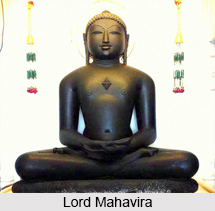
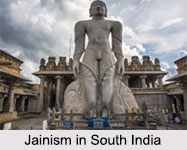
 Jainism had a prominent place in South India, especially in Karnataka. During the rule of the Maurya Dynasty, Chandragupta Maurya had visited Shravanabelagola with his Acharya Bhadrabahu. Kundakunda, the great Digambara Jain Acharya and philosopher also belonged to South India. All the rulers of South India including the Ganga Dynasty, Kadamba Dynasty, the Chalukya Dynasty, and the Hoysala Empire etc. patronised and enthusiastically supported Jain religion. Under their rule construction of caves and rock cut temples, erection of pillars and installation of images were carried out. Jain Literature also flourished during their time.
Rise of Jainism in South India
Jainism prospered in South India under the rule of Kalinga King Kharvela. He supported Jainism and helped it flourish in South India through Andhra Pradesh and the coastal ranges of Tamil Nadu. During the rule of the Maurya Dynasty, Jainism became popular in Kuntal region. It extended from the route of Avanti Janapada via Maharashtra and Andhra regions. In the early mediaeval period, the growth of Jainism was curbed by the Khilji Dynasty, the Tughlaq rule and the rise of Bahamani Kingdom. However, it gained impetus in the Hindu Vijayanagar Empire. This dynasty was very tolerant towards Jainism and helped to popularise it in different parts of the country. The rulers of the Tuluva dynasty contributed for the growth of Jainism. They constructed Jain temples and installed many images of Jain saints.
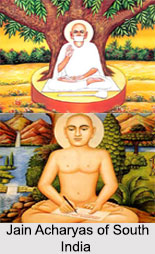 Jain Acharyas of South India
The South Indian Jain Acharyas who had their influence were Kundkunda, Madhavsena and Vishalkirti. Even the Bhattaraka tradition marched from south to north. During the medieval period many religious leaders, munis, pandits, authors, poets, Suris and Bhattarakas of the South India re-established Jainism. Some of them were Panditdeo Nyayakirti, Shubhachandra, Nemichandra, Suri Mallinath, Vijayakirtideo, Bhattaraka Lalitkirti, Dharmabhushan Charuchandra, Hemachandra, Telug Adidev, Maladhari Madhavchndra Ramachandra and Keshava, Aluva Mahaprabhu, Muni Bhadradeo Shrutmuni, Charuchandra Pandit and Manikyadeo. According to an inscription at Shravanabelagola bearing the date 1373 the names of the Bhattaraka Vasantkirti, Devendrakirti, Vishalkirti, Shubhakirti, Kalikalsarvagya Bhattaraka Dharmabhushan Amarkirti and Muni Vardhaman have also become prominent.
There were many other Jain poets, authors and scholars like Simhakirti, Udai bhasha-Chakravarti, Bhaskar, Kalyankirti, Jinadeo, Pandit Bahubali, Keshawavarni, court-poet Madhur, Abhinav shrutmuni, Chandrakirti, Vijay who contributed significantly towards Jain Literature.
Jain Pilgrimage Centers in South India
Vijayanagara, Kuragahalli, Rabandur, Mulgunda, Shravanabelagola, Hariyawali, Mullura, Sangitapura, Mudabidri, Karkal, Venur, Bhatkal etc. have been the important Jain centres in South India.
Construction and installation of temples and images also gained prominence at this time. Many manastambhas were erected during this period at places like Shravanabelagola, Kambadhalli, Humacha, Hiriyagarhi, Karkal, Mulki and Mudabidri. All these pilgrimages were adorned with intricate architectural beauty. The temples reflected the magnificent work of the craftsmen.
Thus, for years together, the conduct and life of the people continued to be affected by the thoughts and principles of Jainism.