Indianetzone: Largest Free Encyclopedia of India with thousand of articles Yoga

Art & Culture | Entertainment | Health | Reference | Sports | Society | Travel
Free E-magazine
Yoga : Yogasanas l Kundalini Yoga l Suryayoga l Bhakti Yoga l Yoga Institutes in India l Mudra Yoga l
Home > Health > Yoga > History of the Chakra System
Forum on
Yoga
Pen down your remark and discuss about the secret of staying fit and healthy.

 
Free E-magazine
Subscribe to Free E-Magazine
on Yoga

 
History of the Chakra System

It is obviously wonderful that the chakras, as archetypal components of consciousness, are finally gaining prominence in the collective mindset. It is supplemented with more books and references than ever before. While this popularity is making the chakras a household word, it is also spreading a lot of confusing and conflicting information. It is important to realize the chakras come from an ancient tradition. Many New Age teachers have barely explored this with great success. A brief summary of the Chakra System`s historical development has been discussed for the improvement of the knowledge.

The chakras are inextricably linked with the science and practice of yoga. The word yoga means `yoke`. It is a system of philosophy and practice designed to yoke the mortal self to its divine nature of pure consciousness. The origin of yoga and earliest mention of the chakras goes back to the Vedas, meaning `knowledge`. There is a series of hymns that are the oldest written tradition in India. These writings were created from an even older oral tradition of the Aryan culture. This is believed to be an invading Indo-European tribe that swept into India during the second millennium B.C.E.

The Aryans were said to have entered India on chariots, and the original meaning of the word chakra as `wheel` refers to the chariot wheels of the invading Aryans. The word was also a metaphor for the sun, that great wheel that rolls across the sky like a blazing chariot of a chakravartin. This was the name for the Aryan chariot-rulers. The wheel also denotes the eternal cycle of time called the kalachakra. In this way, the wheel represents celestial order and balance. One further meaning is that a chakra is a Tantric circle of worshipers as well.

It is said that the chakravartins were preceded by a glowing golden disk of light, much like the halo of Christ. The birth of a chakravartin was said to herald a new age, and it could be this time period that marked the dawning of the third chakra era of human history. It is also said that the god Vishnu came down to Earth. He had four arms and each of them carrying something as a chakra, a lotus flower, a club, and a conch shell. This may also have referred to a chakra as a discus-like weapon.

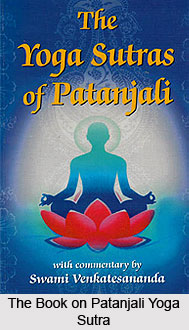
Following the Vedas were the Upanishads. Upanishad is mainly the wisdom teachings passed from teacher to disciple. There is some mention of the chakras as psychic centers of consciousness in the Yoga Upanishads and later in the Yoga Sutras of Patanjali. The classic eightfold path of yoga tradition can be understood from Patanjali`s sutras. This tradition was largely dualistic, stating that nature and spirit were separate. It advised ascetic practices and renunciation of one`s instinctual nature as a way to enlightenment.

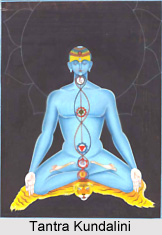
It was in the non-dual Tantric tradition that the chakras and Kundalini came to be an integral part of yoga philosophy. The Tantric teachings are a syncretical weaving of many spiritual traditions of India. This mainly came to popularity during the sixth and seventh century A.D., in reaction to the dualistic philosophy, which preceded it. This tradition advised being in the world rather than separate from it. Tantra is commonly viewed in the West as primarily a sexual tradition. Tantrism put sexuality in a sacred context and regards the body as a sacred temple for the consciousness within. Yet this is actually only a small part of a broad philosophy, which combines many practices of hatha and kundalini yoga. Worship of deities, especially of the Hindu goddesses, and focuses on integrating universal forces all get importance.

The word tantra literally means `loom` and denotes a weaving of disparate threads into a tapestry of wholeness. Thus, the Chakra System, coming out of Tantric tradition, weaves the polarities of spirit and matter, mind and body, masculine and feminine, Heaven and Earth, into a single philosophy of many philosophical strands, reaching even back to the oral tradition that preceded the Vedas.

Apart from the Sat-Cakra-Nirupana, and the Padaka-Pancaka, written in the tenth century there is also another tenth-century text called the Gorakshashatakam, which gives instructions for meditating on the chakras. These texts form the basis of our understanding of chakra theory today.

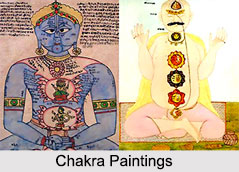
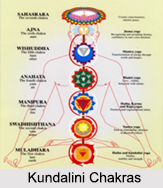
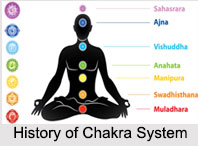
In these traditions, there are seven basic chakras that exist within the subtle body, interpenetrating the physical body. The subtle body is the nonphysical psychic body that is superimposed on our physical bodies. It can be measured as electromagnetic force fields within and around all living creatures. As for example Kirlian photography has actually photographed the emanations of the subtle body in both plants and animals. In yoga psychology, the subtle body is divided into five sheaths of varying refinement in the subtle body, called koshas. At the core of the body, the subtle field appears as spinning disks or chakras. The chakras are the psychic generators of the auric field. The aura itself is the meeting point between the core patterns generated by the chakras and the influence of the external word.

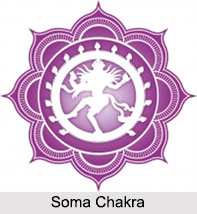
Through modern physiology it can be seen that these seven chakras are located near the seven major nerve ganglia that emanate from the spinal column. There are two minor chakras mentioned in the ancient texts, the soma chakra, located just above the third eye, and the Anandakanda lotus, which contains the Celestial Wishing Tree or Kalpataru of the Heart Chakra. Some esoteric systems propose nine or twelve chakras, while other traditions, such as Vajrayana Buddhism, describe only five centers. Since a chakra is literally a vortex of energy, there is no limit to their number. However, the original seven master chakras form a profound and elegant system. Mastering the first seven chakras can easily take a lifetime.

Many interpretations on the chakras advise transcending the lower chakras in favor of the more expansive upper chakras. This view arose during a period in history where all the major patriarchal religions advocated the greater importance of mind over matter, thus denying the existence of the spiritual within the mundane realms. Careful reading of the Tantric texts does not imply the denial of the lower chakras in favor of the upper chakras, but merely an enfoldment, where each higher level is transcendence. This includes and is built on the level below it. In this way, the lower chakras provide a foundation for our spiritual growth, much as the roots of a tree, which push downward, allow the tree to grow taller.

Recently Updated Articles in Yoga
  • Techniques of Spiritual Energy Massage
    It is to awaken the kundalini or the seven charkas of the body so that the body can rhythm with the environment.
  • Bhakti Yoga
    A spiritual practise of offering utmost devotion to God which is considered as the easiest way to liberate oneself.
  • Kriya Yoga
    Kriya Yoga practice is an ancient method, which was reintroduced by Lahiri Mahasay and Paramhansa Yogananda.
  • Samadhi Pada , Patanjali Yoga Sutra
    This pada explains the significance of yoga as well as of Samadhi i.e.mean profound meditation and supreme devotion.
  • Concept of Kriya Yoga
    Kriya yoga is a special Yogic Technique that was introduced and taught by Paramhansa Yogananda.
E-mail this Article | Post a Comment
History of the Chakra System Sitemap