Havelis of Jaisalmer
|
Showcasing the creativity and innovations of craftsmen from the ancient times, the havelis of Jaisalmer boasts the rich cultural heritage of the city.
|
|
|
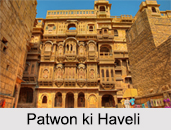 The city of Jaisalmer has witnessed different forms of architecture in different eras. The ancient times saw dominating Rajput architecture whereas the medieval period witnessed the fusion of Rajput and subtle Islamic architecture. It is this era that saw the construction of most of the Havelis. A haveli is basically a palace, which served as the residence of Wazirs i.e. ministers and landlords. Usually they are very big and spacious with lots of rooms. All the havelis are made using yellow sandstone and have beautifully carved facades and beautiful oriel windows. Some popular havelis of the city are Patwon Ki Haveli, Nathmal Ki Haveli and Salim Singh Ki Haveli. The city of Jaisalmer has witnessed different forms of architecture in different eras. The ancient times saw dominating Rajput architecture whereas the medieval period witnessed the fusion of Rajput and subtle Islamic architecture. It is this era that saw the construction of most of the Havelis. A haveli is basically a palace, which served as the residence of Wazirs i.e. ministers and landlords. Usually they are very big and spacious with lots of rooms. All the havelis are made using yellow sandstone and have beautifully carved facades and beautiful oriel windows. Some popular havelis of the city are Patwon Ki Haveli, Nathmal Ki Haveli and Salim Singh Ki Haveli.
Patwon ki Haveli: A complex of 5 havelis built by the 5 sons of Guman Chand Patwa, a trader in textiles and precious metals, the Patwon ki Haveli was constructed in the beginning of the 18th century. These multi-storeyed buildings were built using yellow sandstone and have, mud floors and wooden ceilings ensuring perfect temperature inside. This is one of the most popular and important havelis in Jaisalmer. With the interiors of mirror halls and intricate stone work, it is no less than a palace. The exquisite facade, detailed delicate stone work, and beautiful interiors are a major tourist attraction in the city.
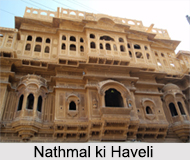 Nathmal Ki Haveli: Built for the Prime Minister in the latter half of the 19th century, this haveli reflects the sheer craftsmanship of the by-gone eras. This ornamental two-storied haveli was built by 2 brothers, Hathi and Lalu, who reportedly fought during its construction leading to one half of the haveli being built by one brother and the other half by another. At first glance, both sides of the haveli look the same, but a closer inspection reveals differences in the carving and symmetry as well. Currently, the roof has been cast by binding stone pieces without using beams and brackets and has a beautiful facade with stone elephants on both side of the platform of the haveli. There are ornamental latticed balconies, partly bloomed lotus flowers, floral patterns on intricate lattices and minute birds and animals. Nathmal Ki Haveli: Built for the Prime Minister in the latter half of the 19th century, this haveli reflects the sheer craftsmanship of the by-gone eras. This ornamental two-storied haveli was built by 2 brothers, Hathi and Lalu, who reportedly fought during its construction leading to one half of the haveli being built by one brother and the other half by another. At first glance, both sides of the haveli look the same, but a closer inspection reveals differences in the carving and symmetry as well. Currently, the roof has been cast by binding stone pieces without using beams and brackets and has a beautiful facade with stone elephants on both side of the platform of the haveli. There are ornamental latticed balconies, partly bloomed lotus flowers, floral patterns on intricate lattices and minute birds and animals.
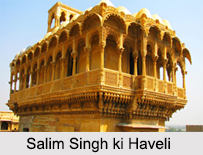
Salim Singh Ki Haveli: Built in the late 17th century, the front facade of the haveli resembles that of a ship stern and is thus also known as Jahaz Mahal. The construction of the Palace was commissioned by Salim Singh, who was the then prime minister of the kingdom. The distinct feature of this haveli is its roof that presumably is in peacock form, and its 38 balconies, each with a different design.
 Visiting Information on the Havelis of Jaisalmer Visiting Information on the Havelis of Jaisalmer
The Jaisalmer Railway Station is the nearest at a mere distance of a kilo metre or 3 km from all the three havelis. And the Jaisalmer Airport is located at a distance of 13 km or so from the aforementioned palaces.
|
|
|
|





