Fever - Informative & researched article on Fever
  Indianetzone: Largest Free Encyclopedia of India with thousand of articles Naturopathy


in  
Art & Culture | Entertainment | Health | Reference | Sports | Society | Travel
Forum  | RSS Feeds  | Free E-magazine
Naturopathy : Fasting Therapy l Colour Therapy l Sleep Therapy l Aromatherapy l Water Therapy l Massage Therapy l Mud Therapy l Magnetic Therapy l Nature Cure Treatments l Bath Therapy l Indian Naturopathy l Magnet l Music Therapy l Flower Remedies l Weight Loss l Diet Therapy l Diseases of the Nervous System l Oushadhi l Unani Medicine in India
Home > Health > Naturopathy > Nature Cure Treatments > Common Ailments > Fever
Fever
Fever is a widespread infectious disease, denoted by an elevation in body temperature with side-effects.
  Common Fever   Dengue Fever or Dandak Jwara   Hectic Fever or Pralepaka Jwara
  Rheumatic Fever or Aamavata Jwara   Sandfly Fever or Marumakshika Jwara   Typhoid Fever or Aantrik Jwara
  Childbirth Fever or Prasuti Jwara   Black-Water Fever or Kalamcha Jwara   Filariasis or Shlipada Jwara
  Kala-Azar or Kala Jwara   Bulbous Eruptions or Visphotaka Jwara   Heat Exhaustion and Heat Stroke
  Sunstroke      

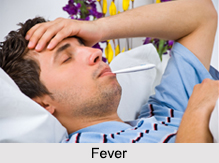
FeverFever is perfectly described as a sudden or gradual rise in normal human body temperature, which, on an average, remains at 98.6 degrees Fahrenheit. The disease fever acts wholly as part of the body`s defence mechanism. When one`s body is terribly battling against infections, the body temperature rises. However, one might just wonder the exact reason for this strange mechanism, which truly acts all by itself. Fever is a symptom of any given infection and contagion; fever indeed is a symptom of almost every disease known and realised by man. Maladies induced by viruses and bacteria invade the bodies and makes one go sick. Without the presence of human immune system, which is mandatory to drive back these infections, one would die in any second. Common cold, tonsillitis, otitis media, the flu (influenza), bronchitis, tetanus, measles, mumps, chicken pox, AIDS, pneumonia are all well-known instances of bacterial and viral infections. Body temperature while a patient is suffering from fever, is generally measured in the mouth by a thermometer, being held under the tongue for 5 to 8 minutes. Other methods to measure body temperature include from the rectum, from the axillary gland (armpit) and employing a particular temperature-taking device in the ear.

Charaka has categorised fever into numerous varieties, depending upon the vitiation of the three doshas, namely - vata, pitta and kapha. There exists several reasons for which fever rises up to higher stages. Examples can be cited as the change of climate or seasons, the nullification of the vital fluid `blood` and other supplementary reasons. Fevers are also classified according to their severity and duration. Ayurvedic teachers have specified the role of the Pancha karmas or five cleansing procedures, for the various fevers and the stages at which they come to serious notice of the physician.

"Fever is a good thing." Indeed, this does sound like an odd statement to almost every human. However, the medical and scientific world does have explanation for this reason too. It is defined that fever is the human body`s `natural response` to combatting harmful germs. Symptoms of a fever include: chills, incontrollable aches and pains all over the body, lassitude, elevated body temperature on the thermometer, flushed cheeks and feeling hot or cold, accompanied by shivering. The body basically trembles and has chills when the fever is gradually rising, especially speedily and sweats when the fever is dropping, or breaking, as is normally known to the common man.

Fever comes about when the body`s internal "thermostat" arouses the body temperature above its normal level. This thermostat can be witnessed in that part of the brain referred to as the `hypothalamus`. The hypothalamus perfectly is knowledgeable about the exact body temperature that a healthy human should have (generally around 98.6 degrees Fahrenheit, or 37 degrees Celsius) and will `send` messages to the body accordingly to keep it that way. Most people`s body temperatures are subject to variations a little bit during the course of the day - it is usually a little lower in the morning and a little higher in the evening and can further vacillate as children run around, play or simply exercise. Sometimes, though, the hypothalamus will "reset" the body to a higher temperature in reaction or reception to an infection, illness, or some other severe cause. A question that generally arises now is that why exactly does the hypothalamus `tell` the body to change into a new temperature (thus implying the arrival of fever). Researchers are of the faith that pushing up the heat is the body`s own way of battling the germs that induce infections and makes the body a less comfortable place for them.

Fever, as the general view is, is not always harmful. In fact, in some diseases, fever has proven to be beneficial, as in instances of neurosyphilis, chronic arthritis and some widespread cancers. Fever is caused in these mentioned cases by injection of milk protein and BCG vaccine. Fever is associated with the releasing of endogenous pyrogens, which triggers off the T- cells and thus enhances the host defence mechanism. Disadvantages of fever also is well-known, which is known to cause hyper-catabolism leading to nitrogen wastage and weight loss and terrible debility. Due to profuse sweating also, it may lead to a malady of electrolyte imbalance. Convulsion and brain damage in cases of high fever can also happen from a sudden bolt. Even worse, circulatory overload, arrhythmia can occur in fever leading to unpleasant effects.

Fever (also recognised as pyrexia, from the Greek pyretos standing for fire, or a febrile response; from the Latin word febris, standing for fever and, archaically recognised as ague) is also described as a recurrent and everyday medical indication that represents an increase in internal body temperature to levels beyond normal. Fever is most precisely exemplified as a temporary elevation in the body`s thermoregulatory set-point, normally by approximately 1-2 degrees Celsius (1.8-3.6 degrees Fahrenheit).

Fever is brought about by an increase in the thermoregulatory set-point, stimulating typical body temperature (generally and debatably regarded as 37 degrees Celsius ±1 degrees Celsius, or approximately 99 ±2 degrees Fahrenheit) to rise; the effector mechanisms are, as a result, enacted out accordingly. A feverous patient has an all-purpose experiencing of cold, despite an elevated body temperature and increase in heart beat, muscle tone and shuddering, all of which are induced by the body`s undertakes to countermine the newly-comprehended hypothermia and reach the new thermoregulatory set-point.

Fever, in a different context, differs from hyperthermia, in that hyperthermia is an abnormal elevation in body temperature over the body`s thermoregulatory set-point, due to unwarranted heat production or inadequate thermoregulation, or both. A fever, as has been seen above, is perceived as one of the body`s immune mechanisms to take a shot at neutralising a comprehended threat within the body, be it bacterial or viral. Carl Wunderlich (legendary German physician, pioneer psychiatrist and medical professor; he is known for his measurement of mean healthy human body temperature of 37°C (98.6°F), now known more correctly to be approximately 36.8°C (98.2°F)) had discovered that fever is not a disease, but the body`s reaction and reception to a disease. When a patient has or is suspected of experiencing a fever, that individual`s body temperature is measured by making use of a thermometer.

Fever is perceived to be very much present at a first glance by the common eye, if:Temperature in the anus (rectum/rectal) or in the ear (otic) is at or beyond 38.0 degrees Celsius (100.4 degrees Fahrenheit) Temperature in the mouth (oral) is at or beyond 37.5 degrees Celsius (99.5 degrees Fahrenheit)Temperature at the armpit (axillary) is at or beyond 37.2 degrees Celsius (99.0 degrees Fahrenheit) The most widespread oral measurement of normal human body temperature is 36.8±0.7 degrees Celsius (98.2±1.3 degrees Fahrenheit). This implies that any oral temperature within 36.1 and 37.5 degrees Celsius (96.9 and 99.5 degrees Fahrenheit) is in all probability, to be normal.

However, there exist umpteen fluctuations in normal body temperature and this needs to be verily deliberated when measuring for fever. The values contributed, are for an otherwise sound, non-fasting adult, sensibly dressed, indoors, within a room that is kept at a normal room temperature (22.7 to 24.4 degrees Celsius or 73 to 76 degrees Fahrenheit), during the morning, but not shortly after rising from sleep. Additionally, for oral temperatures, the patient should not have eaten, drunk, or smoked anything in at least the previous fifteen to twenty minutes.

Body temperature generally varies all through the day, with the lowest levels close to 4 a.m. and the highest around 6 p.m. (taking the individual follows the established pattern, i.e., sleeping during night and staying awake during day). As such, an oral temperature of 37.2 degrees Celsius (99.0 degrees Fahrenheit) would firmly be looked as a fever in the morning, but not during the afternoon. An oral body temperature registering up to 37.5 degrees Celsius (99.5 degrees Fahrenheit) in the early/late afternoon or early/late evening, also would not be considered a fever. Normal body temperature may differ as much as 1 degree Fahrenheit (0.6 degrees Celsius) between individuals or from day to day. Amongst women, temperature varies at several points during the menstrual cycle and this is also utilised as an element of fertility awareness (although temperature is only one of the variables). As such, numerous parameters do exist while measuring human body rise of temperature, concerning both men and women. Temperature generally increases after eating; psychological constituents also influence body temperature.

There exists different locations where body temperature can be measured and these further fluctuate in temperature variability. Tympanic membrane thermometers assess the `radiant heat energy` from the tympanic membrane (infrared). These can come as very convenient at first, but may also exhibit more unevenness. Children acquire higher temperatures from activities like playing, but this does not come under a feverish parameter, because their set-point is normal. Elderly patients can have a decreased ability to yield body heat during fevers, so even a low-grade fever can have severe rudimentary causes in geriatrics. Fever is almost always accompanied by `sickness behaviour` (a coordinated lot of adaptive behavioral changes that develop in sick individuals during the course of an infection), which includes weariness, depression, anorexia, drowsiness, hyperalgesia and the powerlessness to concentrate.

Beyond all such feverish descriptions and their detailed doctorial prescriptions, the common fever, or the common cold, as can be seen almost in every household, bears much similarity to fever in general. Common fever most often have the chance to develop into what is known as `flu`. The causes of common fever and treatments of common fever are hence looked into deeply by the professional medical practitioner at all instances. The types of common fever into which cough and cold can move into are - Typhoid Fever, Meningitis Fever, Dengue Fever, Diphtheria Fever, Sandfly Fever, Mumps, Rheumatic Fever, Heat exhaustion and Heat Stroke, Chickenpox Fever, Measles Fever, Bulbous Eruptions, Erysipelas, Hectic fever, Malaria, Black Water Fever, Kala-Azar or Filariasis.

(Last Updated on : 21/03/2009)
  More on Common Ailments...
 
Allergies Fever Sore Throat
Urinary Disorders Common Cold Headache
Tonsillitis Cough Insomnia
Sinusitis Fissure and fistula Warning signs of Stress
Nosebleed or Nakseer Hoarseness or Swarabheda Puiikama
Earache or Kaan Ka Dard Poliomyelitis or Balapakshaghata Types of Allergies
Recently Updated Articles in Naturopathy
  • Types of Magnets
    The planet earth is full of different types of permanent magnets, which vary in size, shape, design and strength.
  •  
  • Classification of Magnetic Materials
    The magnetic materials are broadly classified into three categories depending on their attraction towards a magnet.
  •  
  • Use of Magnets
    The magnets are very useful in treating various human ailments like toothache, stiffness of shoulders etc.
  •  
  • Affect of magnets in Human Metabolism
    The magnet has its affect on blood and hence it influences the whole human metabolism in a good or bad way.
  •  
E-mail this Article | Post a Comment
Free E-magazine
Subscribe to Free
E-Magazine on Naturopathy

 
Fever - Informative & researched article on Fever
Sitemap
Contact Us   |   RSS Feeds
Copyright © 2008 Jupiter Infomedia Pvt. Ltd. All rights reserved including the right to reproduce the contents in whole or in part in any form or medium without the express written permission of Jupiter Infomedia Pvt. Ltd.
