


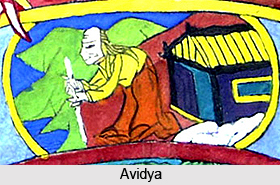
 Avidya is the antithesis of Vidya, or true knowledge. In the Bhagavad Gita it is considered that all sufferings and limitations imposed by the ego come from Avidya. As a result man has to seek knowledge with which hatred, damage and greed are contrary. Spiritual ignorance fuels the fires of rebirth. In early Buddhism, ignorance is of the four noble truths which is thus a failure to appreciate the nature of things as temporary and lacking stable identities. The Yoga tradition considers ignorance as a defect of the mind along with self-will, passion, hatred neurotic attachments and natural drives. Avidya is the antithesis of Vidya, or true knowledge. In the Bhagavad Gita it is considered that all sufferings and limitations imposed by the ego come from Avidya. As a result man has to seek knowledge with which hatred, damage and greed are contrary. Spiritual ignorance fuels the fires of rebirth. In early Buddhism, ignorance is of the four noble truths which is thus a failure to appreciate the nature of things as temporary and lacking stable identities. The Yoga tradition considers ignorance as a defect of the mind along with self-will, passion, hatred neurotic attachments and natural drives.
The Advaita Vedantic philosopher Sankara says that ignorance is same as the confusion of what is subjective and features of the objective world. Avidya is a misconception and it is the nature of worldly existence. Later it was treated as a cosmic force that is the material cause of all forms of misconception. The theistic Vedantin Ramanuja implicates ignorance as kanna that doubts the soul's awareness of itself as God's servant. Kashmiri Shaivas who belong to the Trim cult understand ignorance as void of one's identity with the universal creative consciousness. Avidya is the primary cause of suffering in Samsara according to Buddhism. It is one of the three klesas. Avidya leads to craving and clinging. It is the first link of Pratityasamutpada and all other links depend on it. Avidya is first spoke on the Bhavacakra and all subsequent states follow in its arousal. Avidya is lack of knowing and can be connected with intention. It has three aspects as associated with the three kinds of sensation, four aspects as the ignorance of the Four Noble Truths, and five aspects as masking the five destinies and has six aspects as associated with the six senses. Mandana had stated that Avidya means illusion, also false appearance, as it is neither the characteristic nature of Brahman nor a unit different from Brahman. It is neither real nor unreal. The locus of Avidya is the individual soul. Ultimately the souls are identical with the Brahman but inexplicably they are diverse. Wisdom is the solution to Avidya and it is achieved by practicing awareness, patient endurance and meditation. All three are incorporated in the pan-Buddhist practices of the Noble Eightfold Path. Thus, Avidya when used as a theosophical term indicates the ignorance of the mind that causes commencing on the spiritual pathway to apply vain effort and pursue vain causes. |
| |||



Avidya
| Avidya means ignorance. It has a dual logic, one is simple lack of knowledge, and the second is a misconception that is mistaken for knowledge. |
| ||||||||||||||||||||||||||||

