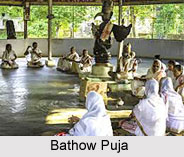
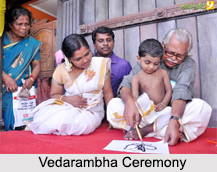
 Vedrambha is a Hindu ceremony among the Hindu families. It is celebrated when a child starts studying the four `Vedas` under the guidance of a `guru`. It starts from learning the "Gayatri" mantra. Earlier, Vedrambha and Upanayana were used to perform together. Then, the teacher or the `guru` had to take the student to his house but now this has changed and the nominal "Acharya" performs the "samskara". Now the `guru` does not take the students to his home.
Rituals of Vedrambha
Vedrambha `samskara` is supposed to be first mentioned in "Vyasa Smriti". To perform this `samskara`, at first an auspicious day is fixed after the "Upanayana". It can be performed on the day of "Upanayana" also. However, if not performed on the same day then, the next day it is performed or else it can be done on any auspicious day before the completion of one year of "Upanayana".
The performer of Vedrambha `samskara` is the father of the child or the "Acharya" in absence of the father. At first, the performer bathes the child with pure clean water. Then the child is dressed with nice attire and he is seated beside the "Acharya" on a good seat in the west of the `Yajnavedi` by facing eastward.
Thereafter, the adoration, supplication and meditation of God with the eight mantras are performed. Then "Agnayadhana" and "Samidhadhana" with three mantras and the sprinkling of water on the four sides of the `Yajanakunnada` are needed to be performed. Now, the fire of `Yajnakunda` is blazed with the wood fuel. Now, the four oblations "Agharavajyabhagahuti", four "Vyahriti Ahutis" and eight "Ajyahutis" along with the eight Mantras are offered.
After that, the four oblations of "Vyahriti Ahuti", one oblation of "Svistakrit Ahuti" and one "Prajapatya Ahuti" are offered on the hand of the child. Then the fire of the `Yajnakunda` is gathered in the `Kunda` with this mantra, "O famous Acharya! Please make me earn fame in the field of education. O Acharya! As you are enjoying prominence and are highly learned. O Acharya! As you among the learned men, you are the preserver of the treasure of knowledge, Yajna etc. So I become amongst the men, the preserver of the treasure of the Vedic knowledge and speech".
The next step is the sprinkling of water around the `Yajnakunda` by the child after he takes a round of it by pronouncing the four prescribed mantras. Now, the child needs to stand on the south side of the `Yajnakunda` while keeping his face towards the north direction. Then, he takes one wood stock, dipped in ghee and offers it in the middle of the fire of the "Vedi" while chanting the following mantra, "I have brought the wood-fuel for the enkindlement of Yajna fire which is mighty in nature and is present in all the created object of the world. As this fire blazer with wood-fuel so shine with long life, wisdom, vigour progeny, animals and the knowledge of Veda and Brahma. May my Acharya have his long life and may I be enriched with high intellectual power. May I not be arrogant to anyone. I may be prominent, vigorous, possessed of the divine merits".
Similarly, the child has to offer the second and the third wood stick in fire. Now the fire of the "Vedi" is accumulated by chanting the prescribed mantras and water is sprinkled in the four side of the "Vedi". Now, the child touches the water in the palm and touches his mouth seven times, each time chanting this mantra- "This fire is the preserver of body let it preserve my body, this fire is the giver of life let it grant me long life, this fire is the giver of brilliancy let it give me brilliancy, whatever has exhausted in my body let this fire recuperate, may the creator of the universe grant me wisdom, let the all-flourishing knowledge give us wisdom, let the teacher and preacher wearing garlands give us knowledge."
Now, as per the rite of Vedarambha, the child touches the different organs as described in each mantra by pronouncing the following mantras,
1. "O God! May my organ of speech be sound and well developed.
2. O God! May my eyes be should and well developed.
3. O God! May my ears be well developed.
4. O God! May my arms, which are the source of fame and strength, grow appropriately.
Now the Vedarambha ceremony continues with the meditation of God while chanting this mantra, "May Agni, the self-refulgent God give me wisdom, progeny and strength. May Indra, the Almighty God bestow upon me the favour of wisdom, progeny and the organic power, May Surya, the all-controlling God grant me wisdom, progeny and Brilliance, May I be effulgent with the effulgence Thou possess in three my Lord! May I be powerful with the power Thou hast in three my Lord! May I be an overpowering force with the force wherewith Thou art endowed my Lord!"
Then, the child walks to the north side of the "Yajnakunda" and sits with the support of his knees on the ground while facing east side. The "Acharya" sits in front of the child facing westward. Now the child says, "O Acharya, instruct me the Gayatri Mantra, the subject-matter of which is savitar, the sun. Please teach me here."
Vedarambha continues with the "Acharya" by putting a piece of cloth on the shoulder of the child and then holds the fingers of both of the hands of the child into his own while chanting the "Gayatri" Mantra to child in three parts. In that case, the child has to pronounce the first part correctly word by word. The child slowly and correctly repeats the second part word by word. In the third time, the "Acharya" gets this repeated by the child slowly and also tells the short meaning of this mantra to the child.
In Vedarambha, the next step is to take vow by the child and the "Acharya" as done in "Upanayana" with the chanting of prescribed mantra. The "Acharya" then ties the girdle in the belt of the child, which is very beautiful and smooth. This should be done with the chanting of this mantra, "This is the girdle, which is as sacred and pleasant as the sister. It is Devi, the song and symbol of purity and chastity. This obstructs the evil in thought and action, preserving the sanctity of Varna system, giving strength for our inhaling and exhaling breath has come into my possession."
The "Acharya" then gives the child the two new clean clothes and asks him to wear one with the chanting of the prescribed mantra. Now the "Acharya" stands up before the child having a stick in his hand. The child then takes the stick from the "Acharya" `s hand with folded hand while pronouncing this mantra, "This stick which has come into my possessing is based on the ground standing straight in the space. I again accept it especially for the attainment of long life, knowledge of the Veda and discipline and strength of continence."
Then, the father of the child gives general information of celibate regarding the life of chastity and teaches him the code of conduct as this, "You realize it that you are celibate from today. You will always perform the act of sipping clean pure water before taking meals and performing daily prayers. Always be away from evil acts and do the pious and righteous acts. You will not ever sleep in daytime. Remaining under the guidance and control of your "Acharya", you will always preserve in learning the Vedas with their limbs and sub-limbs. You will lead the life of celibate throughout till 48 years in proportion to 12 years for each of the four Vedas without any failure, unless you complete the study of the four Vedas with limbs and sub-limbs. You will always follow the rules of `Dharma` under your "Acharya", you will obey the advice of your "Acharya" if he preaches you anything of `Adharma` and desire you to act according to that. You will do abstain from anger and telling a lie. Always you will keep yourself away from the habit of the eight kinds of passionate acts. You will sleep only on ground. Never be in the habit of `kaushilava`, i.e. bad song, playing on musical instruments, dancing etc. abominable acts, use of perfumery. You will always keep away from much bathing, much eating, much sleeping, much awaking, reproach, undue indulgence, fear, and grief. Rise in the fourth part of night; You will always do needful acts like clearance of bowls etc, brushing the teeth with "Dantadhanvana", washing the mouth, bath daily, two times meditations, eulogium, prayer and communion with God and the practice of Yogic systems. Do not eat meat dry, coarse cereals and do not ever drink intoxicant drinks."
The father adds "You will never live in a village (except in Gurukula), never use shoes and umbrella except in the case of urine-discharge. Never touch the organ of urine to cause the discharge of semen and restraining the semen in body. Always try to become the man whose semen is never discharged and has thus become the source of attaining knowledge by taking up trends towards mind and thus do your work with all such cares. Do not ever use massage with oil etc. do not use mustard-plaster for the beauty of body, do not take ever the eatables which are very sour like tamarind etc. Daily do your work of eating and other dealings with great care and thought and be active in learning knowledge. You will always possess a good character, be not extravagant in talk and cultivate behaviour and courtesies of sitting in meetings and assemblies. These are the deeds of your daily performance and whatever has been prohibited; you should abstain from doing that."
Now the child salutes the father and says to the father with folded hands, “I would with no doubt, act according to whatever you have preached me." Then the child walks around the fire of "Yajnakunda" and asks alms from mother, father, sister, brother, maternal uncle, mother`s sister, uncle etc. The alms collected from them are gathered and the child gives them to the "Acharya". The "Acharya" takes some cereal from that and returns the rest of the alms to the celibate and the child keep it safe for his own food. The child then sits and performs the song of `Vamdevya` as prescribed in `Samanya Prakarana`. Now, the child eats the alms, which were kept for him. The child then rests till evening and then the "Acharya"gets the child to perform the prayer and meditation as prescribed in `Grihashrama Sanskara`.
Then the "Acharya" and the Brahmin sits in the west side of the `Yajnakunda` keeping faces eastward. Then they prepare `SthaliPaka` as described in `Samanya Prakarana` and sprinkles ghee on it and keep it safe. Keeping the fire of the `Kunda` ablaze, they offer the four oblations of `Agharavajyabhagahutis` and four oblations of "Vyahriti Ahutis". The child then stands up and warms up his hand-palms on the fire of `Yajnakunda` and touches his limbs, mouth as per the procedure of `Vedarambha Samskara`. The child then hands over the prepared rice to the "Acharya" for offering oblations and eating thereafter. The "Acharya" then sprinkles ghee on the rice and offers three oblations with the chanting of this mantra, "May I attain God who is self-effulgent the master of knowledge, wondrous, dear to all desirable by human spirit and also the discriminatory wisdom. Whatever has been uttered here in is true. The oblations offered is meant for obeying the command of `Sadasaspati` and it is not for me. I hold into me the praiseworthy qualities and light of all creating God who is almighty. May he lead our intellects and acts towards good qualities. Whatever has been uttered herein is true. The oblation offered is meant for Savitar and it is not for me. We describe the qualities of seers who study Veda and see."
After offering the above three oblations, "Acharya" offers the fourth one with the prescribed mantra. After that, the four oblations of "Vyahriti Ahutis" and eight oblations of "Ajyahutis" are being offered. Then, the child sits keeping his face eastward with "Acharya". The child says, "I born in the genealogy of so and so salute you, O my teacher" and salutes him. Then the "Acharya" replies, "O my dear disciple! May you be long-lived and celebrated with knowledge." As the "Acharya" gives his blessings to the child, he eats the cereals remained from "Yajna" and also other sweets etc. Then they serve the food to the invited guests. The people bless the child before leaving.
After the day of Vedarambha ceremony, the child needs to sleep on the ground for the next three days. The "Acharya" gets performed the procedure of three `samidha` with the prescribed mantra and the `Angasparsha` procedure. He also asks the child to perform the four oblations with the chanting of the mantras. The child takes only salt free food for the three days. Then, the child has to go to the `Pathshala` and perform the pledge and vows of the time of education. He performs the `Sandhayapasana` there every day and continues his education until it completes. At the end of Vedarambha, the teacher is gifted by a `Purnapatra` and the officiating Brahmana is given `dakshina`.