





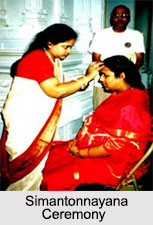
 Simantonnayana is also called as ‘Simanta’ or ‘Simantakarana’ ceremony which is performed after the fourth month of pregnancy on the day of moonlight. It is performed in the last trimester of pregnancy to wish for the secure delivery and is similar to a baby shower. It is the third ‘Samskaras’ of the embryo in a pregnant lady in Hindus. This should be done only when moon is connected with the stars, which have masculine names like ‘Punarvasu’, ‘Pushya’, ‘Anuradha’, ‘Mula’, ‘Shravana’, ‘Ashwini’ and ‘Mrighshira’. Simantonnayana literally means "parting the hair upwards". The importance of the ceremony is to wish a healthy development of the baby and a secure delivery to the mother. Simantonnayana is also called as ‘Simanta’ or ‘Simantakarana’ ceremony which is performed after the fourth month of pregnancy on the day of moonlight. It is performed in the last trimester of pregnancy to wish for the secure delivery and is similar to a baby shower. It is the third ‘Samskaras’ of the embryo in a pregnant lady in Hindus. This should be done only when moon is connected with the stars, which have masculine names like ‘Punarvasu’, ‘Pushya’, ‘Anuradha’, ‘Mula’, ‘Shravana’, ‘Ashwini’ and ‘Mrighshira’. Simantonnayana literally means "parting the hair upwards". The importance of the ceremony is to wish a healthy development of the baby and a secure delivery to the mother.
Myths of Simantonnayana The reason behind Simantonnayana ritual is partly practical and partly superstitious. It is believed that a pregnant woman is the target of evil spirits and hence some rites are performed to get rid of them. The ‘Asvalayana Smriti’ preserved this belief. According to this, demons come to the pregnant woman during the first pregnancy to consume the foetus. So, the husband of the pregnant woman prays to the goddess ‘Sri’ to protect his lady. The main aim of Simantonnayana ritual is to bring affluence and peace to the mother and the child in her womb by reciting the verses. Another important and practical reason of performing Simantonnayana is that from the fifth month of pregnancy, the formation of mind of the foetus starts. Since that time the mother needs to avoid any physical shock to the foetus. So the woman is kept in good mood and the husband himself parts and dresses her hair. Then the pregnant lady is addressed as ‘Raka’ or ‘full moon light’ or ‘Supesa’. Aryans race still wishes for heroic sons during the Simantonnayana ritual by reciting the above stanza they try to create a heroic atmosphere and influence the child in the mother's womb. Rituals of Simantonnayana In Hinduism, Simantonnayana ceremony is performed for the better health and long life of the mother and for the fortification of the unborn child. The ancient texts are of the view that the ceremony can be held anytime from the fourth month to the eighth month. The time of Simantonnayana ritual is decided by the "Grhyasutras" and the astrological works. If the ritual is performed after the birth of the child then it is considered to be a fake one. The opinion varies whether the ceremony is needed in every pregnancy or it is only for the first pregnancy. On the day of the ceremony, the mother needs to fast and it is performed under the male constellation. It is started with "Matrupuja", then "Nandisraddha" and offering to ‘Prajapati’. Then the mother is seated on a soft chair on the western side of the fire. The husband then parts the hair of the wife towards upward direction, beginning from the front, with a bunch of an even number of green ‘Udumbara’ fruits; three bunches of ‘Durba’ grass, a porcupine’s quill that had three white spots, a stick of the ‘Viratara’ wood and with a full spindle. This has to be performed along with the recitation of the mantra "Bhur Bhuvah Swah", or with each of the three ‘Mahavyahrtis’. In later years, one more practice started during the Simantonnayana, in which a red mark on the person of the wife is given to frighten the demons. The husband ties the ‘Udumbara’ branch around the neck of his wife with a string of three twisted threads. This is done along with the recital "Rich in sap is this tree; like the tree rich in sap, be thou fruitful". The next step of the Simantonnayana is the husband asks the wife to look at the rice, sesame and ghee and to see into it the cattle for prosperity and long life. According to some authorities, few Brahmin ladies sit beside the pregnant mother and utter, "Be mother of heroic sons, be mother of living sons". After this the husband asks the two lute players, "Sing the King, or if anybody else is still more valiant". The ceremony ends by a feast of Brahmins. The mother remains silent till the stars appear in the sky. After that, she touches a calf, an act indicative of a male issue, then utters the ‘Vyahrtis’, ‘Bhur Bhuvah Swah’ and the lady breaks her silence. The Simantonnayana ritual continues by giving the full respect and entertainment to the participants of the ceremony. The ladies should see off the ladies and the gents should see the gents off as the ceremony ends. The ceremony varies from community to community. |
| ||||||||||||||||||||||||||||

