


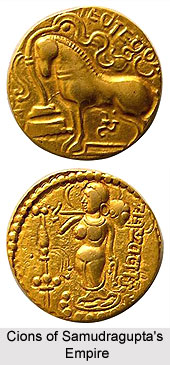
 During the reign of the later Kushanas, when they had become unable to maintain the administration of such a vast kingdom, the political condition of North India was pretty anarchical. The vast Kushana Empire was disintegrated into several small provinces and the provincial chiefs unfurled the flag of independence. Among these independent states, some were autonomous tribal republics and the others, monarchical. When Samudragupta set out on his military campaign, these small provincial states offered him resistance. But they were however defeated and subjugated by him. During the reign of the later Kushanas, when they had become unable to maintain the administration of such a vast kingdom, the political condition of North India was pretty anarchical. The vast Kushana Empire was disintegrated into several small provinces and the provincial chiefs unfurled the flag of independence. Among these independent states, some were autonomous tribal republics and the others, monarchical. When Samudragupta set out on his military campaign, these small provincial states offered him resistance. But they were however defeated and subjugated by him.
The principal source of information about the ascension and reign of Samudragupta is the Allahabad Prasasti, composed by his court poet Harishena. Information about the local kings are also available from Allahabad Prasasti. The coins and inscriptions of these local kings also throw much light on the condition of northern India and the part played by the local kings before the ascension of Samudragupta to the throne of the Gupta Dynasty. In Uttar Pradesh and Central India there were four kingdoms standing as rivals to Samudragupta. They were- king Achyuta of Ahichchatra, Nagasena of Mathura, Ganapati Naga of Padmavati and a king of the Kota family (the name of the king is not known), who formed a formidable resistance against the powerful Gupta emperor Samudragupta. The Nagas had risen from the ruins of the Kushana Dynasty. Due to Saiva leanings of the founder king Bhavanaga, the Naga family was called Bharasivas. According to Dr. Jaiswal, the Guptas were originally feudatories of the Bharasivas. But scholars discarded the view. However these Nagas had formed a strong kingdom of their own. Henceforth Samudragupta had to fight against them to extend his Empire. Among these four kings Nagasena of Mathura and Ganapati Naga of Padmavati both belonged to the Naga clan. The Kota king ruled in Sravasti region of U.P. As historical records suggest, during that time the entire region of U.P and Central India was under the dominance of the Naga kings. However Samudragupta managed to defeat such a formidable opposition fabricated by the Naga rulers. In Allahabad Prasasti the names of six kings who were defeated by Samudragupta is mentioned. They were Rudradeva, Matila, Nagadatta, Chandravarmana, Nandin and Balavarmana. Rudradeva is often identified with Rudradeva I of Vakataka or Western Deccan, Matila ruled in Western Uttar Pradesh, Nagadatta, Nandin and Balavarmana were the Naga descendants, who ruled in central India. Though Chandravarmana has been variously identified, it is generally believed that he was the ruler of the Bankura district in West Bengal. These small provincial kings were at continuous war against one another and the entire northern India was disintegrated and extremely chaotic. Samudragupta had to defeat these independent kings before expanding the limits of the Gupta Empire in those regions. 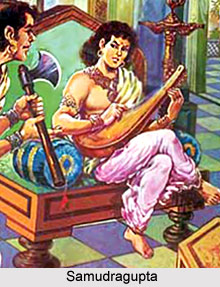 Samudragupta had also led his military conquest in several other fragmented parts, which was occupied by some tribal communities and forest kings. Among these regions mention may be made of the Atavika kings or the forest kings, who ruled in the forest tracts, extending from the Ghazipore district of Uttar Pradesh to Jabbalpore in Central Province. Outside Uttar Pradesh, Bengal and Central India, there were four Pratyanta Rashtras or frontier kingdoms. Three of them i.e. Samatata or South East Bengal, Davaka or part of Assam and Kamrup or upper Assam, were included in the territory of Samudragupta. Apart from these, Allahabad Prasasti also refers to some non-monarchic tribes, who lived in the west and the southwestern fringes of Aryavarta or the proper northern India. Samudragupta crushed these tribes and earned reverence from them. Apart from these tribes, the other tribes who held small kingdoms of their own were also defeated by the mighty conqueror Samudragupta. These were the Malavas, Arjunayas, Yaudheyas, and Madrakas. Samudragupta had also led his military conquest in several other fragmented parts, which was occupied by some tribal communities and forest kings. Among these regions mention may be made of the Atavika kings or the forest kings, who ruled in the forest tracts, extending from the Ghazipore district of Uttar Pradesh to Jabbalpore in Central Province. Outside Uttar Pradesh, Bengal and Central India, there were four Pratyanta Rashtras or frontier kingdoms. Three of them i.e. Samatata or South East Bengal, Davaka or part of Assam and Kamrup or upper Assam, were included in the territory of Samudragupta. Apart from these, Allahabad Prasasti also refers to some non-monarchic tribes, who lived in the west and the southwestern fringes of Aryavarta or the proper northern India. Samudragupta crushed these tribes and earned reverence from them. Apart from these tribes, the other tribes who held small kingdoms of their own were also defeated by the mighty conqueror Samudragupta. These were the Malavas, Arjunayas, Yaudheyas, and Madrakas.
Thus the Allahabad Pillar inscription of Harishena, depicted a vivid picture of Punjab, Rajputana and parts of Central India, which was divided into several tribal republics. However it has been pointed out by historians that though Chandragupta I was powerful enough, the actual political unification of Gupta Empire was fulfilled by Samudragupta. The Kushana kings ruled an independent suzerain outside the core of Northern India, further in the northwest. Thus northern India was divided into petty political units on the eve of Samudragupta's conquest. Samudragupta competently had solidified the Gupta Empire with his conquest, the base of which was established by the third Gupta ruler, Chandragupta I. |
| |||



Home > Reference > History of India > Gupta Empire > Gupta Emperors of India > Samudragupta > Political Condition of North India before Samudragupta
Political Condition of North India before Samudragupta`s Rise
| Samudragupta was successful in establishing a gigantic empire through his prowess, subjugating the inconsequential local |
| ||||||||||||||||||||||||||||

