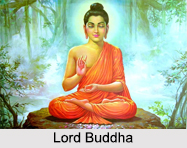
 The Madhyamika philosophy, an ancient system can be described to the original teaching of Buddha, based on the teaching of "emptiness". The term "Madhyamika" connotes the school of Buddhism, which was initiated in India in the second century A.D and continued till the eleventh century A.D. Mahayana Buddhism played the role of the influential source for the Madhyamika school of thought. The ethical teaching of Buddha is referred to as the Middle Way or `madhyama`. The teachings of Buddha repudiate the two extremes of an exaggerated asceticism and an easy secular life. In metaphysics he condemned all extreme positions that expound the existence of everything. The Philosophy of Madhyamika tries to advocate the mean between extreme affirmation and extreme negation.
Middle Path in Buddhism refers to neutrality and unbiased attitude in a human being. The origin of the theory lies in the older religions like Hinduism. The latter also propagated nirvana. But there were lot of unanswered questions regarding nirvana. It was Gautama Buddha who answered the need to free oneself from the cycle of rebirth and the way to do it. These wise teachings are referred to as the Middle Path in Buddhism. The Middle Path enabled Buddha to distinguish his religion from the religions.
The word middle is used in the sense of centered and upright. It professes that it is essential for the human beings to judge a particular situation or life neutrally. To derive a logical answer for a problem it requires thorough investigation, analyzing ability and comprehension of the truth. Objectivity is the main principle of this theory. The Middle Path in Buddhism deals with the relationship between thoughts, actions and their consequences. Hence it includes personal problems, environment and society. Hence Buddha developed two principles of human behaviour- Eightfold Path and Middle Path of Dependent Origination. These two would help an individual to uplift himself.
However, on a broader aspect the Middle Path in Buddhism is seen as a path of non-extremism. According to Theravada School of Buddhism the middle way leads one to nirvana by following the ways of morality and wisdom. So an individual can attain nirvana if he moves away from self-degradation and sensual indulgence. In the Pali canon the Middle Path is uttered by Buddha himself. By saying this he refers to the Noble Eight Fold Path. This can be found in the first discourse called the Dhammachakra pravattana Sutta. To attain nirvana it is necessary to follow the right actions. These actions are described by Buddha himself.
One of the interesting facets of the Middle Path in Buddhism is the theory of Dependent Origination. Opposing the two extremities of eternalism and annihilationism, Buddha formulates a new path which states that there is no permanent self and no self destruction. It denounces the concept of soul. According to Buddhism self is the cause of all suffering and it arises out of ignorance. Instead it propagates the theory that there is only an endless arising and cessation of experiences.
Nagarjuna, a much-revered monk of Buddhist religion was the patron of the Madhyamika school Of thought. Nagarjuna`s conception about the world was that the world is a veil of "maya". His philosophy remains indifferent from the Advaitic interpretation of the Upanishad view. Though Nagarjuna got his inspiration from Upanishad but his philosophy is entirely related to the Buddhistic concept.
Nagarjuna criticized the concept of essence or "self-nature" ( svabhava ) as self-contradictory. He holds the view that nothing self-existent can be subject to change. He opined the "nirvana" and the "samsara" which is the bondage in birth and death, as identical. According to his belief, the truths are of two separate levels and those are the absolute and the conventional.