


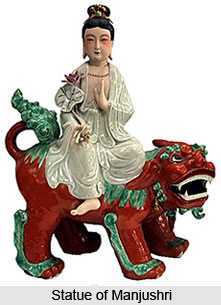
 Manjushri literally means highly auspicious. One of the bodhisattvas of compassion Manjushri is more popular with Tibetan Buddhists. He is looked upon as the Buddha Resplendent who is also similar to a glorious sun. In Tibet the name, Manjushri, means a kind friend. He also represents the Kadampa denomination that is well known for its scholars. Manjushri literally means highly auspicious. One of the bodhisattvas of compassion Manjushri is more popular with Tibetan Buddhists. He is looked upon as the Buddha Resplendent who is also similar to a glorious sun. In Tibet the name, Manjushri, means a kind friend. He also represents the Kadampa denomination that is well known for its scholars.
Manjushri is considered an extension of Vairochana too. He is the ancient white Buddha who is similar to the sun as he is all pervading. As a bodhisattva he is instrumental in preaching the notions of emptiness (sunyata), true nature of the self and how to liberate one's spirit. According to legends when Manjushri decided to leave the temporal world in a youthful state he actually was to invite queries regarding the true nature of the self from the laymen. As he is associated with these two attributes the religious iconography represents him holding a double-edged sword in his left hand. The sword stands for logic and right thinking. In his right hand he is seen holding the Buddhist religious text, Prajnaparamita Sutra, comprising the doctrine of emptiness. The bodhisattva is either seen seated on a lion or an elephant. These two creatures are associated with a fully enlightened Buddha. Although he is 16 years of age his wisdom is paramount. Through Manjushri's image, Buddhism represents the concept that age and maturity have nothing to do with wisdom. The sutras describe Manjushri dwelling in the Pure land. His compassionate nature lies in the fact that he will lead followers to the path of enlightenment. Manjushri is not concerned only about his upliftment. |
| |||



Home > Society > Indian Religion > Types of Religion in India > Buddhism > BoBodhisattvas - Hindu Philosophy > Manjushri
Manjushri
| Manjushri is one of those bodhisattvas who preach the concept of emptiness. |
| ||||||||||||||||||||||||||||

