Lohan, Buddhism - Informative & researched article on Lohan, Buddhism
  Indianetzone: Largest Free Encyclopedia of India with thousand of articles Indian Religion


in  
Art & Culture | Entertainment | Health | Reference | Sports | Society | Travel
Forum  | RSS Feeds  | Free E-magazine
Indian Religion : Vastu Shastra l Indian Religions l Indian Myths l Indian Mythology l Gods of India l Goddesses Of India l Religious Thinkers of India l Types of Religion in India l History of Indian Religion l Indian Yogis l Ajivikas l Sacred Scriptures in Indian Religion l Tantra l Shaivism l Indian Communities l Sacred Animals in India l Roman Impact on South Indian Art and Society l Bhattacharyas l Indian Classical Terms
Home > Society > Indian Religion > Types of Religion in India > Buddhism > Lohan
Lohan, Buddhism
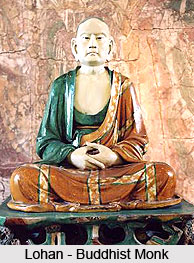
Lohan is the Chinese word for Arahant and in Chinese tradition Lohans have been represented mostly through portraits.

Lohan is the Chinese arahant. According to Theravada Buddhism a Lohan is one who follows the Noble Eight fold Path and has been successful in breaking away from the clutches of worldly pain and suffering. He is also liberated from the cycle of rebirth and karma. In China, Lohans are famous for their supernatural power, insight and bravery. They are also bestowed with the power to fight against evil powers. As a result they are considered the guardian angels of the Buddhist shrines.

In Chinese Buddhist temples ,one would come across the Lohans standing in the main hall as protectors. It is said that there were initially 16 Lohans and around 500 lesser Lohans. Though there were originally 16 of them two were added during the Tang Dynasty. Hence today one will find 18 Lohan figures.

According to legends this portrait was painted in 891 AD by Guan Xiu, a Buddhist monk. The monk is said to be proficient in painting, poetry and calligraphy. Due to his expertise the Lohans chose him to draw this portrait. They appeared in his dream and entreated him to do the job.

There are several orders to which the Lohans belong. The order has been decided in accordance with which they are represented in the portrait. These orders are-Raised pagoda, Deer Sitting, Taming Tiger, Happy, Calico Bag, Elephant Riding, Raised Bowl, Meditating, Laughing Lion, Oversea, Open Heart, Doorman, Scratched Ear, Raised Hand, Plantain, Taming Dragon, Thinking and Long Eyebrow.

Such portraits, however, differ from dynasty to dynasty.
(Last Updated on : 7/04/2009)
  More on Buddhism...
 
Schools of Buddhism Noble Eight Fold Path , Buddhism Buddhist Councils, Buddhism
Tripitaka, Buddhist Scripture Avalokitesvara, Buddhism Four Noble Truths
Abhidharma Dukkha Suchness
The Five Precepts of Buddhism Ambapali Mahayana Buddhism
Bodhisattvas Buddhist Literature Buddhism in India
Wheel of Dharma Dependent Origination Buddhist Pilgrimage Centers
Tantrik Buddhism Wheel of Life Akanithaka
Appamanabha Appamana Subha Awiha
Bodhi-Sattwa Rebirth in Buddhism Sravaka
Lohan Nagarjuna Maitreya
Jataka Sotapanna Triple Gems in Buddhism
Angulimala Brahma Sahampati Middle Path
Dagoba Mara Mudita
Dasa Dandu Dasasil Punya
Rahula Sakwala Samanera
Sangha Sardhawa Dinachariyawa
Sangha Hinayana Dharma in Buddhism
Decline Of Buddhism In India Brahma Nirvana  
Recently Updated Articles in Indian Religion
  • Dhammapada
    Dhammapada, the core of Buddhist teaching in Pali language, is considered the gospel of Buddhism even today
  •  
  • Brahma Nirvana
    Brahma Nirvana is the ultimate communion with the eternal Reality of life that is the Brahma.
  •  
  • Ahmadiyya Sect,
    Ahmadiyya Sect is an Islamic sect founded in India by Mirza Ghulam Ahmad of Qadian.
  •  
  • Arahant
    Arhant according to the philosophy of Dhammapada is an individual who has attained the highest degree.
  •  
E-mail this Article | Post a Comment
Free E-magazine
Subscribe to Free
E-Magazine on Indian Religion

 
Lohan, Buddhism - Informative & researched article on Lohan, Buddhism
Sitemap
Contact Us   |   RSS Feeds
Copyright © 2008 Jupiter Infomedia Pvt. Ltd. All rights reserved including the right to reproduce the contents in whole or in part in any form or medium without the express written permission of Jupiter Infomedia Pvt. Ltd.