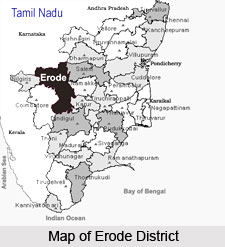
Situated on the north bank of the river Noyyal, a tributary of the famous river Kaveri, 20 km west of the iron-rich hill of Chennimalai, Kodumanal village is one of the most important archaeological sites of South India. Pattitrupattu, a Tamil book of the Sangam age (300 B.C. to 300 A.D.), refers to the village as Kodumanam. Located in a semi-arid zone, the village is almost at the mid-point of a major Roman trade route linking the port of Muziris on the Malabar Coast with the port of Kaveripattinam on the Coromandel Coast.
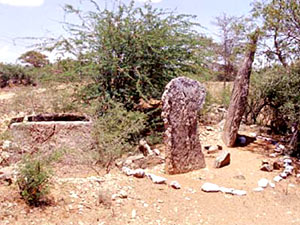 The Kodumanal village has repeatedly attracted many archaeologists. Much of the excavations took place in an area full of stone burials (megalithic burials), over two thousand years old. One such excavated burial has been carefully preserved for the tourists to see.
The village has yielded several ancient iron objects such as swords and arrow heads. The other finds from the site include roulette pottery, Roman silver coins and gold and silver spirals. During the Roman times (300 B.C. to 300 A.D.), Kodumanal was a thriving bead-production centre. The beads were made out of precious and semi-precious stones such as beryl, carnelian, lapis-lazuli, quartz and sapphire. Beryl was obtained from a not-too-far village called Padiyur, referred as Pounatta by Ptolemy. Sapphire was obtained from another neighbouring place called Sivanmalai. Quartz was procured from a place called Vengamedu (meaning `quartz mound`), again not far from Kodumanal. Carnelian was imported from Gujarat and lapis-lazuli from Afghanistan.
Most villagers do not know the glorious history and antiquity of the village. A walk from the village-centre to the Noyyal river is a real `heritage walk`- if one is lucky, one could pick up ancient pottery pieces, quartz stones and old stone beads strewn on the riverbank.