


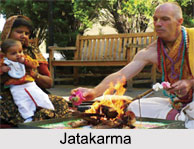
 Jatakarma Ceremony is the birth ritual in Hindu belief. The principle of this ceremony is to welcome the birth of the new child into the world. This ceremony is also considered to arouse the sensory organs in the child. The rituals or actions, which are performed after the child is born, are known as "Jatakarma". These involve lot of actions to install some values in the newborn child although he does not understand their values. Jatakarma Ceremony is the birth ritual in Hindu belief. The principle of this ceremony is to welcome the birth of the new child into the world. This ceremony is also considered to arouse the sensory organs in the child. The rituals or actions, which are performed after the child is born, are known as "Jatakarma". These involve lot of actions to install some values in the newborn child although he does not understand their values.
Etymology of Jatakarma The origin of the ceremony is related to ‘Jatak’, which is the ancient Sanskrit word for a ‘new born child’. Jatakarma is a merged Sanskrit word, with roots of ‘Jata’ and ‘karman’. The word ‘Jata’ literally means ‘born’. The word ‘karman’ literally means ‘action’. The word, Jatakarman, thus means ‘a ritual when one is born’ or ‘a birth ceremony’. Rituals of Jatakarma The original 'Jatakarma' process, which was practiced earlier, has changed a lot now. Some of the rituals are now in trend but they are said to be based on 'Puranas'. As per the "Brihadaranyaka Upanishad", the 'Jatakarma' includes five steps; 1. 'Homa' is performed with curds and clear butter along with mantras. 2. The word 'vak' is whispered in the ear of the child. 3. The child is made to lick from a golden spoon cards, honey and clarified butter. 4. The child is addressed by a secret name. 5. The mother offers her breast milk to the child. Homa- This is performed according to the "Brihadaranyaka Upanishad", Manava grihya sutra and Kataka grihya sutra. Here, 'stutikagni' or Uttapaniya Agni is installed replacing the 'Aupasana fire' and then it is kept near the door of the chamber of the child's birthplace. Madhajanana- In this ritual of 'Jatakarma', the main action is to make the child to lick from a golden spoon honey, curd and clarified butter. Ayushya- This 'Jatakarma' ritual involves the whispering of prescribed mantras over the naval or into the right ear of the child, which raise powers that gives long life to the child. Asvalayana and Bharadvaja advise to perform it during the 'Madhajanana'. Amsabhimarsana- In this ritual of 'Jatakarma', the father touches the shoulders of his child as he chants the prescribed mantras. Matrabhimantrana- In this rite of 'Jatakarma', the mother of the child addresses with the mantras. Pancha-brahmanashthapana- The father needs to breathe thrice over the child while chanting verses from three Vedas. This rite of 'Jatakarma' also includes the breathing of five Brahmans from the east ‘Prana’, ‘Vyana’, ‘Apana’, ‘Udana’ and ‘Samana’ (the names of the five Vayus). Sthana-pratidana- In this rite of 'Jatakarma', the mother offers her breast milk to her child when the father chants mantras. Desabhimantrana- In this rite, the father touches the earth, where the child was born along with the chanting of mantras. Namakarana- This rite of 'Jatakarma' involves giving a name to the child. Again, as per Sankhayana's view, the secret name is given on the day of birth and the common one is given on the tenth day. Uttana- While performing this rite of 'Jatakarma', the father of the child shaves, takes bath, purifies his house and performs 'Jatakagni', a sacrifice to earth through a person belonging to the other gotra. All these are performed on the 10th or 12th day after the childbirth. Celebration of Jatakarma As the father is chanting in Jatakarma, the mother of the child presents him/her breast milk. The father of the child then bends down and touches the mark of earth where the child was born with chanting the mantras. After this, the parents present a name to the new child. The father then bathes, shaves and purifies the house. He then performs ‘Havan’. According to Sushrut, an ancient Ayurvedic textbook, a small amount of ghee is placed on the child's tongue. After then the 'Jatakarma' follows by sprinkling of water on the woman, who has given birth to the child by the concerned persons. These are performed as prescribed in Paraskar Grihya sutra and Ashvalayana, Gobhiliya and Shaunakiya Grihya Sutra. All of the phases before this point are performed on anywhere between the 10th to the 12th day after the child is born. The symbol for Om is drawn on the tongue of the child with the end of the golden spoon; this is so that his words will lead him to holiness. |
| |||



Jatakarma - Hindu Ceremony
| Jatakarma is a Hindu ceremony, which is performed to welcome the newborn baby in this world. It is one of the major ‘Samskaras’ in Hinduism. |
| ||||||||||||||||||||||||||||

