Introduction
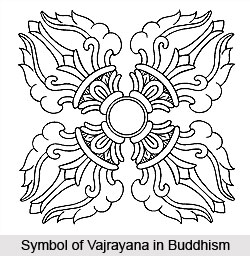 Vajrayana is one of the schools of Buddhism thoughts which was first practiced in India and from here the Vajrayana school of Buddhism spread to Tibet, Bhutan and Mongolia. The Vajrayana school of Buddhism comes from the Mahayana Buddhism. Vajrayana is closely associated with the Theravada schools of Buddhism and Mahayana school of Buddhism, even if there are few differences as far as practice between them is concerned.
Etymology of Vajrayana
Vajrayana is derived from the two words "vajra" and "yana". Vajrayana is also regarded as the third Yana of Buddhism, it is the Sanskrit word which when translated means; "vehicle". This school of Buddhism got its name from Sanskrit word "vajra" which symbolizes the thunderbolt handled by the God of weather and war, Lord Indra. It also loosely translates in order to mean "diamond", symbolizing the unbreakable strength. Thus, the Vajrayana school of Buddhism is also known as the Diamond Vehicle and also the Indestructible Path of Buddhism. It also possesses various other names like True Words Sect, Esoteric Buddhism, Thunderbolt Vehicle, Tantric Buddhism, Secret Mantra and Mantrayana among others.
History of Vajrayana
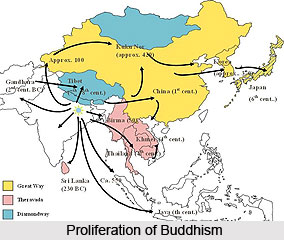 History of Vajrayana is engulfed in ambiguities. Scholars believe that it got its origin from India, while there are several other scholars who opine that Vajrayana has its roots in Bengal. There are still others who are of the view that it originated in Pakistan or South India. As per the Tibetan Buddhism, Buddha himself taught tantra. However, these were secret teachings and they were written much later than his other teachings. The teachings on tantra are known as sutras. The earliest references to these are to be found in a fourth century Buddhist text. The major centre for the development of Vajrayana was the Nalanda University, which till the eleventh century India was the leading the Vajrayana practices. However, by the thirteenth century Vajrayana died out in India. Padmasambhava, an Indian Vajrayana master, travelled to Tibet and Bhutan to take Vajrayana to these countries. After this the Nyingma School was established here. In the eleventh and the twelfth centuries another important diffusion took place with several other forms and gave rise to new schools of Tibetan Buddhism, such as, Sakyapa, Gelukpa, Kagyupa, and Kadampa.
Vajrayana established itself in the seventh century in China and was officially recognized by the Tang Dynasty. Changan or the present day Xian was then an important centre for Buddhist studies as well as for Vajrayana practices. Vajrayana spread to Japan from China. On Emperor Kammu`s initiative monk Kukai went to the Tang Dynasty and learnt all about the tantric studies in Buddhism. He then created his own version and thus the Shingon school of Buddhism was founded. This school exists even today. Countries like Mongolia and the Malay Archipelago were also influenced by Vajrayana. However with the downfall of Yuan Dynasty Vajrayana lost its significance in the Far East countries like China and Mongolia. In the seventeenth century it was revived in Mongolia as the emperor had good relations with Dalai Lama. Vajrayana is still practiced in the Far East countries but as a folk art.
Vajrayana Buddhism is also called Esoteric Buddhism, Tantric Buddhism, Mantrayana, Tantrayana, Secret Mantra and the Diamond Vehicle. The phase of Vajrayana Buddhism has been sorted as the fifth or the final phase of Indian Buddhism. Vajrayana is a multifaceted and a complex system which developed over several centuries and brings out several inconsistencies and an assortment of opinions. Vajrayana likely got its form in the sixth or the seventh century CE, and the very term `Vajrayana` first introduced in the eighth century CE. The scriptures of Vajrayana are known as Tantras. The peculiar feature of Vajrayana Buddhism is ritual, which acts as an alternative or a substitute for the old abstract meditations. The scriptures of Vajrayana tell that Vajrayana relates to one of three paths leading to enlightenment, while the other two paths are Hinayana and Mahayana Buddhism.
Views are also different as far as the history of Vajrayana in Indian sub-continent is concerned. Few believe that Vajrayana had its origin in Bengal, which is presently divided between the Indian Republic and Bangladesh. There are several others who claim that Vajrayana originated in Uddiyana, located by few scholars in the present day Swat Valley, situated in Pakistan, or in the southern parts of India. In the tradition of Tibetan Buddhists, it is believed that the Shakyamuni Buddha taught tantra, since the teachings are secret, was confined to the guru and the disciple relationship, and was written down long after the other teachings of Lord Buddha; the Mahayana sutras and the Pali Canon.
The most former texts came out in the earlier parts of the forth century. The Nalanda University in the eastern parts of India became a favourable destination for the growth and development of Vajrayana theory, though it is probable that the university followed the early Tantric movement. Vajrayana Buddhism almost died out in India in the thirteenth century and tantric religions of Hinduism and Buddhism were also getting pressure from the intruding Islamic armies. By that period, a large segment of the practices were there in Tibet, where they were upheld till date.
During the later half of twentieth century, a substantial quantity of Tibetan exiles took flight from the anti-religious, oppressive rule of the Communist rulers of China in order to found Tibetan Buddhist communities in India`s northern part, mainly around Dharamsala. These Tibetan Buddhists settled in and around Dharamsala remained in India and all over the world the major practitioners of Tantric Buddhism.
The oldest king of Sambalpur in the Indian state of Orissa was Indrabhuti who founded Vajrayana and his sister founded Sahajayana. His sister was the wife of Yuvaraja Jalendra of Lankapuri or Suvarnapur. Thus, Buddhism`s new tantric cults introduced Mudra, Mantra and Mandala together with a list of six tantric Abhicharas or practices like; Stambhana, Marana, Sammohana, Uchchatana Vidvesan and Vajikarana. Tantric Buddhist sects worked hard to uplift the self-respect of the lowest of the society to a much higher platform. It re-energized the old practices and beliefs, a less formal and simpler approach to the personal god, a respectful and liberal attitude to women, and the rejection of caste system.
Starting from the seventh century A.D., a number of famous religious elements of mixed nature were integrated into Mahayana Buddhism which ultimately resulted in the inception of Vajrayana, Sahajayana and Kalachakrayana tantric Buddhism. Tantric Buddhism had its origin in Uddiyana, a country divided into two kingdoms called Lankapuri and Sambhala. Sambhala is identified with Sambalpur and Lankapuri is identified with Suvarnapura or Sonepur. Several renowned Vajrayana Acharyas like Hadipa, Tantipa, Sarah, Heruka, Dombi and Luipa were from the supposed lower classes. The cult exercised a significant influence over the oppressed classes of Sambalpur-Bolangir region. In the ninth and the tenth century A.D. there came into existence seven renowned Tantric maidens at Patna or Patnagarh region then known as Kuanri-Patana. These renowned maidens are famously called Satvaheni or Seven sisters. They were from the lower castes of society and followed Lakshminkara. Due to their providential feats and power, were later deified and prayed by the folk people.
Significance Of Vajrayana
 Vajrayana is a deep-rooted Buddhist phenomenon, dating right back to the Abhidharmika and Mahayana systems if philosophy. The Significance of the Vajrayana school of Buddhism emerges on a closer analysis of its various fundamental beliefs. In order to be properly practised, a clear understanding of the insights in Mahayana Buddhism as well as the Vaibhasika and Sautranika doctrines is absolutely essential.
The practice of Vajrayana is a much-debated topic, with two extreme view-points arguing the subject. Though Vajrayanic insights may be tolerable or even acceptable to many, its praxis is judged irrelevant and impractical in today`s world. The sadhana, involving the panca makaras is condemned as repugnant and repulsive. The injunctions prescribed by the Tantras are said to be immoral and wild. The way of life prescribed for the yogi in the tantric texts may be culturally and religiously alien to the modern world. Hence the question of the relevance of Vajrayana remains and unanswered question.
However, keeping in mind present sensibilities, it may be said that the practice of Vajrayana cannot be cut and pasted on to the modern man in its ancient garb; his sense and sensibility needs to be taken into account. Some of the practices may be outdated and offensive and impractical for practice in the modern era. However, Vajrayanic practice in its broadest outlines may be relevant for man even today. The mantric and yogic practices such as breath control, the meditation employing the visualisation techniques and the imaginative thinking with the aid of a mandala, can prove beneficial to the psycho-spiritual growth of the modern man. Finally, the practice is meant only as means for the realisation of the Vajrayanic vision and experience of reality and so the former is subservient to the latter. While the Vajrayanic insights into reality are relevant for modern man, he should perhaps strive to refine the ancient tantric practices, keeping in mind the time and tenor of modern society.
The significance of Vajrayana is thus immense. It makes man aware that the possibilities of liberation are contained within him. Furthermore, it chalks out a path that activates them and achieves the goal. In this sense, Vajrayana serves as a help and not a hindrance. The terrain of Vajrayana may be a difficult one to traverse, nevertheless, the journey proves to be a most fruitful. The significance of Vajrayana lies in that it has the potential to furnish us with a new vision of Man, a deeper understanding of metaphysics and rich insights into religion.
Philosophy of Vajrayana
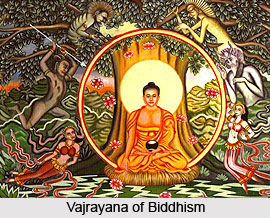 The philosophy of Vajrayana has emerged out of a fusion of mahayanic and Tantric elements. At first glance, the mahayanic concepts appear to be full of Mahayanic terms and concepts, obscure cults, tantric mandalas etc. which have been described in cryptic language. However, a closer inspection of the same reveals the building blocks of metaphysics beneath the surface of these texts. When pieced together, they form the basis of the philosophy of Vajrayana school of Buddhism. Though it does not have the sophistication and conceptual precision typical of Buddhism, nevertheless certain basic elements may be detected in the philosophy of Vajrayana.
Nature of Existence
The first step in the Vajrayanic investigation of reality is the comprehension of existence in its realistic and pluralistic appearance. The Abhidharmika delineation of dharmas into skandhas, ayatnas and dhatus is taken for granted here. The Madhyamika view that the Dharmas are sunya since they arise out of Dependant Origination is also accepted by the Vajrayana School. Though the Dharmas have no nature of their own, they appear in empirical experience. This, according to the Vajrayanists is because these dharmas are projected by the mind. It is essentially consciousness seen as an `other`. As long as the mind continues to act, the empirical reality is sustained; but ultimately the mind also ceases and consciousness alone exists as non-dual bliss. With the negation of the object, the subject function of consciousness also lapses and consciousness regains its intrinsic quiescence.
What is new about the Vajrayanic conception of Dharma is that they perceive a kind of homologous correspondence among them. They are not just seen as mere concepts, but as deities. These deities are seen as inhabiting the body of the principal deity as well as the internal mandala, the body of the sadhaka. In this way, each of the dharmas is visualised and experienced within the sadhaka during the meditative process of visualisation. The nishvabhavata of the dharmas is believed to be realized by the saddhaka during the process of visualisation.
Nature of Avidya
Empirical reality as it appears is actually the mental modification of consciousness. This is brought about by avidya. The two forms of avidya- jneyavarana and klesavarana- are believed to influence the mind and give expression to its creativity. Jneyavarana brings about a multiplicity of views (drstis) about the Real and thereby prevents from acquiring the knowledge about the real nature of Ultimate Reality. The other form of avidya, klesavarana, is responsible for the emotional responses to the empirical reality, which afflict the human mind.
Both Jneyavarana and klesavarana together create a sort of web of illusions about empirical reality. This is a complete process with views and categories and psychic responses. The removal of all these misconceptions and avarnas can be brought about by knowing the real nature of empirical existence in the Vajrayanic way. It is believed that once the nature of the world is known, the false views about it (Jneyavarana), and the accompanying inordinate mental afflictions (klesavarana), which prevent the saddhaka from attaining his goal will disappear.
Ultimate Reality as Vajra
The realisation of ultimate reality as the essence is Vajra, achieved through the removal of avidya. Though similar to the concept of sunyata of the Madhyamika and the vijnana of the yogacara, the concept of vajra is not synonymous with the two. Vajra, is the sunyata of dharmas {dharmasunyata), but not the sunyata of views (drsti-sunyata), as spoken of in Madhyamika. It is the absence of knower-knowledge duality (grahya-grahakabhava) as in Yogacara. The difference between the sunyata of the madhyamika and the vajra is that while the former is an epistemic entity, the latter is an ontological one. It is a firm essence (drdham saram). It agrees with Yogacara that the Ultimate Reality is non-dual consciousness but goes further to state that it is the Innate (sahaja) and is of the nature of Great Bliss (mahasukha). The idea of vajra encompasses a more extensive than that of sunyata, as vajra signifies a fusion of both sunyata and karuna and therefore signifies both.
Ultimate Reality as Bi-polar
Another philosophical foundation of Vajrayana is that it conceives of the Absolute as bi-polar. These two polarities are formed by sunyata and karuna, the two fundamental principles of Mahayana Buddhism. This polarity should not be mistaken as duality. The polarity referred to here is the inherent and inseparable condition of the absolute. The Vajrayanists hold that the empirical reality reflects this essential bi-polarity of the Absolute, in the form of the female and the male. It is believed that every individual in the psycho-physical realm is endowed with this polarity- one as female and the other as male.
Yoga: Union of Polarities
The goal of Vajrayana lies in the recognition and eventual union of the polarities within the body. The yogi is helped to identify himself as the male polarity and view the yoginis as the female polarity, and through their physical union, following the Vajrayanic prescription and the Guru`s instructions, attains psychic reintegration.
The yogi may perform this process of reintegration and union, purely as an internal process using the visualisation techniques prescribed by the Vajrayanic texts, under the guidance of a competent Guru. In the process of internal union, he visualises the two nadis, lalana and rasana, as the female and the male principles, and the central nadi, avadhuti, as the union of the two.
Nature of the Absolute as Bliss
Mahasukha or great bliss is provided by the state of re-integration. This great bliss is said to be beyond the realm of concepts. The Absolute is not something perceived as transcendent and sterile, as the sunyata of the Madhyamika, or only as the underlying non-dual consciousness of the yogacara. For the Vajrayanist too, the Absolute is inexpressible in terms of empirical categories, yet not altogether beyond human experience. In terms of expression the Absolute is sunya, but in terms of experience, it is Great Bliss. However, in this experience there is no subject-object duality.
These are therefore some of the basic tenets underlying the tenets of vajrayana. It is on the roots of these philosophical assumptions that the entire body of work of the vajrayana rests.