


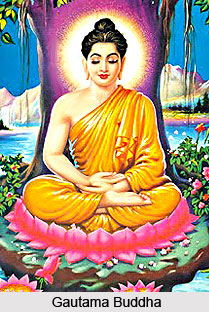
 The philosophy of the dependent origination or Pratityasamutpada is a profound doctrine that was formulated by Gautama Buddha himself. The basic principle of this doctrine is that the existence of every living being is mutually interdependent. It is this complex net of cause and effect that binds the existence of the living beings. After receiving enlightenment, Buddha realized the truth of dependent origination. According to him, thus, the existence of one living being is closely dependent on the survival of another living being. He viewed it as a spider's web or Indra's (Hindu deity) net. However this web is beautiful as there are many jewels attached to it. The philosophy of the dependent origination or Pratityasamutpada is a profound doctrine that was formulated by Gautama Buddha himself. The basic principle of this doctrine is that the existence of every living being is mutually interdependent. It is this complex net of cause and effect that binds the existence of the living beings. After receiving enlightenment, Buddha realized the truth of dependent origination. According to him, thus, the existence of one living being is closely dependent on the survival of another living being. He viewed it as a spider's web or Indra's (Hindu deity) net. However this web is beautiful as there are many jewels attached to it.
Buddhism considers it essential for the human race to comprehend the idea that their survival is completely dependent on other living beings. Whatever happens in the world or the universe will definitely affect it. Similarly the actions of the humans will also have a similar impact on the world. Hence there is a cause and effect relation between the existences of the beings. This Buddhist philosophy has a scientific approach as well. Science professes that the man is responsible for the environment and vice versa. It is necessary to perform the right actions so that the balance in Nature is not disturbed. Buddha, of course depicts this concept on a larger aspect and philosophically. Buddhism proclaims that due to the dependent origination there is no independent entity on earth. Hence the concept of anicca and anatta arises. Anicca says that everything in the temporal world is subject to change and as a result it is useless to think about self or soul. These will also decompose and be annihilated with the passage of time. Hence what dominates the earth is sunya or nothingness. Wise beings, thus, will rise above petty attachments or renounce the world. This is the ultimate Truth that every being sooner or later has to realize. Buddha found two ways to apply the concept of dependent origination. One was the Four Noble Truths and the other was the Twelve Nidanas. The Four Noble Truths will lead one to the Eight fold Paths, which will be instrumental in achieving arahantship and nirvana. Twelve Nidanas is the conditional existence that propagates the theory of that the three stages of life of a being (past, present and future) are dependent on each other. One's actions will decide the fate of the next stage of his life. The postulates of birth and death are based n dependent origination. Without birth there can be no death. So what living beings view as life is again conditioned by attachments and wealth. Buddha realized that the craving in humans is related to senses and to free oneself from this web of dependent origination it was vital to conquer the senses. It was necessary to overcome this psychophysical phenomenon for a dukkha free life. Dependent origination in Buddhism, thus, became a primary pillar on which some of the most important Buddhist doctrines were based. |
| |||



Dependent Origination
| Dependent Origination has evolved from the Middle Path in Buddhism. |
| ||||||||||||||||||||||||||||

