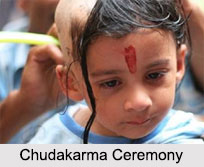
 Chudakarma is the ceremony of a child`s head shaving for the first time, where a tuft of hair is left on the crown. While shaving, the tuft is left remaining because it is believed that an important artery passes through this part of the head and shaving here may prove to be fatal. In the northern India, this ceremony is also known as `Mundan`. It is one of the most important and most necessary rituals to be followed. It is performed on the child when the child completes a year.
Etymology of Chudakarma
Chudakarama is derived from a Sanskrit word for "Mundan" and is ideally known as the first hair-cut for the baby. "Chuda" means the tuft of hair, which is left. The meaning of Chudakarama is arranging the hair tuft.
Rituals of Chudakarma
Chudakarma begins with the performances of "Samanya Prakarna". In Chudakarama rituals, the child should not be older than 3 years of age for the "Mundan". For this ritual, the entire hair is shaved, leaving only the "Chuda" or the "Shikha". "Shikha" is considered as the crown of the head. In Hinduism, Chudakarana is a measure that is implemented to get relieve or to reduce the impact of those unwanted traits from the past life. When the ritual is done, the child is made to move into the future life or the present life from the past. It is generally done on the Ganges and particularly in places like Rishikesh and Haridwar. However, today, a lot of families have a tendency to do this ritual in their own houses by calling a "pandit". This ceremony is done in spite of of the gender. When the ritual is performed on the child, "pandit" recites Vedic Mantras and prayers. After the ceremony, the child`s hair is presented to the holy waters of the Ganges.
According to the "Ashvalayana Grihyasutra", "Paraskara Grihyasutra" and "Gobhiliya Grihyasutra", Chudakarma has to be performed in the full-moon fortnight in north solstice. Father shares the responsibility of bringing up the child and educating. After shaving, hair is then put on in the bull dung. A barber specially invited for this occasion then cuts the rest of the hair. He applies lukewarm water first on the head and continues with utmost care. When the shaving is complete, the father gives the barber whatever is laying near the `yajnakunda` and the four cereal filled earthen dishes. The barber gets some money also.
Depending on the family ancestry the numbers of tufts are left. As per `Sushruta`, there is an artery at the crown, where the tuft is left. This artery joins a critical nerve juncture and any injury on that part can lead to be a very fatal condition. So to avoid any such situation, the hair of that part is not shaved. Chudakarma has some relation with physical hygiene also. It is believed that, this ritual cleanses the body and soul. The hair grown in the womb of the mother is supposed to be impure and so it is cut and removed. On completion of the shaving, the father applies some curd and butter in the child`s head and after the bathe dresses him with new clothes.
Celebration of Chudakarma
Brahmins, relatives and friends are invited for the Chudakarma ceremony. Then four earthen pots, one full of rice, the second full of barley, third one full of small Black Beans. Then water is sprinkled on the four side of the "Vedi" with mantras. Now, the fire of the "Kunda" is ablaze by `Agnyadhana` and `Samidhadhana`. The mother with her child sits along the western side of the fire, while the father stands in their right. But if the mother is pregnant or menstruating on that day, the Chudakarma is postponed. In the case of pregnancy, it can be performed before the fifth month. Otherwise the fatigue of sitting long time holding the child on her lap may disturb her unborn child.
The father needs to give offerings to the fire and pours warm water into a cold water glass, which symbolizes the presence of Lord `Vayu` and goddess `Aditi`. The next step of Chudakarma is to offer 16 oblations to the "Vedi", which includes four "Agharavajyabhagahuti", four "Vyahriti Ahutis", and eight oblations of ghee with the eight mantras as described in the `Samanya prakarana`. Some butter or ghee is applied on the right side of the child`s head and then three stalks of `kusha grass` are inserted into the child`s hair. It is believed that the grass protects the child from any injury during the process of shaving.
Chudakarma is continuing from the Vedic period and it is apparent from the Vedic mantras, which are recited during the ritual. Now, the guests, who are invited in the Chudakarma, will present gifts to the child. The ceremony of Chudakarma will then conclude with a feast. The "Grihyasutras" give prospect of Chudakarma for the girl child also. But this is performed without the recitation of Vedic mantras. It is believed that the Chudakarma cannot be done at an even-numbered age of the child like at two or four year`s age. It is thought that even numbers are not that auspicious like the odd numbers.