


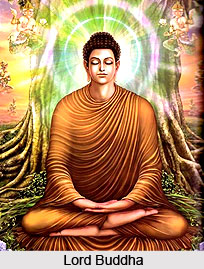
 The fifth concept of Nistha according to the philosophy of Dhammapada is Arhant. It has been declared that Arhant is the one who has attained the highest degree. Lord Buddha had described an Arhant as: "There is no sorrow for him who has completed his journey and his wholly free. The fever of passion does not exist for him as he has thrown off all ganthas-ties". He had also said that the mind of an Arhant is calm and quiet. His deeds and speech is also measured and restrained. An Arhant is such a person who has obtained enlightenment through freedom; in the process he becomes perfectly peaceful and tranquil. The Lord had also said about the Arhant that, "He indeed is the noblest of men who is free from credulity, who understands Nirvana (the uncreated), who has severed all attachments, who has removed all temptations and destroyed all desires and clinging". The fifth concept of Nistha according to the philosophy of Dhammapada is Arhant. It has been declared that Arhant is the one who has attained the highest degree. Lord Buddha had described an Arhant as: "There is no sorrow for him who has completed his journey and his wholly free. The fever of passion does not exist for him as he has thrown off all ganthas-ties". He had also said that the mind of an Arhant is calm and quiet. His deeds and speech is also measured and restrained. An Arhant is such a person who has obtained enlightenment through freedom; in the process he becomes perfectly peaceful and tranquil. The Lord had also said about the Arhant that, "He indeed is the noblest of men who is free from credulity, who understands Nirvana (the uncreated), who has severed all attachments, who has removed all temptations and destroyed all desires and clinging".
The word 'Arhant' is derived from 'arh,' which means to be worthy. In BuddhismBuddha was the first arahant. Buddha was the pioneer who had set the path for other aspiring arahants to follow. They are also referred to as "buddhanubuddha" meaning the one who has attained enlightenment after the Enlightened One. He achieves enlightenment by following the Noble Eight Fold Path. According to Theraveda Buddhism, Buddha himself is the first Arahant as he is free from all kinds of defilements, such as, greed, ignorance, anger, illusion, hatred and others. Such virtues definitely helped him to attain nirvana. Mahayana Buddhism views Buddha as the ideal and the arahants should strive to be like him. There four stages to attain arahantship. The first step is Sotapanna wherein the Buddhist follower has to overcome the three fetters. Then the Sotapanna usher into the second stage where he makes his insight more perfect and thus reaches the second stage, Sakandagami. After attaining this stage the arahant will only be reborn as a human being. The third stage is the Anagami. At this stage he is completely free from sensual desires and ill will. Now he is the non- returned who will never be born again as human being. On contrary he will be reborn in the Heaven and attain Nirvana. The final stage is that of attaining arahantship. He is now free of all the ten fetters and will definitely achieve salvation. Dhammapada has said that the thoughtful exert them; they are not attached to any abode. It also declares that men who have no accumulation of properties and who live on pure food, whose goal in life is unconditioned freedom which comes after realising the empty and transient nature of life, their path is indeed difficult to understand. Lord Buddha had preached his disciples that the man whose passions are stilled moves very easily towards Nirvana. He had also said that even the gods emulate him whose senses have been subdued and who is free from pride and all passions. According to Dhammapada there is no chain of births and deaths for such a man who is imperturbable and tolerant as earth, firm and steady as pillar and serene and pure like a lake. It has been claimed that the place where the Arhants dwell is ever delightful. The Arhants also have no charm for the worldly people as they do not seek delight in sensual pleasures. The Lord had said that an undisciplined man can never become an ascetic because it is never possible for a man full of desire and greed to become an ascetic or a samana. On the contrary a person who subdues all sins is worthy of becoming an ascetic. The Dhammapada declares that a man who has eschewed all sins is called a Brahmin, he who lives in serenity is called a samana and one who has renounced all impurities is called a 'Pravrajit'. A man does not become a Bhikku just because he begs others for alms rather by adopting the whole code of morality one can become a Bhikku. Indeed such a man is called a Bhikku who has transcended both good and evil, who is chaste and who passes with care throughout this world. As this section of Dhammapada explains about Muni, it says that an individual who accepts the good and rejects the evil and he who weighs both the World on that very account is worthy to be called a Muni. Ultimately the conclusion of this section of the Dhammapada says that he in whom a longing for the ineffable has sprung up and whose mind is tranquil and who is not distracted by material desires such a man is called 'uddhamsto". He indeed is the noblest of men who has emancipated his soul from all passions and cravings. |
| |||



Home > Society > Indian Religion > Types of Religion in India > Buddhism > Schools of Buddhism > Theravada > Dhammapada > Arahant
Arahant
| Arhant according to the philosophy of Dhammapada is an individual who has attained the highest degree. |
| ||||||||||||||||||||||||||||

