


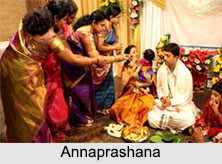
 Annaprashana is a Hindu ceremony which is performed to mark a baby's first introduction to solid food after its birth. This ceremony is done when the baby is of 6 to 8 months old if it is a boy and in case of girl, it should at the age of 7 to 9 months age. It is done at that age because at that period the child gains the strength to digest the cereals and rice. In some special cases, where the child is found to be very weak, the time can be postponed further. Annaprashana is particularly popular in the states of West Bengal and Kerela, where it is celebrated with great splendour. Annaprashana is a Hindu ceremony which is performed to mark a baby's first introduction to solid food after its birth. This ceremony is done when the baby is of 6 to 8 months old if it is a boy and in case of girl, it should at the age of 7 to 9 months age. It is done at that age because at that period the child gains the strength to digest the cereals and rice. In some special cases, where the child is found to be very weak, the time can be postponed further. Annaprashana is particularly popular in the states of West Bengal and Kerela, where it is celebrated with great splendour.
Etymology of Annaprashana Annaprashana is a Sanskrit term, which literally means "food feeding" or "eating of food". The term "anna" means "food'" mainly "boiled rice" and "Prasana" means 'eating' specifically 'the first feeding of a child'. Legends of Annaprashana According to Hindu tradition, Annaprashana is performed in the even months for boys whereas for girls, it is performed in the odd months. Annaprashana signifies a distinct transform in a child’s life, celebrated amongst family and elders. In earlier days, people used to call a priest in home who would carry out the rituals or they would go to any temple for a Pooja. But, these days people generally choose to book a banquet or a party hall and a family priest is called over to do the rituals. Earlier, the 'namakaran' ceremony of the baby is to coincide with this Annaprashana. In those days, few rites like 'homa', 'vriddhi' (worship of ancestors and deities) were also done during Annaprashana. But now, it has been simplified and many people only offer few grains of dried rice to the Lord Jagannath of Puri and then these are given to the mouth of the baby. Brahmins and the invited relatives are served with the specially prepared food for the occasion. As a symbol of gratitude, the family gives gift to the Brahmins. Celebration of Annaprashana Annaprashana cannot be performed before the child becomes four months old since then it is not capable enough to digest any solid food. Friends and relatives are invited to bless the child with their good wishes. The food, which will be served to the child, is prepared with chanting of Vedic mantras. The father of the child gives the first morsel to the child when the priest recites ‘Mahavyahritis’. The father places the child on 'kusha grass' and offers his prayer to the 'Agni'. He prays that the child becomes well versed and strong and for a long peaceful life and earns fame. The rice to be served to the child on the day of Annaprashana is prepared in a special way along with the chanting of mantras. Rice is washed with chanting of a prescribed mantra, then cleaned and cooked well with ghee in a fixed quantity so that it mixes well with the rice. After the rice is cooked, it is placed in 'Homashthali', the pot for 'Homa'. Then the rice is distributed in the dishes of 'Yajmana', the 'Ritvij' and the priests along with the following five mantras. The 'Yajmana' of Annaprashana mixes little of curd, honey and ghee. This particular rice is fed to the child with this mantra from Yajur Veda. The blessing is given along with chanting. The child is dressed in a 'dhoti-kurta' during the Annaprashana, which is mainly done among Bengalis. Before that the child is bathed by rubbing with 'haldi' and mustard oil. A yellow mark of 'haldi' and sandalwood is put on the forehead of the child as a ritualistic decoration. The child requires wearing a body cloth named "Uttariya" on his upper body. On the head of the child, a 'Topor' is put on, which is also worn by grooms during marriage. The religious ceremony is often followed by a fun game where a number of symbolic objects are placed on a banana leaf or silver tray which your baby can then pick up. The objects consist of: In case of the Annaprashana of a girl child, she is dressed with a red Banarasi saree and blouse as well as a transparent ‘dupatta’. The 'Topor' is replaced with a 'Mukut', which is made of the same material but made in a more attractive way. After feeding the child, the mouth and the hands of the child are washed properly by singing the ‘Vamedevyagana’ as described in the end of ‘samanya prakarna’. Then, parents of the child and the old ladies and gentleman bless him and Annaprashana ceremony ends here. |
| |||



Annaprashana
| Annaprashana is a ceremony of Hindu families, performed to mark a baby`s first introduction to solid food after its birth. It is a popular Hindu custom. |
| ||||||||||||||||||||||||||||

