
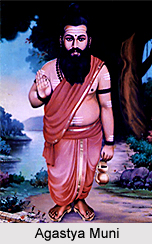
 Agastya was a Vedic sage. He is also believed to be one greatest Seven Sages or Saptarishis. It is believed that Agastya and his followers authored many mantras of Rig Veda. Agastya was the son of Varun, god of sea. From his earliest days he had lived the life of an ascetic, deep inside a forest. Agastya is also considered as the first and foremost person of Siddha and the teacher of many other renowned saints. He is also called as `kuru muni`. He made significant contributions in the field of medicine and astrology. According to some scholars he is said to have lived for 5000 years. He had many disciples among them prominent were Therayar, Tholkappiar and Mahavatar Babaji. Agastya muni plays a significant role in the great Indian epic, Ramayana. In the `Aranya Kanda` or the `Forest Trek` part, Lord Rama requests Sage Agastya to indicate a place in the forest to make a residence during the days of exile. He also foresees the next course of Ramayana and orients his conversation around womanhood and Sita.
Agastya
Agastya was a legendary sage according to Hinduism. It is firmly believed by many that it was sage Agastya who first introduced and popularised Vedic religion in the southern part of India.
Introduction
Agastya was a Vedic sage. He is also believed to be one greatest Seven Sages or Saptarishis. It is believed that Agastya and his followers authored many mantras of Rig Veda. Agastya was the son of Varun, god of sea. From his earliest days he had lived the life of an ascetic, deep inside a forest. Agastya is also considered as the first and foremost person of Siddha and the teacher of many other renowned saints. He is also called as `kuru muni`. He made significant contributions in the field of medicine and astrology. According to some scholars he is said to have lived for 5000 years. He had many disciples among them prominent were Therayar, Tholkappiar and Mahavatar Babaji. Agastya muni plays a significant role in the great Indian epic, Ramayana. In the `Aranya Kanda` or the `Forest Trek` part, Lord Rama requests Sage Agastya to indicate a place in the forest to make a residence during the days of exile. He also foresees the next course of Ramayana and orients his conversation around womanhood and Sita.Legend of Agastya
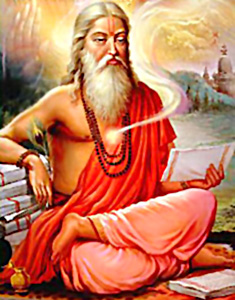 Agastya is one of the rishis or great sages of the Hindu legend. The great sage is linked mainly with the south India, and whose story gives a very good resemblance to that of the myth of Prometheus. Agastya is believed to have given lesson to the Dravidian people about the art of civilization, and although he was not actually being chained to the mountains, he is still - as per the legend-obliged to take shelter on the Agastyakudum, a peak to the north in case it should suddenly decide to grow taller and obstruct the courses of the sun and the moon.
The name of the sage Agastya appears to have been included to the large list of famous and renowned Hindu sages in the post-Vedic periods, after the Aryanization of South India; and this suggests that the sage was originally a Dravidian or even pre-Dravidian deity or a culture hero. The tribes of the Western Ghats, who are considered to be the oldest surviving peoples of the state of Kerala, respect Agastya as the leader who brought them from the north and who also gave then valuable lessons on how to clear the land and to live well in the forests.
Among the megalith builders themselves the tribes people who speak of Agastya appear to know nothing; they refer to their monuments as `monkey stones`, and associate them with the great simian army which the Lord Rama and his famous disciple Hanuman led through South India to the conquest of Ceylon, as described in the great epic Ramayana. Yet when one comes to consider who the megalith builders - the first men to begin the human conquest and ordering of Kerala - actually were, one immediately begins to speculate on the mountain tribes themselves and to consider whether the myth of Agastya leading them down from the north does not actually refer to the southward movement of the megalith builders.
The provenance of Sage Agastya, as the Sea God, Lord Varuna`s son, could be because of his suitable ability of sea-navigation and it might be also sea warfare as well. The Lord Indra and a number of other Devas asked for the aid of Agastya in order to defeat a group of Asuras known as the Kalakeyas, who were very brave and fierce sea warriors. Thus, the arrival of Agastya in Kerala can also be considered to have happened by the sea route.
Worship of Sage Agastya
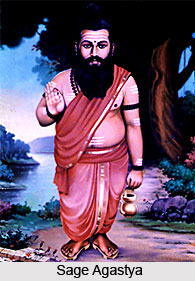 Agni Purana says that sage Agastya should be deemed as an incarnation of the god Hari and it is believed that a man by worshipping this venerable sage attains the latter`s divinity. The immortal Rishi should be worshipped during the three days and a three-quarter part thereof, before the entrance of the sun into the sign of Virgo. The worshipper should fast on the three days stated above, and worship the sage with Argha offerings, etc. The white and effulgent image of the sage, having complexion like the hue of a Kasha flower, should be invoked at night fall in a pitcher, full of water, and the night should be spent in vigil, after having addressed him as follows: "Accept this worship made by me in love, oh thou the greatest of the holy sages, oh thou whose mind is always filled with the noblest of thoughts, oh thou whose body is resplendent as the midday-sun." Thus having invoked the presence of the holy sage, the worshipper should offer him perfumes and sandal-paste, and worship him on the morrow with the Argha offerings, on the bank of a pond, by reciting the Mantra.
The Purana narrates that just as the sage Agastya is offered obeisance similarly the princess Lopamudra, the daughter of the king of Vidarbha, and the wife of the sage, should be worshipped by reciting the following prayer :" Obeisance to thee, O princess, O thou the wife of the holy sage, who hast undertaken the greatest vow of lifelong renunciation. O thou goddess, O thou Lopamudra of universal fame, accept this Argha offered by me."
It has also been said that the Argha to be offered to the holy sage Agastya, should be composed of bits of gold and silver, the five gems known as the Pancharatnam, a metal bowl containing the seeds and grains known as the Sapta-dhanya, curd and sandal-paste; and which should be offered without uttering any Vedic Mantras, where the penitent would belong to the Shudra community or to the opposite sex. The worship should be closed with the following prayer, "Accept this Puja made by me, O thou Agastya, who grantest all boons the greatest of all the holy sages and resplendent as the sun, and depart in peace from this place of worship.
Agni Purana narrates that for life the penitent should forego a class of paddy, a fruit or articles of a particular taste in honour of Agastya. Then the Brahmanas should be feasted with boiled rice, porridge, articles fried in clarified butter, sweetmeats, and confectionaries; and gifts of cows, clothes and gold should be made to them. It is believed that by offering such Arghas for a period of seven years, a woman becomes the mother of many children and the mistress of a large fortune, while a virgin becomes a princess by wedlock.
Agastya and Lopamudra
For a long time Agastya was content with his life. But then something happened that disturbed his peace. He had a dream in which he saw the spirits of his ancestors wandering about restlessly in the air. Agastya asked them why they were not in heaven. He said that why were not in heaven in spite of being good people. They were supposed to reside in heaven amidst peace and plenty. The spirits replied that they had come back to earth because they were worried. For the time being Agastya is there and he is offering sacrifices in the name of his forefathers ensuring their peace in the other world. But what will happen when he is not there. Moreover Agastya was not married and had no son, who will take over his duties towards his ancestors after him. Thus they asked Agastya to get married and raise a family so that they could have someone to perform the duties.
At this point Agastya suddenly woke up. He had never before wished to get married. But now, out of a sense of duty to his ancestors, he decided to marry. By then Agastya had earned renown as a sage. People came to him from far and near to ask for boons. One such person was the king of the country of Vidarbha. He was childless and came to Agastya so that he could be blessed with a child. Agastya heard the king`s request and sat in meditation for a long time. Finally he announced to the king, who was waiting anxiously that he would be blessed with a beautiful girl child. The sage`s prediction came true. Soon after, the queen of Vidarbha gave birth to a girl who was named Lopamudra. With the passing years she grew into a maiden of exquisite beauty that her fame spread among the royal households of the country.
A few years later, Agastya came to the court of Vidarbha and asked for the hand of Lopamudra. Now the king had promised that this would be done. But when the time came, he was unwilling to do so. His daughter had been brought up in the lap of luxury. The king was worried as he did not know how his princess could lead her life in an ashram. Lopamudra after knowing the truth gladly agreed to marry the sage. Her parents were surprised. But they were also greatly relieved, and, in due course, the marriage was celebrated. The time came for Lopamudra to go to the forest with her husband. She was dressed in fabulous silks and laden with priceless jewels. But such finery had no place in the life of an ascetic. Agastya told his wife to give it all away and she did so with a smile. Covering herself with a deerskin and garments made of bark, she gladly accompanied the sage to his ashram. Agastya and Lopamudra spent many years in prayer and meditation at a place called Gangadwar. They were very happy together.
At this point Agastya suddenly woke up. He had never before wished to get married. But now, out of a sense of duty to his ancestors, he decided to marry. By then Agastya had earned renown as a sage. People came to him from far and near to ask for boons. One such person was the king of the country of Vidarbha. He was childless and came to Agastya so that he could be blessed with a child. Agastya heard the king`s request and sat in meditation for a long time. Finally he announced to the king, who was waiting anxiously that he would be blessed with a beautiful girl child. The sage`s prediction came true. Soon after, the queen of Vidarbha gave birth to a girl who was named Lopamudra. With the passing years she grew into a maiden of exquisite beauty that her fame spread among the royal households of the country.
A few years later, Agastya came to the court of Vidarbha and asked for the hand of Lopamudra. Now the king had promised that this would be done. But when the time came, he was unwilling to do so. His daughter had been brought up in the lap of luxury. The king was worried as he did not know how his princess could lead her life in an ashram. Lopamudra after knowing the truth gladly agreed to marry the sage. Her parents were surprised. But they were also greatly relieved, and, in due course, the marriage was celebrated. The time came for Lopamudra to go to the forest with her husband. She was dressed in fabulous silks and laden with priceless jewels. But such finery had no place in the life of an ascetic. Agastya told his wife to give it all away and she did so with a smile. Covering herself with a deerskin and garments made of bark, she gladly accompanied the sage to his ashram. Agastya and Lopamudra spent many years in prayer and meditation at a place called Gangadwar. They were very happy together.
Legend of Lord Ganesha and Sage Agastya
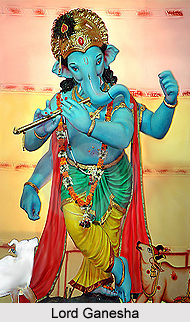 The Legend of Lord Ganesha and Sage Agastya is related with the flowing of the Kaveri river in South India. During the marriage of Lord Shiva and Goddess Parvati, the northern part of the land plunged as all the Gods, deities and Rishis (sages) assembled on the Kailash Mountain. Thus Shiva sent one of the Saptarishis, Agastya Muni, (also known as Agathiar or Agastyar) to the southern India in order to balance the land. Lord Shiva put Kaveri in the Kamandalu, a copper pot for carrying sacred water, of Sage Agastya and sent him to the Podhigai ranges.
During this period, the demon Surapaduman threatened the Hindu deities and also frightened the king of gods, Lord Indra, who escaped to a holy garden created by Shiva. But as Lord Varuna, the god of wind, was also terrorized by Surapaduman, there was a lack of rain and Indra`s garden started to dry up. Then Narada informed the king of gods that Kaveri River was inside the Kamandalu of Agastya Muni. Subsequently Lord Indra prayed to Lord Ganesha, the remover of obstacles, for help.
By this time, Sage Agastya had traveled to the Kodagu mountains (in Coorg). Lord Ganesha then took the appearance of a crow and landed on the edge of the kamandalu, while Agastya Muni was involved in meditation. The sage then realized this and raised his hands to remove the crow. But while departing, the divine crow tipped and knocked over the sacred pot.
 Thus River Kaveri was poured on the ground and she started to flow in to the land, which is now known as Talakaveri (Talacauvery).
The divine crow then took the appearance of a small boy. The holy sage realized that the small boy was playing some trick. Agastya Muni clenched his fists and tried to strike on the head of the boy. The small boy then ran away and the sage followed him. Eventually the boy took the form of Lord Ganesha and appeared in front of Agastya. The sage became astounded to discover that the boy was Ganesha. As penance, Agastya Muni started hit his own head with his clenched fists. The Lord then stopped him and blessed the sage with wisdom.
There is another version of this legend, which states that Kaveri was originally known as Ponni. Once she disrespected Agastya Muni, who trapped Ponni in his sacred kamandalu as punishment for her behaviour. Consequently, Narada prayed to Lord Ganesha for help. Thus the Lord took the appearance of a divine crow and knocked over the pot. It poured the river Ponni on the ground, who immediately started flowing. After this event, Ponni was known as Kaveri (Cauvery).
Recently updated articles in Indian Puranas
Kausika, Son of Vasudeva
Kausika is a minor figure in Hindu mythology and is identified in the Vishnu Purana as the only son of Vasudeva and his wife Vaishali. He is recognize...
Tandu, Attendant of Lord Shiva
Tandu is revered as the divine attendant of Lord Shiva and the foremost exponent of the Tandava dance. According to the Natya Shastra, he instructed S...
Niramitra, Mahabharata
Niramitra was a son of Nakula and Kareṇumati in the Mahabharata. A descendant of the Pandavas and the Kuru dynasty, he fought on the Pandava side duri...
Mahodara, Ramayana
Mahodara was a prominent Rakshasa warrior, minister, and army chief who served under Rāvaṇa during the Battle of Lanka in the Ramayana. Celebrated for...

Lalabaksha, Hell in Purana
Lalabaksha is one of the hells described in Hindu Puranic literature, particularly in the Bhagavata Purana and the Devi Bhagavata Purana. It is a real...
Related articles in Indian Puranas
Adhyayas in Agni Purana
Adhyayas in Agni Purana are all encompassing. The chapters have dealt with a variety of subjects related to human lives. A large number of chapters ha...
Indian Puranic Tribes
The existence of Indian Puranic tribes is often mixed with mythology and fiction that depict them as superhuman or sub.
Puranic Texts
Puranic Texts are vital according to Hindu, Jain or Buddhist religion; they describe the history of the Universe.

Puranic Shaivism
Puranic Shaivism established during the Gupta Dynasty. This puranic religion developed and expanded, and was accompanied by the development of Brahman...
Nilamata Purana
Nilamata Purana is a Kashmiri Purana that is referred by Kalhana. It is considered as one of the sources of ancient history of Kashmir.