The conquests of
Samudragupta had given him the title `Alexander of India`. Such an enormous conquest was guided by the sole aim of Samudragupta to bring about a political unification of India under his own supremacy and himself becoming the Ekrat or the sole ruler. Samudragupta set out to expand the boundary of his kingdom and adopted the policy of "Digvijay". The
Allahabad Prasasti delineates a vivid description of Samudragupta`s military campaigns.
According to the description provided by Harisena in the Allahabad Prasasti, it was clear that Samudragupta undertook two campaigns in Aryavarta or northern India. There are descriptions of those kings who had been defeated by Samudragupta during his military expedition in the northern and southern territories.
Scholars have opined that the conquests of Samudragupta can be broadly classified into four categories. The four categories are - his conquest against the kings of south, conquest against nine kings of Aryavarta, conquest against the Atavikas and the five frontier kingdoms and nine tribal states and lastly the conquests of some independent and semi-independent principalities in the remote areas. These kingdoms were compelled to offer allegiance and tribute to Samudragupta.
Samudragupta at first thoroughly subjugated the neighbouring kings in the Ganga Yamuna valley and consolidated his position in the north before he set out for his military conquest in the territories of south. Samudragupta defeated the kings Achyuta of Ahichchatra, Nagasena of
Mathura and Ganapati Naga of Padmavati and also the prince of Kota family, who constituted a formidable resistance against Samudragupta. The region of Ahichchatra has been identified with Ramnagara and
Bareilly district of
Uttar Pradesh. Nagasena and Ganapati Naga were the Naga princes who ruled
Mathura and Padmavati in Gwalior. The Kota family was concentrated in the Sarasvati region of Uttar Pradesh. Samudragupta routed the league formed by these allied powers in the battle of Kaushambhi. As a result he became the sovereign authority of the vast tract of Ganga Yamuna valley. He consolidated these kingdoms under his own supremacy and annexed it with the
Gupta Empire. From Allahabad Prasasti composed by Harishena, it is known that he conducted the military operation in Aryavarta from the region of Purushpura.
A great conqueror, Samudragupta brought political unification within India. He set out for the conquest of southern India or Deccan. Historians have opined that Samudragupta personally did not lead in all campaigns. Being a shrewd diplomat, Samudragupta deviated from the policy of Digvijay in Deccan or south India. In his southern campaign Samudragupta followed in the footsteps of the Mauryan Emperor Ashoka, i.e. the policy of Dharmavijaya. It was guided by three principles: `grahana (capture of the enemy), `moksha` (liberating him) and `anugraha` (favouring him by reinstatement of his kingdom). He did not annex the kingdoms of the local rulers of Deccan; rather he reinstated their kingdom under his own authority. However the historians have different theories regarding his conquests in South India.
Samudragupta defeated as many as twelve kings in course of his campaigns in south India or
The Deccan. The identification of the kings defeated by Samudragupta proves that his sway extended in eastern Deccan also. He defeated the kings of Kosala, Mahakantara, Kaurala, Pistapuram, Kottura, Erandapalla, Kanchi, Vengi, Avamukta, Palakka, Devarashtra and Kushalapura.
Samudragupta further extended the boundary of his Empire by conquering the Atavika kingdoms from the forest kings. Atavika or the forest kingdoms extended from the regions of Ghazipore district in Uttar Pradesh to Jabalpore in
Madhya Pradesh. The sweeping conquest of Samudragupta in north and south made him the paramount ruler in India. There were five kingdoms and nine tribal states on the frontier, which became his vassals and paid him tribute, obeyed his orders and offered him homage. Apart from these, several tribal states also became his vassal, which included Samatata, Davaka, Kamrup, with Guwahati district. Among those tribal states mention may be made of the Arjunayas, Madrakas and Yaudheyas.
Conquests of Samudragupta in South India
 Conquests of Samudragupta
 in South India according to some historians disclose that he was opposed by a confederacy of kings of the Eastern Deccan near the Colair Lake. This made him abandon his conquests in the coast of
Orissa and returned home. The
Allahabad record however clearly shows that
Samudragupta advanced in the south. The Prasasti of Harisena claims that Samudragupta defeated all the kings of Daksinapatha, the location of the South Indian states.
Since the second century good ports sprang up on the eastern coast of South India and Samudra Gupta wanted to have them under his control. The Vakatakas were under control who was becoming the dominant power in the Maharashtra region realising his power.
Samudragupta evidently got hold over the Ganges Yamuna valley and secured his position thereby turning his attention towards South-India. Mahendra of Kosala was defeated by him. The districts of
Bilaspur,
Raipur and Sambalpur came under his control. Vyaghraraja of Mahakantara was also overpowered by Samudragupta. Mantaraja of Kurala was also captured. Mahendragiri of Pistapura was defeated by him. Pistapura is the modern Pitliapuram in the Godavari district. This is mentioned in the Aihole inscription of Pulakesin. Svamidatta of Kottura was crushed by him and according to some historians this should be identified with Kothoor in the
Ganjam district.
Damana of Erandapalla had to kneel before him and accept his supremacy. Visnugopa of Kanchi, the modern Kanchipuram in the Chingliput district, Madras accepted the defeat in the hands of Samudragupta. Visnugopa was the king of the
Pallava dynasty. Nilaraja of Avamukta is another who was defeated by him. Hastivarman of Vengi who was captured by him, may be identified with the region round Vengi, a village in the Ellore taluka of the Godavari district. Hastivarman was certainly the king of the Salankayana dynasty. Ugrasena of Palakka was another king whom Samudragupta had overpowered.
King Dhananjaya of Kusthalapura which is near Polur in North Arcot had also accepted his suzerainty.
Some interesting inferences has been made regarding his Southern campaign : (i) the list of the Southern rulers in the Allahabad record includes the names of kings as well as of District Officers; (b) Samudragupta fought his crucial battle in the Colair Lake region; (c) Southern emperors had been grouped under two chief leaders-Mantaraja of Kurala leading Svami datta and Damana of Erandapalla, while Visnugopa of Kanchi led Nilaraja of Avamukta, Hastivarman of Vengi, Ugrasena of Palakka Kuvera of Devarastra and Dhananjaya of Kusthalapura.
Conquests of Samudragupta in North India
The conquests of
Samudragupta in North India prove that he became the sovereign authority of the vast tract of Ganga Yamuna valley. The digvijaya of
Samudragupta in can be divided in chronological order: First campaign in Aryavarta, Campaign in Daksinapatha and Second campaign in Aryavarta. Evidences seem to indicate that Samudragupta led two campaigns in North India, though most of the scholars do not favour such a theory. The
Allahabad record states that Samudragupta violently uprooted Achyuta, Nagasena and a king of the Kola family. Samudra Gupta undertook two campaigns in North India.
First campaign in North India of Samudragupta
In his first campaign in North India, Samudragupta overpowered Achyuta, Nagasena and a prince of the Kota family. It is also believed that Samudragupta had to fight in the Padmavati region twice in course of the same campaign in as much as both Nagasena and Ganpatinaga belonged to the same house. Some scholars think that Nagasena, Achyuta and the prince of the Kota family entered into an association against Samudragupta who defeated their combined forces in a battle at Kaushambhi. There is no evidence of this fact at all.
Second campaign in North India of Samudragupta
The Allahabad record says that the Daksinapatha conquest of Samudra Gupta was marked by three distinct features - grahana or capture of the enemy, moksa or liberating him, and anugraha or favouring him by reinstating him in his kingdom. This is followed by a description of nine kings of Aryavarta whose kingdoms were integrated into his own territory. The kings who became victims of this extermination are Rudradeva, Matila Nagadatta, Chandravarman, Ganpatinaga, Nagasena, Achyuta, Nandin and Balavarman. These kings are considered as the rulers of Aryavarta. It appears that the territories of the above nine kings lay to the west of the Prayaga which was the western boundary of the empire of Samudra Gupta`s father. From Allahabad Prasasti composed by Harishena, it is known that Samudragupta conducted the military operation in Aryavarta from the region of Purushpura.
Samudragupta at first thoroughly subjugated the neighbouring kings in the Ganga Yamuna valley and consolidated his position in the north. As a result of this war of extermination, the empire of Samudragupta included
Uttar Pradesh and a portion of
Madhya Pradesh. The southern boundary of this empire was further extended by the conquest of the forest Countries.

 Samudragupta was a benevolent ruler who reigned from 335 to 380 BC. He was a great warrior and patron of arts. He was the son of Chandragupta I and probably the greatest king of Gupta dynasty. There is a detailed and authentic record of Samudragupta`s reign, which was composed by his court poet Harisena which is found in the rock pillar of Allahabad. He had to undergo a struggle for the throne with his elder brothers after his father`s death. Samudragupta ascended the throne and conquered almost whole of India. His greatest achievement was the political unification of most of the India into a unique power. Samudragupta took the title of Maha Rajadhiraja. After winning all the big battles, Samudragupta performed Ashwamedha Yajna or Horse sacrifice. Many rulers of foreign states like the Saka and Kushana kings accepted Samudragupta`s supremacy and offered him their services.
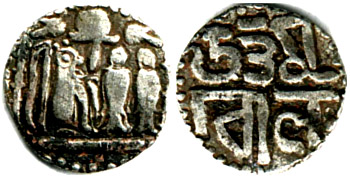
 Monetary System under the Rule of Samudragupta
 Administration of Samudragupta discloses the fact that he not only established a vast empire but also left it as legacy to his successors well-knit and well-organised. The Allahabad Pillar Prasasti mentions the name of officials who were known as `Mahadandnayaka` `Kumaramaty` and `Sandhivigrahika`. His administration was harsh and tyrannical and he was very firm towards sinners however generous towards moral people.
 Samudragupta (reigned 350-375) was the second emperor of the Gupta dynasty of India. His reign ushered in the Golden Age in India and he is remembered both as a benevolent imperial conqueror and a patron of arts and letters. During his ascension to the Indian throne, the Guptas existed as the local powers in the Gangetic valley. Samudragupta, through his conquests expanded the territory of the Gupta Empire to a vast extent, both in northern and southern India. The total extermination of the nine kings of the north, testifies his uncommon military skills. His brilliant power of leadership is proved by his southern conquests. The dazzling campaigns and the organisational skills of Samudragupta has led Dr. Smith to describe him as "Indian Napoleon".
 Samudragupta was the famous ruler of the Gupta dynasty, under whom Gupta Empire was destined to attain dazzling success and prosperity. Samudragupta, the son of Chandragupta I by his Licchavi queen, Kumaradevi, succeeded his father to the throne. With the ascension of Samudragupta to the throne of the Gupta Dynasty, the Guptas attained conspicuous superiority over all the important authorities and was transformed from the local powers in Gangetic valley into a pan Indian Imperial authority.
 The foreign relations under
  During the reign of the later Kushanas, when they had become unable to maintain the administration of such a vast kingdom, the political condition of North India was pretty anarchical. The vast Kushana Empire was disintegrated into several small provinces and the provincial chiefs unfurled the flag of independence. Among these independent states, some were autonomous tribal republics and the others, monarchical. When Samudragupta set out on his military campaign, these small provincial states offered him resistance. But they were however defeated and subjugated by him.
 Samudragupta had also led his military conquest in several other fragmented parts, which was occupied by some tribal communities and forest kings. Among these regions mention may be made of the Atavika kings or the forest kings, who ruled in the forest tracts, extending from the Ghazipore district of Uttar Pradesh to Jabbalpore in Central Province. Outside Uttar Pradesh, Bengal and Central India, there were four Pratyanta Rashtras or frontier kingdoms. Three of them i.e. Samatata or South East Bengal, Davaka or part of Assam and Kamrup or upper Assam, were included in the territory of Samudragupta. Apart from these, Allahabad Prasasti also refers to some non-monarchic tribes, who lived in the west and the southwestern fringes of Aryavarta or the proper northern India. Samudragupta crushed these tribes and earned reverence from them. Apart from these tribes, the other tribes who held small kingdoms of their own were also defeated by the mighty conqueror Samudragupta. These were the Malavas, Arjunayas, Yaudheyas, and Madrakas.