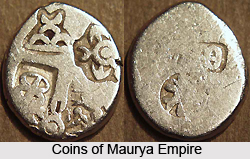
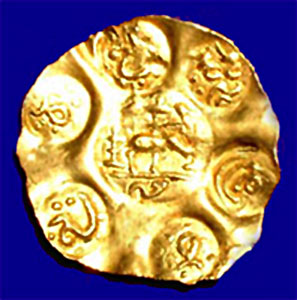
Vasishtaputra Siri Pulamayi or Pulamayi inherited the throne of his father Gautamiputra Satakarni in 130 A.D. Vasishtaputra Pulamayi, son of Gautamiputra Satakarni, ascended the throne when the consolidated Sattavahana Empire was disintegrated and the major parts were occupied by the Saka power. Gautamiputra suffered loss of territory towards the closing of his reign due to the revival of the Saka power in northern boundary of his kingdom. Gautamiputra`s son, Pulamayi II compensated this loss by making conquests southward upto the area of river Kistna. Though Pulamayi failed to recover the Northern part of his paternal kingdom, he extended his kingdom towards the Krishna-Godavari district upto the mouth of river Krishna. Moreover the district of Bellary was also annexed with the Sattavahana kingdom during his reign. The coins of Pulamayi II, which have been found in the districts of Chennai and Coromondal coast, indicates that these regions had formed the parts of the Sattavahana kingdom. Pulamayi`s inscriptions are also found in the regions of Nasik, Karle and at Amaravati in the Krishna district of Andhra.
Vasishtaputra Pulamayi or Pulamayi II ruled for 28 to 29 years. However there is a prolonged controversy among historians regarding the chronology of Pulamayi`s ascension to the throne. Bhandarkar has suggested that Gautamiputra and Pulamayi ruled jointly for several years according to the Nasik Prasasti, however Dr. D.C Sirkar refutes this interpretation of Nasik Prasasti. Dr D.C Sirkar puts forth that Pulamayi II or Vasishtaputra Pulamayi ascended the throne only after the death of his father, Gautamiputra Satakarni. Apart from these, there is also a keen controversy among the scholars about the conquest made by Pulamayi II. Dr. H.C Roychowdhury himself doubted the inclusion of the Bellary district in the territory of the Sattavahanas by Pulamayi II. According to Roychowdhury the coins and inscriptions from which the story about the conquests of Pulamayi is known, has no supporting evidences. Dr. Gopalachariya has however suggested that the coins of Pulamayi testify the naval power of the Sattavahanas and their expanding maritime trade.
Pulamayi II though formed a vast and formidable Sattavahana kingdom, yet he had to contest against the Saka adversary, Rudramana in the north. Although Pulamayi had suffered defeats in the hands of the Saka chief, Rudramana in the north, yet Pulamayi retained his hold over the entire kingdom of Maharashtra and Andhra. The Junagarh Inscription vividly describes the relation and struggle between the Saka chief in the north and the lord of Deccan, Pulamayi. The first battle between Rudramana, the Saka king and Pulamayi II, the Sattavahana king, took place in 150 A.D. According to the Junagarh inscription, Rudramana defeated the Sattavahana king Pulamayi twice but did not destroy him completely, owing to his familial relationship with him. The Kanheri tank inscription depicts that Pulamayi II was the husband of Rudramana`s daughter. Hence the Saka ruler refrained from destroying the Deccan lord completely.
Pulamayi, one of the great kings of the Sattavahana dynasty failed to retrieve the fallen fortune of the Sattavahanas as long as Rudramana was alive. Vasishtaputra Pulamayi consolidated the entire Sattavahana kingdom in the Deccan region and established his capital at Pratisthana or Paithan. He founded the town called Navanagara and assumed the title of Navanagaraswami. As a king Pulamayi followed in the footsteps of his father Gautamiputra Satakarni and worked for pubic welfare. He was tolerant towards other religious creeds. The Karle inscription mentions the donations he had made to the Buddhists. Apart from these, the Sattavahana navy was strengthened under Pulamayi II. Maritime trade and overseas colonisation achieved a great impetus under him. Moreover he reconstructed and enlarged the Amaravati Stupa. Pulamayi`s reign witnessed a thriving economic prosperity throughout the country.
Vasishtaputra Pulamayi or Pulamayi II though could not attain great heights like his father Gautamiputra Satakarni, yet he was a mighty conqueror and a benevolent ruler. He made a formidable Sattavahana Empire, encompassing nearly the whole of south India and was known as "Lord of Deccan" throughout his reign.