


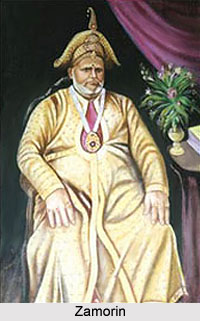
 Zamorin of Calicut was the mightiest of ruler of Kerala who was able to have its sway throughout the state. The Zamorin of Kerala rose to power in the 14th century A.D. Calicut used to be a free port where ships several countries enjoyed facilities and royal protection. Both the Arabs and the Chinese thronged to Calicut and their commercial rivalry, Zamorin took advantage. At that time the Zamorin was regarded as the wealthiest monarch of India who had contacts with Arab countries, Egypt and even beyond, and as a port Calicut ranked first on the west coast shipping the bulk of pepper, cinnamon, cardamom and ginger. No doubt, Zamorin had the requisite power and resources to bring about a union of Kerala, but he failed to follow up on a vigorous policy towards this goal because of two reasons: the rise of Cochin and the reaching of the Portuguese on Indian coast. Zamorin of Calicut was the mightiest of ruler of Kerala who was able to have its sway throughout the state. The Zamorin of Kerala rose to power in the 14th century A.D. Calicut used to be a free port where ships several countries enjoyed facilities and royal protection. Both the Arabs and the Chinese thronged to Calicut and their commercial rivalry, Zamorin took advantage. At that time the Zamorin was regarded as the wealthiest monarch of India who had contacts with Arab countries, Egypt and even beyond, and as a port Calicut ranked first on the west coast shipping the bulk of pepper, cinnamon, cardamom and ginger. No doubt, Zamorin had the requisite power and resources to bring about a union of Kerala, but he failed to follow up on a vigorous policy towards this goal because of two reasons: the rise of Cochin and the reaching of the Portuguese on Indian coast.
By the 13th century most of the commerce with Arabia and Muslim Egypt was already concentrated in the northern ports of Cannanore and Kolikod (Calicut), because the Zamorin, after having fought his way to the coast, gave special privileges to the Arab merchants who settled in his new port city of Calicut. The Muslims controlled the business of Calicut so thoroughly that the Zamorin's overseer who valued cargoes was a Muslim and the activities of the market were determined by their religious customs. The Arab merchants never allowed religious fanaticism to spoil the smoothness of their relations with the Zamorin and his Nayars. Contribution of Arab Merchants in the Conquests of Zamorin The Zamorin was considered to be the friend of the Arabs, and it was in their interests to increase his power, since this would not only ensure their own trade, but would also increase the territory on which they could carry on with their trade. Thus, they encouraged him to fight against the neighbouring Rajas, and helped him with soldiers and money equipped with modern arms. In Calicut the Muslims, like the Nayar, were allowed to bear arms, and the Zamorin was able to call out the Moplah levies to fight beside the Nayars in times of emergency. For naval operations he relied on the Arabs who had better ships and ordnance than the Malayalis and were much more experienced sailors; his hereditary admirals, the Kunjalis, were Muslims. The domination which the Zamorin had established over most of northern Kerala by the time of Vasco da Gama's arrival in 1498 was mainly due to the support he received from his Muslim allies. Arrival of Vasco da Gama in Calicut 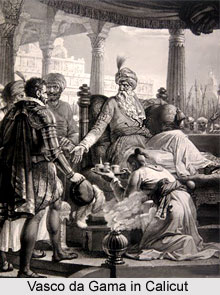 In the month of July 1497, Vasco da Gama sailed from Portugal. The Malayalis looked at the newcomers with wonder, but the Arab merchants, who had close trading links with the Mediterranean, were bitterly aware of the identity of the newcomers, and when, as they awaited an audience with the Zamorin, the Portuguese tried to open trade, they encountered a disconcerting lack of interest in the goods they offered. In the month of July 1497, Vasco da Gama sailed from Portugal. The Malayalis looked at the newcomers with wonder, but the Arab merchants, who had close trading links with the Mediterranean, were bitterly aware of the identity of the newcomers, and when, as they awaited an audience with the Zamorin, the Portuguese tried to open trade, they encountered a disconcerting lack of interest in the goods they offered.
Eventually, the Zamorin received Vasco da Gama in ceremonial durbar, with his ministers and chieftains around him. For da Gama the strangeness of his surroundings seems to have been no compensation for the evasiveness of the Zamorin when it came to questions of business. No direct answer was given, and the Portuguese became increasingly suspicious of Arab intrigues. They even, with no apparent justification, became concerned for their own safety and seized five Malayalis as hostages; ignorant of local customs, they made the mistake of picking low-caste fishermen. In the end the Zamorin agreed that the Portuguese might leave a factor to seek buyers for their unsold goods, provided the usual customs dues were paid. Vasco da Gama refused, and sailed away with his hostages. This confirmed in the Zamorin's mind the warnings he had received from the Arab merchants about the ambitions of the Portuguese and sowed the seeds of future hostility. With the willing help of the Arab traders, the Zamorin had assembled a fleet of eighty ships and 1,500 fighting men, which sailed down the coast towards Cochin. As soon as it was sighted off the Vypeen Island, Cabral's velour evaporated, and, having already loaded his ships, he set sail by night so hastily that he left thirty Portuguese ashore, one of whom, fortunately for posterity, was Duarte Barbosa, the best of the early European chroniclers of native life on the Malabar Coast. During the next year, 1501, a Portuguese captain, Joano de Nova, fought a battle at sea with the Zamorin's fleet, sinking several vessels, and in 1502 Vasco da Gama was sent out a second time with twenty ships which appeared off Calicut after having intercepted an Arab boat and burnt it with all its crew on board. At the sight of such a large fleet, the Zamorin adopted a conciliatory tone and offered compensation for the destruction of Cabral's factory. Da Gama countered by demanding the immediate expulsion of all the Arab merchants. The Zamorin refused. Da Gama then captured thirty four Arabs, hanged them and cut off their heads, hands and feet. By 1524 the Kunjalis, the Muslim admirals of the Zamorin, were waging open war, and the Zamorin broke the truce and attacked the fort of Calicut, which the Portuguese were forced to abandon and destroy. The Portuguese held the Malabar Coast until 1571 and the Zamorin at last captured the vital stronghold of Chaliyam, and a generation of Portuguese efforts was undone. For after this, though attacks on the Zamorin's towns and ships continued, the blockade became ineffective, and the Portuguese tacitly abandoned their effort to control the Malabar Coast as a whole, concentrating on the stretch, which was roughly a hundred miles in length, between Cochin and Quilon, the two centers where they held undisputed power. In this way they still controlled access to the richest pepper-growing region, on the rising ground around the present city of Kottayam; the supply failed only when the intrigues of the Zamorin persuaded the petty chieftains of the hills to withhold it. Downfall of Zamorin In 1757, Hyder Ali was a local commander in the service of the Hindu king of Mysore. At this time the Zamorin of Calicut had tried to impose his authority over the principality of Palghat, which commanded the main pass through the Western Ghats to Coimbatore and Tamil Nadu. Already he had annexed part of the state, when the local Raja, Komu Achan, appealed for protection to the King of Mysore, agreeing to accept his suzerainty and to pay him an annual tribute. At Kurumbranad on the way to Calicut the Zamorin came out to meet Hyder Ali and Hyder Ali was willing to leave the territory of Calicut uninvaded, provided the Zamorin accepted his suzerainty, to which the latter agreed, but he was unable to meet Hyder Ali's demand for an enormous indemnity which some reports - difficult to believe in the light of Indian state finances at the time - place as high as ten million gold mohurs. Hyder Ali accordingly placed the Zamorin under virtual house arrest in his palace, while fighting continued south of the city between the Mysore forces and the Nayars led by the heir apparent. In the end, humiliated by the treatment he was receiving, the Zamorin arranged for his family to be smuggled out to a refuge in Travancore, while he set fire to the palace and died in the flames. The death of the Zamorin left Hyder Ali as master of Calicut, and immediately he claimed suzerainty over north and central Kerala. |
| |||



Zamorin of Calicut
| Zamorin of Calicut was one of the most powerful Kerala rulers who maintained good relations with the Arab merchants. The Arabs helped the Zamorin to fight against the neighbouring rajas by supplying him with arms and soldiers. |
| ||||||||||||||||||||||||||||

