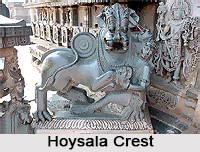
 The crest of the Hoysala household is seen on temples throughout the South. Often the figures on either side of the doors incorporate the theme, or there are carvings on the lintels.
The design of the crest depicts Sala (the founder of the dynasty), engaged in fierce struggle with a tiger. According to a legend this image represents a real encounter, which took place when a monk with whom Sala was travelling was attacked by a tiger. In his panic, he cried out to the future king hoysala (kill it Sala). The fearless warrior did just that, overcoming the tiger in straight combat, and earning for himself the title by which his dynasty became known.
The Hoysalas, ruled between the 11th and 14th centuries, and originated in the hill tribes of the Western Ghats. For a long rime, they were feudatories of the Chalukyas. They did not become fully independent until 1190 A.D., though they first rose to prominence under their leader Tinayaditya (1047-79 A.D.), who took advantage of the vanishing power of the Gangas and Rastrakutas. Under Bittiga (1108-52 A.D.), better known by his later name of Vishnu-vardhana, they began to develop and it was during his reign that the distinctive temples at Belur and Halebid were built, which distinctly bear the Hoysala crest in their entrance doorways. These temples are squat, star-shaped structures set on a platform to give them some height. They are more human in scale than the soaring temples found elsewhere in India, but what they lack in size they make up for in the sheer intricacy of their sculptures.
A study of these sculptures reveals that the arts of music and dancing were highly regarded during the Hoysala period. The Hoysalas converted to Jainism in the 10th century, but then took up Hinduism in the 11th century. This is why images of Saivite, Vaishnavite and Jain sects coexist in Hoysala temples.