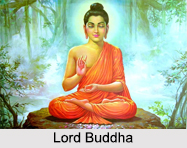
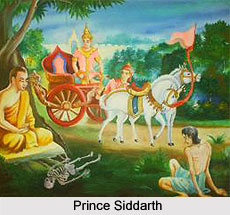
 Buddha lived first twenty-nine years of his life as a prince of Kapilavastu and was totally unaware of the real world outside the palace. His father King Suddhodhana tried to protect his son from being a monk and kept him sheathed within the palace wall. But suddenly Prince Siddhartha decided to see how the people in his town were living and managed to come out of the palace wall accompanied by his servant, Channa. He came across a weak old man, a sick person, a corpse and he was shocked by the reality of life. Siddhartha saw the mortality and realized that no man can avoid the disease old age and ultimately death and also thought that one day his turn will come, too. While thinking this, Siddhartha met a monk and was impressed by seeing the serenity and peace at his face. So Siddhartha decided to renounce the material world, which was full of luxury and comfort and also sufferings and pain and made his mind to find the reason and solution of earthly sufferings and pain. He actualized that all worldly happiness was transitory and resolved to enter the monastic life.
So one night Siddhartha left his palace with his servant Channa and horse Kanthaka, leaving the luxuries and comfort of the royal life far behind to become a mendicant. It is said in the Buddhist scriptures that the horse`s hooves were muffled by the gods in order to prevent the guards from being aware of Siddhartha`s departure. This event is known as `Great Departure`.
Siddhartha initially went to Rajagaha and began his ascetic life by begging for alms in the streets of the city. King Bimbisara recognized Siddhartha and offered him his throne after hearing about Siddhartha`s quest. Siddhartha rejected the offer but promised to return to the kingdom of Magadha after attaining the enlightenment.
After that Siddhartha left Rajagaha and started practicing under two hermit teachers. He mastered the teachings of `Alara Kalama` and was asked by Kalama to follow him but he left his teacher, as he was unsatisfied with his practices. Siddhartha then became a student of Udaka Ramputta, but again he moved on, as he was not satisfied with his path. However he achieved high levels of meditative consciousness.
Siddhartha then formed a group with five companions led by Kondanna in order to achieve further austerities. They tried to attend enlightenment through total deprivation of worldly goods, including food, practicing self- necrosis. Siddhartha starved himself to almost death as he restricted his food intake to only a leaf or nut every day and collapsed in a river while taking bath and almost drowned. Siddhartha gave a second thought about his path. Then suddenly he remembered a moment from his childhood while he was watching his father to start the season`s plowing and had fallen naturally concentrated and focused. This thought showed him the hint of the real path for enlightenment. At this point he decided to give up the extreme life he had been living, eat food in moderation and adapt the `middle path` or the moderate way.