Downfall of Kushana Empire
|
Kushana Empire witnessed a decline after the death of Vasudeva I in 225. The kushanas were turbulent tribes.
|
|
|
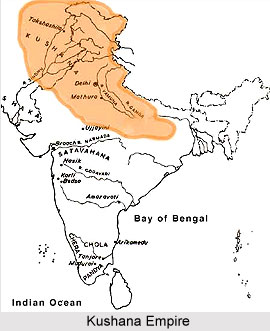 Kushana Empire split into western and eastern halves. Kushana Empire was one of the most powerful Empires in ancient India. Kushanas were turbulent tribes, who established their Empire in ancient India after confronting several obstacles. The Kushanas were mighty conquerors and the Kushana Empire stretched to a vast extent including the entire parts of Northern and northwestern India. The Kushana Empire was destined to decline due to the weak successors of Kanishka or the later Kushanas. After the death of Vasudeva, forces of disintegration set within the Kushana Empire, which was already in the verge of downfall. Kushana Empire split into western and eastern halves. Kushana Empire was one of the most powerful Empires in ancient India. Kushanas were turbulent tribes, who established their Empire in ancient India after confronting several obstacles. The Kushanas were mighty conquerors and the Kushana Empire stretched to a vast extent including the entire parts of Northern and northwestern India. The Kushana Empire was destined to decline due to the weak successors of Kanishka or the later Kushanas. After the death of Vasudeva, forces of disintegration set within the Kushana Empire, which was already in the verge of downfall.
Historians have opined that after the demise of Vasudeva I, the Kushana throne was ascended by Vasudeva II and later by Kanishka III. But there is nothing to prove the authenticity of this fact. Moreover historians contradict over their views regarding the relationship between the kings. Hence it is generally believed that whoever the successor of Vasudeva was, ruled for 30 years and during this time Kushana Empire completely declined.
Forces of disintegration had started showing signs within the Kushana Empire, during the time of the later Kushana Kings. Kushana Empire was a vast kingdom and to maintain the local and provincial administration, the antecedent of the Kushana Dynasty appointed local chiefs. But the later Kushanas were incompetent enough and they could not hold their authority properly over the local and provincial administration. The later Kushanas were not even mighty militants like their predecessors and hence could not suppress the rebellion initiated by the local chiefs. Saka Satraps of Western and Central India who offered their allegiance to the Kushana suzerain became independent taking advantage of the weakness of the later Kushanas. In the meantime the Nagas rose to power in this region, defying the Kushana authority.
The Puranas mention that the Mathura and Padmavati regions were ruled by the Nagas before the Guptas. It has also been mentioned in the Puranas that the Nagas suppressed the Kushana dominance in the areas of Mathura and emerged victorious. The Yaudheyas ousted the Kushana supremacy in wide regions of the Sutlej valley in Punjab. To the east of Mathura, the Maghas also rose to power. The Kunidas overthrew the weak Kushanas from the regions of Yamuna and Sutlej. The regions of West Punjab and northwest were occupied by the tribes called Shakas and Shiladas. Some other tribes called Sanchi, Jhansi and Bhilsa occupied the other fragmented portions of the Kushana Empire. Internal dissension within the Kushana Empire weakened the very foundation of the Kushana Empire in India, which ultimately led to the downfall of the Kushana realm.
When the very foundation of the Kushana Empire started to collapse within the heart of India, the successors of the Kushana King Vasudeva I precariously clung to their position in the Northwest Frontier Province and Afghanistan. But this last stronghold of the Kushanas were suppressed and shattered completely by the Sassanian invasion from Persia. However the vigour of the Kushanas after their complete disintegration was not exhausted. Some Kushana tribes called the Kidara Kushanas flourished in Kabul Valley.
|
|
|
|





