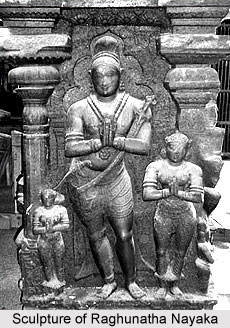
 Succeeding his father Achyutappa Nayaka and contributing in no small measure to the cultural wealth of the Tamil country, Raghunatha Nayaka of Tanjavur established himself as one of the most illustrious kings of the medieval period in South India. Achyutappa appointed Raghunatha as the crown prince early in his own reign, probably as early as 1589 A.D., and he thus gained enough experience in the administration of the kingdom to become a very competent ruler in his own right in 1614 A.D. He participated in a number of wars involving the gradually weakening Vijayanagara powers. Raghunath nayaka was not much known for his prowess as a warrior or general as for his very great contribution to religion and the fine-arts.
Epigraphical records have well attested Raghunath`s impartial patronage of Vishnu and Siva temples as well as other religious faiths. The Ramaswami temples at Kumbakonam as well as the temples for Rama at Rameshwaram and Srirangam were constructed during his time. The gopura of the Kumbheswara temple at Kumbakonam was also constructed under his sponsorship. Raghunath is known for the interest he evinced in the celebration of the rathotsavams (temple-chariot festivals or ther) of numerous shrines of his land. He honoured the renowned Madhva preceptor Sudhindra by performing kanakabhisekham (bathing him with gold). Christian merchants were permitted to settle at Nagapattinam and Tranquebar (Taragambadi) under his reign.
Under Raghunatha`s reign Tanjavur became a centre of literature and fine arts, especially music and dance was largely enhanced. He was a scholar and a talented poet who was proficient in Sanskrit and Telugu, his mother tongue. He authored numerous books in Sanskrit and Telugu language. It is believed that the Telugu poem Parijatapaharna was composed by Raghunatha in a span of six hours. Valmiki Charitam, Rukmini-parinaya Yakshaganafiajendra Moksha, Nala Charita and other works have been attributed to him. A biography of his father called AchyuUndrabhyudaya gives many details about the Tanjavur Nayakas.
Numerous poets and scholars flocked to Raghunath`s court where they were honoured and patronized. A very talented poetess of his court was Ramabhadramba. He was a musician and a musicologist and is believed to have audiored a treatise on music in Sanskrit known as Sangria Sudha, but tliere are some who believe tliat it was actually composed by his scholar-minister Govinda Dikshita. Raghunatha created a new tune (rajja) called Jayantasena and new talas such as Ramananda. He was also an expert in playing on the veena. A new variety of this instrument with twenty-four frets was called Raghunatha Mela Veena, after this king.He was very interested in dance and wrote a Sanskrit work called Bharata Sudha. Dancers frequented his court and often received expensive gifts from him.