N.S.Bendre
|
Narayan Shridhar Bendre’s early work has been considered as intellectual and impressionist. His dominant subject was the landscape.
|
|
|
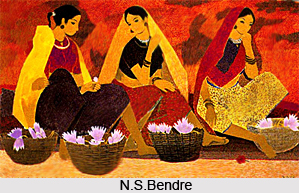 Narayan Shridhar Bendre was born in a Deshastha Brahmin family in 1910 in Indore. He had undergone his early art education in the State Art School, Indore. Thereafter, he obtained his Government Diploma in Art from Bombay in 1933. As he was an enthusiastic traveler he visited many places and captured those on his canvas with different stylistic means. Initially his interests centered on the quasi-mode-mist landscape painting of Indore School. However, later his favorite subjects were landscapes and portraits in oils and gouache. He had experimented with cubist, expressionist and abstract trends. Narayan Shridhar Bendre was born in a Deshastha Brahmin family in 1910 in Indore. He had undergone his early art education in the State Art School, Indore. Thereafter, he obtained his Government Diploma in Art from Bombay in 1933. As he was an enthusiastic traveler he visited many places and captured those on his canvas with different stylistic means. Initially his interests centered on the quasi-mode-mist landscape painting of Indore School. However, later his favorite subjects were landscapes and portraits in oils and gouache. He had experimented with cubist, expressionist and abstract trends.
This resulted in works like Sunflowers, The Parrot and the Chameleon and "Thorn" which won National award in the year 1955 where he elegantly combined European modernism with Indian formal thematic reflection. In 1940 he had moved to Madras to work as an art director for a film company. In the year 1945 he had stayed in Shantiniketan as an artist with Nandalal Bose, Ram Kinkar Baij and Binod Bihari Mukherjee. Thereafter he travelled abroad to places like New York, Europe, West Asia, Japan and London where hi exhibited his works as well as met many modern European artists.
Then he came back to India. From 1950 to 1966 he served in the Department of Paintings in Faculty of Fine Arts, Baroda and left it when he was a Dean. He had received a Silver Medal from the Bombay Art Society in 1934, followed by a Gold Medal in 1941. In 1956 he formed the Baroda Group of Artists. He was awarded Padma Shri in the year 1969. He was also the Chairman of the International Jury at the Second Triennale in New Delhi in 1971 and a fellow of the Lalit Kala Academy in 1974. He had received the Aban-Gagan Award from Viswa Bharati University in 1984, and the Kalidas Samman in 1984. He passed away in February 18th, 1992.
Bendre's creativity initially was concerned with the appearances of things. He cultivated a technique to present them in his work in an academic style. He gradually became familiar with contemporary world trends. He studied tenets of Cubism and became aware of the significance of known aspects of an object. He was convinced when he was engaged in cultivation of non-representational art forms.
|
|
|
|





