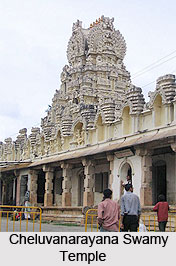
 Melkote, also known as Melukote, is one of the holiest places in Karnataka. Built on rocky hills and nestled on the banks of Cauvery River, it presents amazing scenes to the travelers. This holy place is also known as Thirunarayanapuram. Melkote is famous for spots like Cheluvanarayana Swamy temple, Melkote temple Wildlife Sanctuary, Library and Sanskrit College etc.
History of Melkote
During the 12th century, Srivaishnava saint Sri Ramanujacharya lived here for a period of 14 years. This place developed as a major center for the Srivaishnava sect of Brahmins. The Hoysala king, Vishnuvardhana, granted a land on which this center was built. He was also given eight villages that were located on the either banks of the river Cauvery.
Religious Spots of Melkote
The main shrine which is Cheluvanarayana Swamy Temple is simple but huge. The temple has been dedicated to Lord Cheluva-Narayana Swamy or Tirunarayana. The deity is made of metal and it is called Utsavamurthi. The deity is also known as Cheluvapille Raya or Cheluvanarayana Swamy. His original name, however, is said to be Ramapriya. According to a prevalent legend, this metallic image was lost and was later recovered by Ramanujacharya. The historical sources have pointed out that the principal idol in this temple was widely worshipped even before the sage started the cult of worshipping it in Melkote, Karnataka. Rather it is believed that he made use of its popularity to rebuild and renovate the temple in this Mysore region. Evidences in the form of monolithic records prove that the worship of this deity existed in places like Tamil Nadu and in the form Vaishnava worship.
The temple became famous when it was under the patronage of Mysore Rajas. They donated expensive ornaments for the goddess and thus the temple in Melkote in Karnataka was richly endowed with gifts. The Wodeyar king, however, handed over the temple to the Brahmins as he adopted the Srivaishnava faith. The bass statute of this king has been constructed on one of the pillars of navaranga.
 The statue is around one and a half feet high. He was a devout believer of this goddess and frequented the temple. He presented the deity with a gold crown fitted with precious stones. This crown was named Raja Mudi after his name. According to folklores, the raja was seen entering the temple before his death and he never returned.
Certain gold jewels point out that they were gifts from Krishnaraja Wodeyar III. He, too, donated a crown that is called Krishnaraja-Mudi. Apart from this, the goddess also received a crown known as Vairamudi or Vajramukuta. However the presenter of this crown is anonymous. These crowns are kept with the government and during festivities they are taken out. For instance on the annual celebrations of Vairamudi, the crowns are taken out to embellish the idol of Cheluvanarayana Swamy. This festival witnesses a turnover of over 400,000 people every year.
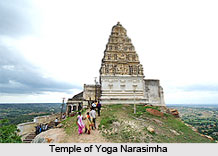
The temple of Yoga Narasimha is situated on a hilltop. Krishnaraja Wodeyar III presented a gold crown to this temple. The infrastructure of this temple possesses a large pond named Kalyani. The beauty of the steps leading to water and the mantapas built all around are indescribable.
Other Attractions of Melkote
Melkote also houses the Melkote Temple Wildlife Sanctuary. This Sanctuary was primarily established to protect the wolves. However, now one can find other mammals such as the jungle cat, leopard, bonnet macaque, langur and pangolin.
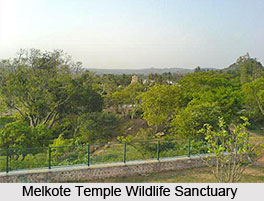 It is also an ornithologist`s paradise, with numerous species of birds native to the area.
Academy of Sanskrit Research is another place of interest among the literature lovers. It was founded by the Government of Karnataka in 1977. The institute carries out research on areas like Vishistadhvaitha, Upanishads and ancient texts. It has a library that is home to 11,000 manuscripts and 35,000 books.
Connectivity to Melkote
The nearest railway stations are located at Pandavapura and Mandya. The closest airport is located in Bangalore. It is also well connected via roads.