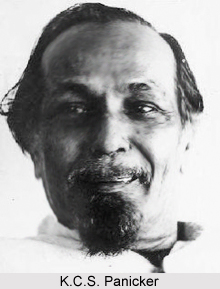
 "I have been influenced throughout my artistic career by the great Indian spiritual thinkers. They explored the metaphysical and the spiritual worlds, while I interpreted it on my canvas." --- K.C.S. Paniker. K.C.S. Panicker is regarded one of the best metaphysical and abstract painters. His artwork during the 60s started establishing a new era of Indian art, in terms of the country`s antique metaphysical and spiritual knowledge. At that time, Western paintings were still dominating over the world of fine arts.
K.C.S. Panicker was born on May 30th 1911 in Coimbatore. He used to live in a lush green village, from where he acquired inspiration. The colourful landscapes, which he created during his early years, were the result of that inspiration. Later he moved away from landscapes onto other things, but the effect of bright colours always stayed in his paintings. A child prodigy, K.C.S. Panicker had started painting landscapes at the tender age of 12. When he was 17, he had presented his paintings at the Madras Fine Arts Society`s annual shows. In 1918, after the death of his father in order to support his family, he took up a job in the Indian Telegraph Department. He had to give up his college education for this.
Later, by the age of 25, Panicker joined the Government School of Arts and Crafts in Chennai. In 1954 he got his first international exposure. During his exhibitions abroad, he came in touch with abstract artists like Sarvodar Dali, who had a major influence in his art. As he recalls, "They hark back to the weird, but spiritually uplifting figurative exaggerations of ancient Indian painting and sculpture." Panicker went on to use calligraphy and symbols down the line, in order to project a state of metaphysical abstraction. K.C.S. Panicker expired in January 1977, at the age of 66 in Chennai.
In 1954, the Ministry of Education, Govt. of India, chose K.C.S. Panicker as one of the Nine Eminent Artists and Member of Executive Board of the Lalit Kala Akademi, New Delhi. He had travelled extensively in England, France, Switzerland and Italy and also had conducted one-man exhibition of paintings at the India House, London, Paris and Lille. Between 1955 to 1958, he was appointed the Vice-Principal as well as Principal of the Govt. School of Arts and Crafts, Madras. In 1959, Panicker travelled extensively in USSR and talked on Indian Art in Moscow, Leningrad and Kiev. In 1961, he took part in the Exhibition of paintings at the VI Bineal de Sao Paulo, Brazil. He had also participated in the Indian Art Exhibition in Mexico and had helped in the upgradation of the
Government College of Arts and Crafts. As a member of the Indian Delegation in 1963, KCS Panicker travelled expansively in USA and took part in discussions with American artists as a guest of the State Department of USA. Between the years 1964 and 1967, he had also participated in the Tokyo International Exhibition, the Festival Hall Exhibition, London (1965), and the Venice Biennale, 1967. He was also conferred the national award for painting in 1966. He had founded the Cholamandal Artists` Village in Madras. In 1967 he retired from the post of the principal of the Govt. College of Arts and Crafts, Madras. In 1976 he was elected Fellow of the Lalit Kala Akademi.