Ashoka`s Inscriptions in South India
|
There are a collection of 33 inscriptions or the Edicts of Ashoka.
|
|
|
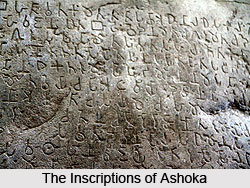 Often cited as one of India's greatest emperors, Ashoka reigned over most of present-day India after a number of military conquests. He was internationally known as Ashoka the Great of the Mauryan Dynasty of North India. Ashoka ruled in the 3rd century BC. It is well knoen that after the battle of Kalinga, which ended in a lot of bloodshed and hardship for the people, Ashoka turned to Buddism and followed the path of non-violence or ahimsa. This emperor also made a unique attempt to communicate to his subjects, spread over a vast area, the message of Gautama Buddha. This he did by inscribing the teachings on specially erected stone pillars and rocks for the common man to read. Most of these inscriptions are found across the length and breadth of North India and even in Nepal. Often cited as one of India's greatest emperors, Ashoka reigned over most of present-day India after a number of military conquests. He was internationally known as Ashoka the Great of the Mauryan Dynasty of North India. Ashoka ruled in the 3rd century BC. It is well knoen that after the battle of Kalinga, which ended in a lot of bloodshed and hardship for the people, Ashoka turned to Buddism and followed the path of non-violence or ahimsa. This emperor also made a unique attempt to communicate to his subjects, spread over a vast area, the message of Gautama Buddha. This he did by inscribing the teachings on specially erected stone pillars and rocks for the common man to read. Most of these inscriptions are found across the length and breadth of North India and even in Nepal.
There are a collection of 33 inscriptions or the Edicts of Ashoka. However very few are aware about the many epigraphs found in several places in South India. His inscriptions on rocks, called rock edicts are found in many areas in present-day Karnataka and Andhra Pradesh like Gavimath, near Koppal in the Raichur district, Maski in Raichur district, Brahmagiri, Jatinga-Rameshwara and Siddhapura in the Chitradurga district of Karnataka and Erragudi and Rajula-Mandagiri in Kurnool district, Andhra Pradesh. These are written in the ancient Brahmi script and the Prakrit language.
The inscriptions proclaim Ashoka's beliefs in the Buddhist concept of dharma ("righteousness") and his efforts to develop the dharma throughout his kingdom. Edits of Ashoka tend to focus on social and moral precepts rather than religious practices. While some texts of few of these inscriptions speak about respecting parents, elders, teachers and following the Dharma on the other inscriptions speak about being kind, humble and speaking the truth. It says by following these beatitudes one shall propound the attributes of Dharma. This is an ancient rule and the principle is venerable.
It is certain that some areas of ancient Karnataka and perhaps Andhra Pradesh were part of Ashoka's far-flung empire, which extended to the south. In any case it is certain that he intended to spread the message of the Buddha in as many regions as possible
|
|
|
|





