Anushilan Samiti - Informative & researched article on Anushilan Samiti
  Indianetzone: Largest Free Encyclopedia of India with thousand of articles History of India


in  
Art & Culture | Entertainment | Health | Reference | Sports | Society | Travel
Forum  | RSS Feeds  | Free E-magazine
History of India : History of India l Medieval History of India l Modern History Of India l Muslim Rule in India l Indian Historical Dynasties l Indian Battles l Indian Natural History l Indian Rulers l Caste System in India l Sources of History of India
Home > Reference > History of India > Modern History Of India > Indian Organisations during Freedom Struggle > Anushilan Samiti
Anushilan Samiti
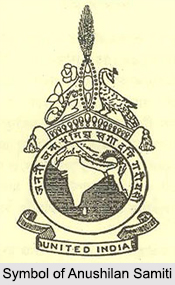
Anushilan Samiti was a revolutionary outfit aimed to free India from the clutches of the British rule.

Anushilan Samiti at the time of Indian Independence was one amongst the secret revolutionary organisations. They were very active in manoeuvering their revolutionary operations throughout undivided Bengal region. Anushilan Samiti means "Self-Culture Association". The organisation used to follow the teachings of `Sahitya Samrat` Bankim Chandra Chattopadhaya. Operations of the Anushilan Samiti was controlled under the pretense of suburban fitness club. Members of the organisation used to believe that the constitution of small, non-terrorist youth clubs committed to the three-fold aims of physical, mental, and moral development of the youth could lead them towards attaining independence. The concept was formulated by Bankimchandra Chattopadhyay, Swami Vivekandanda, and Aurobindo Ghosh, which has its roots in Shakta Hinduism. Their main aim was to create urge amongst the Hindus to become vigorous spiritually, physically and intellectually. As a result unnumbered youth clubs denominated as Anushilan Samitis (Anushilan Samiti) were formed in the rural and urban areas for experiencing mental and physical exercises. These kinds of organisations were formed much before the actual beginning of the revolutionary terrorism.

In the initial phase, Anushilan Samiti was established in 1902 in Kolkata under the headship of Pramatha Nath Mitra, a barrister and a patron of revolutionary movements. Sri Aurobindo and Deshabandhu Chittaranjan Das were made the vice-presidents of the Samiti. Noted revolutionist Suren Tagore became the treasurer. Jatindra Nath Banerjee (Niralamba Swami), Jatindra Nath Mukherjee (Bagha Jatin), Bhupendra Nath Datta (Swami Vivekananda`s brother), Barindra Ghosh were the other legendary nationalist leaders. The partition of Bengal in 1905 led the Anushilan Samiti to take up fulltime extremism programmes. The unpopular educational reforms of Lord Curzon and the partition of Bengal thus are considered the chief reasons behind terrorist activities of Anushilan Samiti. In 1906, a Bengali weekly namely Jugantar (New Age) was published by the members of the Samiti. The purpose of the weekly was to advocate `sedition in no ambiguous terms`.

Bipin Chandra Pal of Anushilan Samiti gave a speech against the Partition of Bengal in Dhaka in 1905, which however had managed to spread tempestuousness among the Hindu gentry of East Bengal. Afterwards, under the leadership of Pulin Bihari Das ( a teacher in Dhaka Government College and a founding headmaster of `National School` (Dhaka)), eighty other young men constituted an Anushilan Samiti in Dhaka in September, 1906. Dhaka was the headquarter of this Samiti. The Calcutta Anushilan Samiti and the Dhaka Anushilan Samiti were now unionised on the lines of the secret societies of Russia and Italy. Jatindranath Banerjee of Calcutta Anushilan Samiti undertook military training in the army of Maharaja of Baroda along with Barindra Kumar Ghosh, younger brother to Aurobindo Ghosh. Calcutta Anushilan Samiti in its beginning was confined to only physical and moral training of the members. The samiti had no significance till the period of 1907 or 1908.

The revolutionary activities of Calcutta Anushilan Samiti started taking off from 1907. On 6th December 1907, members of the Anushilan Samiti had attempted to blow up the train of Lieutenant-Governor of the new province of East Bengal and Assam. On 23rd December, they again initiated to assassinate Mr. Allen, previously District Magistrate of Dhaka. Douglas Kingsford, Magistrate of Calcutta and later District Judge of Muzaffarpur, Bihar became their target, but the members of Anushilan Samiti mistakenly killed two innocent English ladies, Mrs. and Miss Kennedy on 30th April, 1908. Prafulla Chaki and Khudiram Bose, two lionhearted freedom fighters, were involved in the operation. Khudiram Bose was arrested while Prafulla Chaki, within no time intervening, shot himself. Khudiram Bose was judged and hanged till death. This incident, viz. the Muzaffarpur killing, has been imprinted as one of the widely known and esteemed events in the history of Bengal terrorism. Khudiram Bose and Prafulla Chaki became idolised martyrs among the mass Bengalis and their sacrifice inspired more youth to join the revolutionaries.

Other notable members of Calcutta Anushilan Samiti were-- Jatindranath Mukherjee alias Bagha Jatin (1879-1915); Rash Behari Bose (1885-1945); Taraknath Das; Nanigopal Sengupta; Hemendrakishore Acharya Chaudhuri (1881-1938); Narendra Bhattacharya alias M.N. Roy (1887-1954); Atulkrishna Ghosh; Amarendra Nath Chatterjee (1880-1957); Jadugopal Mukherjee (1886-1976); Bhavabhushan Mitra (1888-1965); Bipin Behari Ganguli (1887-1954); Purnachandra Das; Nolinikanta Kar; Bhupendra Kumar Datta (1894-1979); Bhupati Majumdar (1890-1970); Surendra Mohan Ghosh alias Madhu Ghosh (1893-1976); Satish Chandra Mukherjee alias Swami Prajnanananda (1884-1921); Manoranjan Gupta (1890-1976); Arun Chandra Guha (1892 born); Narendra Ghosh Chaudhuri (1894-1956); Kiran Chandra Mukherjee (1883-1954); Harikumar Chakrabarti (1882-1963); Gopen Ray; Jibanlal Chatterjee; Debabrata Bose, later Swami Pragyananda; Ullaskar Dutta.

By the time, in Maniktola garden in Calcutta a bomb-manufacturing factory was ascertained and Barindra Kumar Ghosh, a leader of the Anushilan Samiti, was brought to trial along with other Anushilan Samiti members in the so-called Alipur Conspiracy Case. Many of them were extradited for life to Port Blair in the Andaman Islands. The Alipur Conspiracy Case led to a division within the Anushilan Samiti. Jugantar and Dhaka Anushilan Samiti remained unified in the western and the eastern parts of Bengal respectively. Eventually the government had distinguished the samitis in two broad groups- Jugantar group and Dhaka Anushilan group. Some notable Dhaka Anushilan Samiti Members were-- Makhanlal Sen; Jogesh Chandra Chattopadhyay (1898-1969); Narendra Mohan Sen (1887-1963); Niranjan Sen Gupta; Pratul Chandra Ganguli (1884-1957); Promode Das Gupta (1910-1985); Rabindra Mohan Sen (1892-1971); Sachindra Nath Sanyal (1892-1971); Satish Chandra Pakrashi (1893-1931); Troilokya Nath Chakrobarty (1889-1970). The radical activities in Western Bengal practically came to a halt for some time from 1910, and since then the epicentre of disturbance of radical activities switched to Eastern Bengal.

Dhaka Anushilan Samiti soon became greater in significance compared to its parent body in Calcutta. By 1932 the samiti had 500 branches. It was the orchestrating ability of Pulin Bihari Das, which made Dhaka Anushilan Samiti to hold premier position. It was Pulin Bihari Das who founded the National School in Dhaka. It was basically built as a training ground for raising a revolutionary force. In the beginning the students were trained with lathis and wooden swords. Afterwards they were groomed with daggers and finally with pistols and revolvers. But the arrest of Pulin Bihari Das gave rise to chaos within the Samiti. After him, Makhanlal Sen became his able successor but most of the time he was attached to social welfare and spiritual development taught by Vivekananda, disagreeing with needless violence. He used to spend most of his time in Kolkata in company of the Jugantar people and used to regularly visit the Ramakrishna Mission. He offered the charge of Dhaka Anushilan Samiti to Narendra Mohan Sen. Later, Trailokyanath Chakraborty and Pratul Chandra Ganguli took charge and the rebels within the samiti were united again.

The members of Anushilan Samiti were by and large school and college students who belonged to the Hindu Bhadralok (high-class, well-to-do Bengali households) families. They were divided into two categories- sanyasis and grihis (family men). The Anushilan Samiti members started to raise funds for their revolutionary attempt by despoiling the houses of people who were loyal to the Raj. In 1913, the Barisal Conspiracy case came up and became famous as it imprinted the fact that in Barisal district alone there were hundreds of revolutionary followers of the Samiti. The relation between Dhaka Anushilan Samiti and the Jugantar group became very narrow before the First World War. First World War brought the opportunity for the Bengali terrorists to conflate into united movements. The Jugantar group again rose as a confederation of revolutionary cells throughout the country.

But the British Government continued in keeping nonindulgent vigilance over the suspects. Jugantar group supported Gandhi during the Non-Cooperation Movement. But the Dhaka branch continued their subversive activities. But in 1924, a unity was established between the members of these two groups who were jailed in Midnapur Central Jail. Outside the jail, under the joint leadership of Narendra Mohan Sen of Anushilan, represented by Rabindra Mohan Sen, and Jadugopal Mukherjee of Jugantar, represented by Bhupendra Kumar Datta, the Anushilan Samiti and Jugantar were brought close. But eventually this merger has been failed. The young activists of the revolutions belonging to Anushilan as well as Jugantar, became disappointed with this failure. As a result they formed a new alliance, the Neo-Violence party or the Revolt group in 1929. Pratul Bhattacharya and Niranjan Sen Gupta of the Barisal Anushilan, Satish Chandra Pakrashi and Satya Gupta of the Dhaka Anushilan, Binoy Raychaudhuri and Jatin Das of the South Calcutta Anushilan, Panchanan Chakrabarti and Jatin Bhattacharya of the Madaripur Jugantar, Ananta Singh and Ganesh Ghosh of the Chittagong Jugantar party were the key members of the party.

It was Surya Sen, unanimously known as `Masterda`, who carried on probably the last radical terrorism in East Bengal. He was a member of the Dhaka Anushilan Samiti as well as the Jugantar group. On April 18, 1930 Masterda and his followers coordinated the Chittagong armory raid. This incident of Anushilan Samiti was unusual for the organisation. This terrorist activity is considered a prowess in the history of terrorist movement. Masterda was arrested and hanged till death on 12 January, 1934. However, Masterda left a spark with this radical movement, in such a point of time when the organisation had started changing their ideology. The British government was also contriving to quit India. Anushilan Samiti also merged with the Congress. The revolutionary ideas of Anushilan Samiti started evolving towards a new direction.

Thus it can be said that after Surya Sen`s precarious move, Revolutionary Terrorism came to an end by 1936. The Jugantar members brought out a statement on 9th September, 1938 not to reorganise a separate party. They had also stated that they would acknowledge full allegiance to the Congress. Anushilan Samiti germinated into the Revolutionary Socialist Party. The wing in East Pakistan developed into the Shramik Krishak Samajbadi Dal in contemporary Bangladesh.

(Last Updated on : 31/01/2009)
  More on Indian Organisations during Freedom Struggle...
 
Anushilan Samiti Bengal Volunteers Jugantar
Ghadar Party Indian Independence League Hindustan Socialist Republican Association
Berlin Committee Hindu Mahasabha Women Labour Organizations In British India
Recently Updated Articles in History of India
  • St. Thomas
    St. Thomas is considered to have preached Christianity in Kerala after he arrived at the Muziris port in A.D. 52.
  •  
  • Impact of Portuguese Rule in Kerala
    Impact of Portuguese rule in Kerala contributed to the advancement of educational system in the state along with advanced mode of agriculture and foreign trade.
  •  
  • Turtle
    Turtle belongs to the order Testudines and the super order Chelonia. It possesses a distinct cartilaginous or bony shell which is developed from the ribs of the turtle and it does the function of a shield.
  •  
  • Sea Turtle
    Sea Turtle lives most part of its life in seas and is found in the shallow coastal waters of temperate and warm seas.
  •  
E-mail this Article | Post a Comment
Free E-magazine
Subscribe to Free
E-Magazine on History of India

 
Anushilan Samiti - Informative & researched article on Anushilan Samiti
Sitemap
Contact Us   |   RSS Feeds
Copyright © 2008 Jupiter Infomedia Pvt. Ltd. All rights reserved including the right to reproduce the contents in whole or in part in any form or medium without the express written permission of Jupiter Infomedia Pvt. Ltd.
