


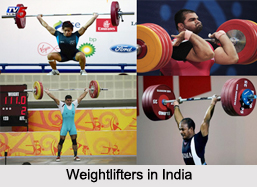
 Weightlifting in India has become a popular event in the recent years. India is a country with no dearth of games, as varieties of sports and games from every corner of the world ventured in India and were practiced all over the country. India, like many other sport, welcomed weightlifting too, which was practiced in ancient Egyptian and Greek societies. Weightlifting in India has become a popular event in the recent years. India is a country with no dearth of games, as varieties of sports and games from every corner of the world ventured in India and were practiced all over the country. India, like many other sport, welcomed weightlifting too, which was practiced in ancient Egyptian and Greek societies.
History of Weightlifting The importance of weightlifting made it one of the prominent games to make a place in the first modern Olympics in 1896 in Athens. But the first World Championship was held on 28th March 1891 in London where 6 countries participated with 7 athletes representing them. In 1935, the Indian Weightlifting Federation was formed. Sir Bijoy Chand Mahatab of Burdwan was its first president and N.N. Bose, Barristar-at-Law, was the first honorary secretary. In the same year it got affiliated with the Indian Olympic Association and International Weightlifting Federation. In the 1936 Berlin Olympic Games, Indian weightlifting team participated for the first time. Similarly, in the Asian games India participated in 1951 games held in Delhi and in the Commonwealth Games in 1966, at Kington. Body weight Categories in India There are five body-weight categories were established for the Olympic Games. They were Feather Weight (60 kg), Light Weight (67.5 kg), Middle Weight (75 kg) Light-Heavy weight (82.5 kg) and Heavy weight (90 kg) and in 1972 Fly weight (52) and Super heavy weight (over 110 kg). A new category (100 kg) was added again in the year 1980. Weightlifting in Olympics Weightlifting got place in modern Olympics in 1920 at the 7th Olympic Games in Antwerp, Belgium. The World War II also could not affect the popularity of the game and total 14 nations competed for the Weightlifting title in that Olympic. Weightlifting in India is popularly known as lifting only. In this game of strength, the participants need to lift heavy weights attached to the steel bars known as barbells. Indian Weightlifters Indian Women weight lifters competed in the World Championship for the first time in 1989 at Manchester although it started in 1987. Kunjurani Devi from Manipur earned three silver medals in that competition. Laita Polley from West Bengal added two bronze medals to this glory. In individual lifts, Shyamala Shetty and Chhaya Adak owned two medals. Events of Weightlifting in India 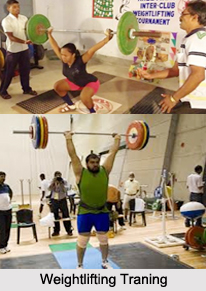 Weightlifting in India can be divided into two events: "snatch" and the "clean and jerk". In 1972 Olympics, the "clean and press" or simply "press" type was introduced but later got abolished for creating problems in judging. Weightlifting in India can be divided into two events: "snatch" and the "clean and jerk". In 1972 Olympics, the "clean and press" or simply "press" type was introduced but later got abolished for creating problems in judging.
Importance of Indian Weightlifting Federation Indian weightlifting federation has it's headquarter in New Delhi, which is affiliated under the Indian Olympic Association, Delhi. Indian weightlifters got a full squad entry in World Championship only in 1957 at Tehran. In that competition Indian participator Mookan reached the highest ever eighth position. In the lightweight category, Alok Nath Ghosh was positioned 10th. Indian weightlifters in 1995 World Championship Indian weightlifters continued its glorious journey at the 1995 World Championship also by winning three gold and six silver medals. Karnam Malleswari won gold medals both in the clean and jerk category and in the snatch category by lifting 113kg and 90 kg respectively. Thus she became the first India woman two win the World title for twice. Few other names that had their part in this success story are Manitombi Devi of the Central Reserve Police Force at the fourth position, Jeevan Jyothi at 5th position and Susmita Laha stood 5th in 76 kg. Above all, the official mouthpiece of the international weightlifting federation, World Weightlifting magazine ranked Indian weightlifters Kunjurani Devi and Karnam Malleswari as World no 1 weightlifter. Indian weightlifting in 1966 Commonwealth Games The Indian weightlifting fame did not stop there as in 1966 Commonwealth games at Kingston, Jamaica, Mohan Lal Ghosh (60kg) created a record for decades by winning a silver medal for jerk category. Indian Weightlifting in 1978 Games In 1978 games, held in Edmonton, Canada, E Karunakaran won a gold medal in the flyweight section. He made another record by winning four gold medals in the Commonwealth games and for winning championship at a stretch from 1978 to1981. Weightlifting in India in 2000’s Weightlifting in India got a jolt when three Indian weightlifters S. Sunaina, Sanamacha Chanu and Pratima Kumari were found guilty of doping in many international competitions in a year. For this reason, International Weightlifting Federation barred the Indian Weightlifting Federation for one year. But these issues cannot blemish the other victories by our Indian weightlifters like Karnam Malleswari's achievement of being the first Indian who got an Olympic medal at the 2000 Summer Olympics at Sydney. One more Indian weightlifter, Geeta Rani became the star at the Commonwealth Games (2006) by winning the gold medal in women's + 75 kg category. Weightlifting in 2010 Commonwealth Games The 2010 Commonwealth Games event was a disaster for all weight lifting athletes. Our players were defeated by lesser known teams, and it was a terrible outing for players for sure. Indian weight lifting team won a total of eight medals out of which only two were gold. Preparation of Weightlifting in India To take weightlifting as a profession, one needs to get prepared from his younger days because fitness and strong body build are important criteria for approaching towards this field. It needs an experienced trainer to prepare a competitor to participate at the international level. If the glorious tradition of weightlifting in India has to continue, well equipped training institutes have to come up and encourage the young talents to get trained to represent the country in International events. |
| |||



Weightlifting in India
| Weightlifting is a popular sporting event in India, which requires strength, agility and power. The weightlifters of India show their talents in regional, national and international sports arena. |
| ||||||||||||||||||||||||||||

