


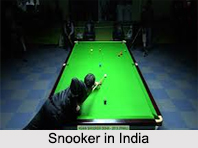
 Snooker in modern India is not a popular sport for every one. This game is concentrated among the rich people of India. Snooker is a game played on a table covered with baize. The snooker has its origin back to the later half of 19th century. The exact origin is not written anywhere clearly but it is recorded that Colonel Sir Neville Chamberlain visualized the game in the British army officer's mess in Jubbulpore, India, in 1875. Snooker in modern India is not a popular sport for every one. This game is concentrated among the rich people of India. Snooker is a game played on a table covered with baize. The snooker has its origin back to the later half of 19th century. The exact origin is not written anywhere clearly but it is recorded that Colonel Sir Neville Chamberlain visualized the game in the British army officer's mess in Jubbulpore, India, in 1875.
Term of Snooker The term "snooker" is originated from a slang word used for the first year cadets of British army or for inexperienced personnel. First World Snooker Championship The First World Snooker Championship was held in 1927, which was organized by Joe Davis, a professional English billiard and snooker player. Due to his initiative, the game got a professional status from just a pastime activity. Introduction of Snooker in India Snooker is a blend of pyramid pool and life pool games. The restricted rules of the game were first published in 1882 in a meeting of the British officers at Udhagamandalam and Ootakamund which is now called as Ooty in the Nilgiri District of modern Tamil Nadu. But it was not accepted by the governing body of that period, "The Billiard Association" until 11th December 1900. The snooker in India got spread all over by Chamberlain through his postings in different parts of the country. Cloth of Snooker Table The cloth of the snooker table in India is made of 100% wool and specifically made for this purpose only. The pockets of the table are also made according to the governing body tables. Objective of Snooker 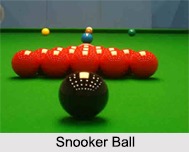 The aim of the game is to score maximum points to beat the opponent by potting balls in a predefined order. The 15 red pyramid balls are racked up in a triangle together with the balls from Life pool that are placed separately and the black is placed below the reds at the foot of the table. Then the players hit the shots one by one. They intend to pot one of the red balls to score a point. If the player succeeds to pot a red ball then another chance is given to pot the other coloured balls. The points earned on potting the yellow ball are 2, 3 for the green, 4 for the brown, 5 for the blue, 6 for the pink and 7 for the black. The process is repeated until the player fails to pot the desired ball and then the opponent comes to take his turn. When on the board only the 6 coloured balls are left and all the red balls are potted the coloured balls are then placed at 2, 3, 4, 5, 6, 7 order. The balls remain of the table while potted in this phase. The game ends with the potting of the final ball and the player with higher points is declared as the winner. The aim of the game is to score maximum points to beat the opponent by potting balls in a predefined order. The 15 red pyramid balls are racked up in a triangle together with the balls from Life pool that are placed separately and the black is placed below the reds at the foot of the table. Then the players hit the shots one by one. They intend to pot one of the red balls to score a point. If the player succeeds to pot a red ball then another chance is given to pot the other coloured balls. The points earned on potting the yellow ball are 2, 3 for the green, 4 for the brown, 5 for the blue, 6 for the pink and 7 for the black. The process is repeated until the player fails to pot the desired ball and then the opponent comes to take his turn. When on the board only the 6 coloured balls are left and all the red balls are potted the coloured balls are then placed at 2, 3, 4, 5, 6, 7 order. The balls remain of the table while potted in this phase. The game ends with the potting of the final ball and the player with higher points is declared as the winner.
Points in Snooker in India A snooker player in India can also earn points while an opponent fouls by hitting any other colour balls when trying to hit a red or by potting a colour which was not being attempted. The opponent's foul may award 4 to 7 points to the player. Use of Accessories Indian snooker players use various accessories which include chalk for the tip of the cue, a triangle to rack the reds and a scoreboard. The huge size of the snooker table prevents it to be played anywhere. Snooker in India is generally played either in private surroundings or in public snooker halls. Now the snooker tables used in India have an internal playing size of 11ft 8.5 inches and 5ft 10 inches with two unequal halves if cut across the middle pockets. In 1970s and 1980s, a new "matric" size snooker table was introduced which was an exact square measuring 1.75m and 1.75m. But it could not continue and the earlier unequal form was accepted again. World Championship is the most significant event in the snooker game which is being held since 1927. Snooker Players in India Pankaj Advani is one of the most successful snooker players of India. He won his first title in China in 2003 IBSF World Snooker Championship. Then defeating his fellow countryman Devendra Joshi he became the second cueist to win both the English billiards and snooker amateur world titles. He achieved the gold medal in 2006 Asian games in English billiard singles. Apart from this he also won many other accolades such as India Billiards Championship, India Junior Snooker Championship, India Junior Billiards Championship, WSA Challenge Tour and more. He was also endowed with Rajiv Gandhi Khel Ratna Award only at the age of 21. Manan Chandra, is another snooker player in India who reached up to the semi final at 2006 IBSF World Championships. Yasin Merchant, Geet Sethi and Anuja Thakur are few other notable names in the snooker game in India. There is no dearth of talented snooker players in India but the women version of the game is yet to get its due. Due to lack of infrastructure and tables for practice the game is not getting enough promotion in smaller towns. Even regular arrangement of tournaments in the country is not being possible due lack of facility. Now, only the support from corporate sponsors and state associations can revive snooker in India. |
| |||



Snooker in India
| Snooker in India is held without any promotions. This game is concentrated among the posh families. The snooker players have over the years represented India at various national and international events. |
| ||||||||||||||||||||||||||||

