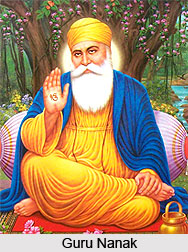
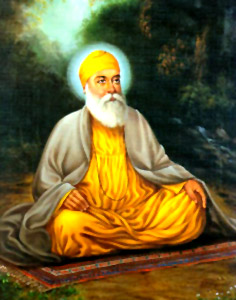
 History of Sikhism commences with Guru Nanak and continues for a time period of two centuries under the guidance of nine other successors. Guru Nanak preached Sikhism throughout the country by travelling extensively. The initial period of Sikh history terminated with the death of Guru Gobind Singh in 1708.
Significant events in Sikh History
Three significant events had taken place during the initial period of the Sikh history. The first notable event of the Sikh history was the appointment of a successor by Guru Nanak to lead the Sikh community which had sprang up during the time of Guru Nanak. The second important event took place in 1603- 1604 when the fifth guru of the Sikhs, Guru Arjan Dev compiled the canonical scripture of the Sikhs. Guru Gobind Singh in 1699 laid the foundation of the third significant event by establishing the Khalsa Panth.
The lineage of gurus started by Guru Nanak provided a continuity of leadership to the Sikh community. Compilation of the teachings of the first five gurus gave the Sikh Community a permanent source of reference to the teachings of the gurus. Last but not the least establishment of the Khalsa incorporated a rigorous discipline into the Sikh community. With the Khalsa Panth percolating into the Sikh lives the Sikhs got a way of life which they should adhere to in order to be a member of the Sikh Community.
Eras in Sikh History
The Sikh history can be divided into important eras. The first era in the Sikh history is the Guru`s period era. The guru`s period era spanned from 1469 to 1708. During this period the three notable events of the Sikh history took place. At this time all the ten gurus of the Sikh community preached the masses the essence of leading a righteous life. All the nine gurus after Guru Nanak followed his footsteps and glorified the name of the Lord. They contributed towards the Sikh community in various ways. Before his death Guru Gobind Singh ended the authority of personal gurus and made Guru Granth Sahib the ultimate authority of the Sikhs.
Banda Singh Bahadur was the first to establish a Sikh kingdom. Guru Gobind Singh had inspired Banda Singh so much that he became an ardent follower of the last Sikh guru. Soon after becoming a Sikh disciple, Banda Singh attacked Sirhind with immense valour and religious fervour. The ruler of Sirhind was defeated and Banda Singh soon became the ruler of Sirhind. He took a number of steps for the upliftment of the poor and the underprivileged. In 1716, Banda Singh became a martyr in the name of Sikhism at the hands of the Mughals.
The death of Banda Singh was followed by a period of severe mistreatment and rampant exploitation of the Sikhs. This phase continued for a period of 50 years. During this time the members of the Sikh community were brutally slaughtered and all their lands and property were persecuted. Only a handful of Sikhs could escape the inhuman treatment which was bestowed upon them. Rules were passed to permanently annihilate the Sikhs. At this juncture, the Afghan monarch Ahmed Shah Abdali entered India. His coming into the country threatened the authority of the rulers. Although the rulers were intimidated by the entry of Ahmad Shah Abdali but the Afghan monarch was also not a saviour for the Sikh community. He attacked the Sikhs in a fiercer manner. In 1757, Ahmad Shah Abdali destroyed the Golden Temple of Amritsar also known as the Harmandir Sahib. The conflict between the Afghan monarch and the Sikh community reached its climax in 1762 when a large number of Sikh people were slaughtered on a single day. This day is known as the `second holocaust` or `vaddaa ghallooghaaraa` in the history of Sikhism.
The year 1760s and 1770s saw the resurgence of the Sikh power under the influence of independent groups led by different chieftains. These small groups established their supremacy over Punjab and Lahore. As these groups were divided, they did not have ant chief ruler. With the emergence of Ranjit Singh the vacuum was filled. Ranjit Singh emerged as a very powerful ruler during this time. He had conquered Lahore only at the age of 19. Maharaja Ranjit Singh compensated for all the sufferings which the Sikh had undergone during the era of religious persecution. He allowed the Sikhs to lead a fearless civilian life. He built a large number of gurdwaras for the Sikh community. During his reign the Sikh community prospered greatly.
After the death of Ranjit Singh in 1839, the stability established by him within the Sikh community soon began to crumble. Bitter squabbles periled the Sikh kingdom and the British took undue advantage of the tumultuous situation. In 1849, Punjab was annexed and hence brought about an end to the Sikh kingdom. But the British knew about the valor and grit of the Sikh community and so they incorporated a large number of Sikh soldiers into the army. Large number of Sikhs was a part of the Indian freedom struggle and many had become martyr in the process. The partition of India in 1947 triggered a widespread conflict and as a result large number of Sikhs was persecuted.