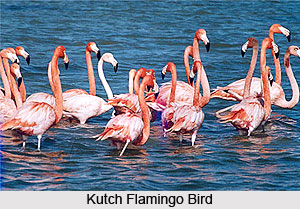
 Kutch is not just all about rocky hills amidst the saline desert, a buried city of the harappan civilization which was recently excavated, innumerable fossils, the breeding ground of the Greater Flamingo (`Flamingo City`) and herds of 30-40 Indian gazelles sprinting on the mudflats at the edge of a hilly island, if you feel so then, the Kutch Desert Sanctuary in the Great Rann of Kutch is waiting for you. This is the largest sanctuary in the state and one of the largest in the country too. Of the 7505.22 sq. km area of the Sanctuary, 109.00 sq. km is the forest area notified under section- 4 of the Indian Forest Act, 1927 and 1313.07 sq. km is a revenue wasteland. Remaining area of the Sanctuary is Territorial Water of India in the Arabian Sea (not now). The Sanctuary is located in the north-eastern part of Kutch district bordering Pakistan and Wild Ass Sanctuary. The Sanctuary was declared in February 1986.
The Great Rann, a part of the Rann of Kutch, is a salt-impregnated wilderness region having an area of about 16000 sq. km. Its average altitude is 15 m above Mean Sea Level (MSL). The area encompassed by the Sanctuary is characterized by vast, salt-impregnated sun-baked mud flats, which are dotted with small patches of uplands and few hilly islands (locally called `bets`). Though the Great Rann is similar to the Little Rann in several ways, the former differs in its silt deposition characteristics. Thus, the silt of the Great Rann has been the deposit of the Indus River, unlike that of the Little Rann, which shows strong resemblance to the material that was derived from the local sources of Gujarat.
The Great Rann owes its origin to a marine transgression. Waters of the Arabian Sea enter the Rann through the Kori creek. The gradual regression of the sea level is clearly shown by the presence. of marine calcareous grit and oyster bed as also by the swash marks and water line at the height of several meters from the present water level at one of the hilly islands within the Great Rann. During the Mesozoic period (65-60 million years ago), the Great Rann was a part of the Arabian Sea. However, when Alexander the Great visited the area in 325 B. C. the Rann was no longer an arm of the sea, but it was a navigable lake. It was a shallow lagoon during the 3rd century A. D.
The Great Rann has been tectonically unstable since a long time. Tectonism was effective till as late as 1819, when a major earthquake destroyed the Indus River connection with Kori creek. The earthquake also gave rise to the `Allah Band`s linear mound-like formation, about 5-10 m high and 50 km long.