|
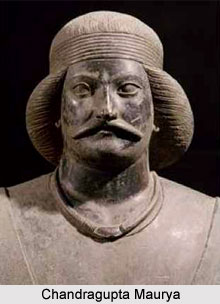 Chandragupta Maurya, the paradigm of a warrior Kshatriya, according to the Buddhist tradition, is a descendant of the Moriya Kshatriya clan of Pipphalivana. As is mentioned in the Buddhist texts, Chandragupta was not blessed with royal parentage and did not have any dynastic connection. Chandragupta's father was a chief of the Moriya clan and was killed in the battle. His widowed mother took refuge in Pataliputra, the capital city of Magadha during that time and somehow gave birth to a male child, who was named Chandragupta. As a boy Chandragupta was reared in a village among cowherds and hunters. Coincidentally while playing a mock royal court with his village playmates, Kautilya happened to pass by that way. Kautilya, highly impressed by the majestic benevolence and dignified potentiality of the boy, purchased him on the spot from his adopted father, who was a cowherd by paying 1000 Karshapanas (coins). Kautilya then brought the young Chandragupta to the city of Taxila and provided him with thorough education of humanities, arts, crafts and military science with the solemn aim to guide him properly for the future royal office. Thus the Buddhist tradition has some resemblance with the classical accounts of Justin who opined that Chandragupta belonged to a humble origin but was promoted to royal dignity by mere destiny. Since the Buddhist texts and the classical writers provide valid records of the Mauryan dynasty, modern historians generally depend on these facts for recreating the historical accounts of the early life of Chandragupta Maurya. Chandragupta Maurya, the paradigm of a warrior Kshatriya, according to the Buddhist tradition, is a descendant of the Moriya Kshatriya clan of Pipphalivana. As is mentioned in the Buddhist texts, Chandragupta was not blessed with royal parentage and did not have any dynastic connection. Chandragupta's father was a chief of the Moriya clan and was killed in the battle. His widowed mother took refuge in Pataliputra, the capital city of Magadha during that time and somehow gave birth to a male child, who was named Chandragupta. As a boy Chandragupta was reared in a village among cowherds and hunters. Coincidentally while playing a mock royal court with his village playmates, Kautilya happened to pass by that way. Kautilya, highly impressed by the majestic benevolence and dignified potentiality of the boy, purchased him on the spot from his adopted father, who was a cowherd by paying 1000 Karshapanas (coins). Kautilya then brought the young Chandragupta to the city of Taxila and provided him with thorough education of humanities, arts, crafts and military science with the solemn aim to guide him properly for the future royal office. Thus the Buddhist tradition has some resemblance with the classical accounts of Justin who opined that Chandragupta belonged to a humble origin but was promoted to royal dignity by mere destiny. Since the Buddhist texts and the classical writers provide valid records of the Mauryan dynasty, modern historians generally depend on these facts for recreating the historical accounts of the early life of Chandragupta Maurya.
As a boy when Chandragupta, came to Taxila, the condition of the entire north India was pretty confused and full of chaotic anarchy. Chandragupta appeared in the political scenario on the eve of Alexander's invasion in 326 B.C. when the entire northwest India was under the control of the mighty Macedonian king who posted his garrison in the vassal areas. The rest of north India was under the tyrant and oppressive rule of Nanda king Dhananada. Meanwhile, one of the vassal chief Porus was killed by the Greek general Eudemus. Taking advantage of this vacuum, created by the death of Porus and manipulating the unpopularity of Dhananada, Chandragupta Maurya, the ambitious youth came forward, and using shrewd diplomacy he went on to become the master of the entire north India.
As the historians have opined, Chandragupta Maurya in his early life had to experience dreadful wars to become a king. According to the Mahavamsa Tika, Chandragupta made an unsuccessful attempt against the Nandas. Since the Nanda power was too formidable for him, he had to escape from Magadha and sheltered himself in an old women's cottage for some time. Plutarch says, Chandragupta visited Alexander's camp and appealed to him for the overthrow of the Nandas. Nevertheless there are a lot of disputes among the historians and several interpretations have come forward regarding the encounter of Chandragupta with Alexander. As the modern scholar Levin puts it in his book "Mauryan India", Chandragupta at that time did not have enough mercenaries to challenge the formidable Nandas, so he sought alliance of Macedonian king Alexander. Secondly Levin says, since Chandragupta was preparing for an anti-Nanda coalition, he tried either to include Alexander in the coalition or to divert the army of Alexander against Dhananada. Finally Levin presumes that Chandragupta had his first encounter with Alexander after he confronted the formidable opposition of the Nandas. Justin agrees with Levin in this point and puts that, during this course of time Chandragupta had to pass his life like a vagrant in the hilly forests of the Vindhya region. Chandragupta in due course raised an army of robbers and trained them. With this band of army Chandragupta marched against the dreadful Nandas and uprooted them to install a new sovereignty of the Mauryas.
There are other interpretations too, regarding the early life of Chandragupta Maurya and his emergence as a king. According to Mccrindle, the mercenary of Chandragupta Maurya were recruited from the Arrattas or Arastrakas, who were one of the republican tribes of Punjab and were kingless at that time. Mudrarakshasha cited that the army of Chandragupta composed different tribal groups. The predatory and warlike tendencies of the tribal groups were used by Chandragupta to build up his army. Though Indian tradition suggests that Kautilya, supported by the Machiavellian diplomacy helped Chandragupta to overthrow the Nandas, the classical writers do not agree to the Indian tradition and denied any part played by Kautilya to overthrow the Nandas. Whatever the theory is, the modern scholars surmised that the sole credit of overthrowing the Nandas could be ascribed to the first Mauryan Chandragupta Maurya. Finally Chandragupta emerged as a king with the establishment of the Mauryan kingdom in 326 B.C.
|





